\n
## Diagram: Reward-Based Evolution
### Overview
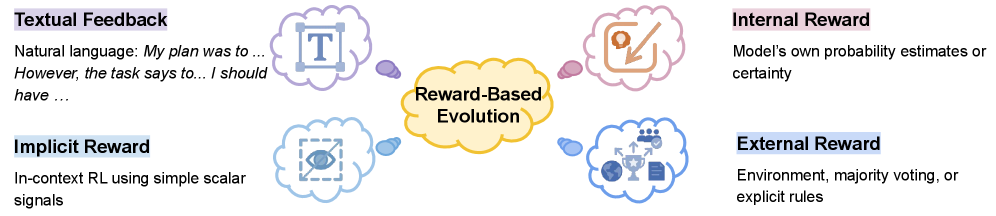
The image is a diagram illustrating the concept of "Reward-Based Evolution" and its various sources of reward signals. It depicts a central concept surrounded by four types of rewards: Textual Feedback, Implicit Reward, Internal Reward, and External Reward. The diagram uses cloud-shaped boxes with icons to represent each reward type, connected to the central concept by arrows.
### Components/Axes
The diagram consists of the following components:
* **Central Concept:** "Reward-Based Evolution" – displayed in a large, yellow cloud shape.
* **Textual Feedback:** Located in the top-left, with a light-blue cloud and a "T" icon.
* **Implicit Reward:** Located in the bottom-left, with a light-blue cloud and an eye icon.
* **Internal Reward:** Located in the top-right, with a light-blue cloud and a percentage sign icon.
* **External Reward:** Located in the bottom-right, with a light-blue cloud and a figure icon.
* **Arrows:** Connecting each reward type to the central concept, indicating the flow of reward signals.
### Detailed Analysis or Content Details
Here's a transcription of the text associated with each component:
* **Textual Feedback:** "Natural language: My plan was to… However, the task says to… I should have…"
* **Implicit Reward:** "In-context RL using simple scalar signals"
* **Internal Reward:** "Model’s own probability estimates or certainty"
* **External Reward:** "Environment, majority voting, or explicit rules"
### Key Observations
The diagram highlights the diverse sources of reward signals that can drive a "Reward-Based Evolution" process. The arrangement suggests that all four reward types contribute to the central evolution process. The use of icons provides a quick visual representation of each reward type.
### Interpretation
The diagram illustrates a system where an evolving process ("Reward-Based Evolution") is guided by various forms of feedback. This is particularly relevant in the context of Reinforcement Learning (RL) and AI development.
* **Textual Feedback** represents human input, providing guidance based on natural language understanding. This is often used in scenarios where the desired behavior is difficult to define explicitly.
* **Implicit Reward** suggests a simpler form of feedback, potentially used in in-context learning where scalar signals are sufficient to guide the process.
* **Internal Reward** indicates that the model itself can generate reward signals based on its own confidence or probability estimates. This is crucial for self-improvement and exploration.
* **External Reward** represents traditional RL rewards derived from the environment or external sources like human evaluation.
The diagram suggests that a robust "Reward-Based Evolution" system benefits from a combination of these reward signals. The arrows indicate a cyclical process where rewards influence the evolution, which in turn generates new behaviors that are then evaluated by the reward sources. The diagram doesn't provide quantitative data, but it conceptually outlines the different components and their relationships within a reward-driven learning system.