## Diagram: Reward-Based Evolution Conceptual Framework
### Overview
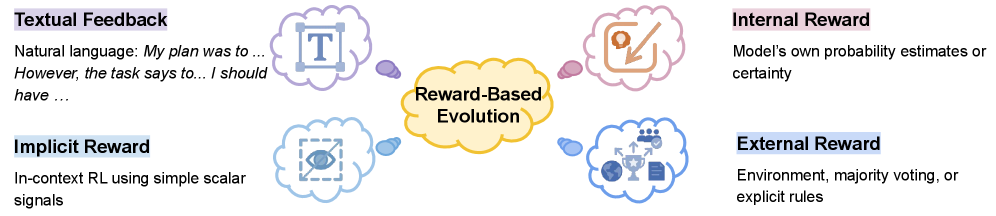
The image is a conceptual diagram illustrating four distinct types of reward mechanisms that feed into a central process called "Reward-Based Evolution." The diagram uses a central cloud as the focal point, with four surrounding clouds representing different reward categories, each connected by a colored line. Each reward category is accompanied by an icon and a brief textual description.
### Components/Axes
The diagram is structured around a central, yellow-outlined cloud labeled **"Reward-Based Evolution"**. Four other clouds, each with a unique color outline and icon, are positioned around it and connected by lines.
**1. Top-Left Component: Textual Feedback**
* **Label:** "Textual Feedback" (in bold, black text).
* **Icon:** A purple-outlined cloud containing a stylized document or text box icon (a rectangle with a "T" inside).
* **Connection:** A purple line connects this cloud to the central "Reward-Based Evolution" cloud.
* **Description Text:** "Natural language: *My plan was to ... However, the task says to ... I should have ...*" (The example text is in italics).
**2. Bottom-Left Component: Implicit Reward**
* **Label:** "Implicit Reward" (in bold, black text).
* **Icon:** A blue-outlined cloud containing an icon of an eye inside a dashed square, suggesting observation or sensing.
* **Connection:** A blue line connects this cloud to the central cloud.
* **Description Text:** "In-context RL using simple scalar signals"
**3. Top-Right Component: Internal Reward**
* **Label:** "Internal Reward" (in bold, black text).
* **Icon:** A pink-outlined cloud containing an icon of a document with a checkmark or seal, suggesting self-evaluation or certification.
* **Connection:** A pink line connects this cloud to the central cloud.
* **Description Text:** "Model's own probability estimates or certainty"
**4. Bottom-Right Component: External Reward**
* **Label:** "External Reward" (in bold, black text).
* **Icon:** A blue-outlined cloud containing a cluster of icons: a globe, a trophy, a document, and a group of people, representing environment, goals, rules, and society.
* **Connection:** A blue line connects this cloud to the central cloud.
* **Description Text:** "Environment, majority voting, or explicit rules"
### Detailed Analysis
The diagram presents a taxonomy of feedback signals for an evolutionary or learning system. The central concept, "Reward-Based Evolution," is the synthesis point for four distinct information sources:
* **Textual Feedback** provides explicit, natural language critique or reflection.
* **Implicit Reward** derives from simple, scalar feedback signals within the immediate context, akin to reinforcement learning (RL).
* **Internal Reward** is generated by the model itself, based on its own confidence or probabilistic assessments.
* **External Reward** comes from outside the model, defined by the environment, consensus (voting), or pre-defined rules.
The visual design uses color-coding (purple, blue, pink, blue) and distinct icons to differentiate the categories. The lines converging on the central cloud visually represent the integration of these diverse reward streams.
### Key Observations
1. **Categorization of Feedback:** The diagram explicitly separates feedback into internal vs. external sources and explicit (textual) vs. implicit (scalar) forms.
2. **Self-Assessment Component:** The inclusion of "Internal Reward" highlights a system capable of metacognition—evaluating its own outputs.
3. **Hybrid External Sources:** "External Reward" is not monolithic; it combines environmental feedback, social consensus (voting), and rigid rules.
4. **Linguistic Example:** The "Textual Feedback" section is the only one that provides a concrete example of its content, showing a first-person reflective statement.
### Interpretation
This diagram outlines a sophisticated framework for training or evolving AI systems, moving beyond simple scalar rewards. It suggests a system that learns from a rich, multi-modal diet of feedback:
* **What it demonstrates:** The model is not just a passive recipient of external scores. It can process nuanced language, infer rewards from context, self-evaluate, and integrate structured external rules. This points towards more robust, adaptable, and perhaps interpretable AI development.
* **Relationships:** All four reward types are presented as equally valid inputs to the central evolutionary process. The design implies that a combination of these signals leads to more effective evolution than any single type alone.
* **Notable Implications:** The framework emphasizes **self-reflection** (Internal Reward, Textual Feedback) and **context-awareness** (Implicit Reward) alongside traditional external supervision. This could be aimed at creating AI that understands its own limitations and can justify its actions in human terms, potentially improving safety and alignment. The absence of numerical data or trends indicates this is a conceptual model, not a performance chart.