## Diagram: Reward-Based Evolution System
### Overview
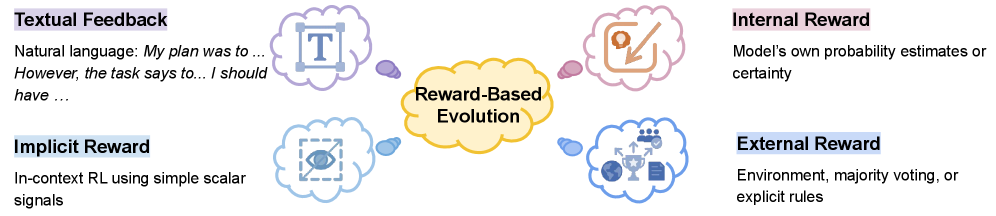
The diagram illustrates a reward-based evolution framework with four interconnected components: Textual Feedback, Implicit Reward, Internal Reward, and External Reward. These elements converge toward a central "Reward-Based Evolution" process, suggesting a system where diverse feedback mechanisms drive adaptive behavior.
### Components/Axes
1. **Central Node**:
- Label: "Reward-Based Evolution" (golden-yellow cloud)
- Position: Center of the diagram
- Connections: Arrows from all four peripheral components
2. **Peripheral Components**:
- **Textual Feedback** (top-left):
- Label: "Textual Feedback" (purple cloud)
- Description: "Natural language: My plan was to ... However, the task says to... I should have ..."
- Visual: Text box with "T" symbol
- **Implicit Reward** (bottom-left):
- Label: "Implicit Reward" (blue cloud)
- Description: "In-context RL using simple scalar signals"
- Visual: Eye icon with dashed box
- **Internal Reward** (top-right):
- Label: "Internal Reward" (pink cloud)
- Description: "Model's own probability estimates or certainty"
- Visual: Lightbulb with arrow
- **External Reward** (bottom-right):
- Label: "External Reward" (light blue cloud)
- Description: "Environment, majority voting, or explicit rules"
- Visual: Trophy, globe, and document icons
### Detailed Analysis
- **Textual Feedback**: Explicitly references natural language contradictions between user intent ("My plan was to...") and task requirements ("the task says to...").
- **Implicit Reward**: Focuses on reinforcement learning (RL) using scalar signals (e.g., binary or continuous values).
- **Internal Reward**: Highlights self-assessment via probabilistic uncertainty or confidence metrics.
- **External Reward**: Encompasses environmental feedback, collective decision-making (majority voting), or predefined rules.
### Key Observations
- All components directly contribute to the central "Reward-Based Evolution" process.
- No numerical data or quantitative metrics are present; the diagram emphasizes conceptual relationships.
- Arrows indicate unidirectional influence from peripheral components to the central process.
### Interpretation
This diagram represents a hybrid reward system for adaptive learning or decision-making. The integration of textual feedback (human intent), implicit scalar rewards (RL signals), internal model confidence, and external environmental rules suggests a multi-modal approach to optimizing behavior. The absence of explicit numerical values implies the framework is conceptual, focusing on architectural design rather than empirical results. The central "Reward-Based Evolution" acts as a synthesis point, indicating that effective adaptation requires balancing diverse feedback sources.