\n
## Textual Document: Vaccine Development Timeline & Statements
### Overview
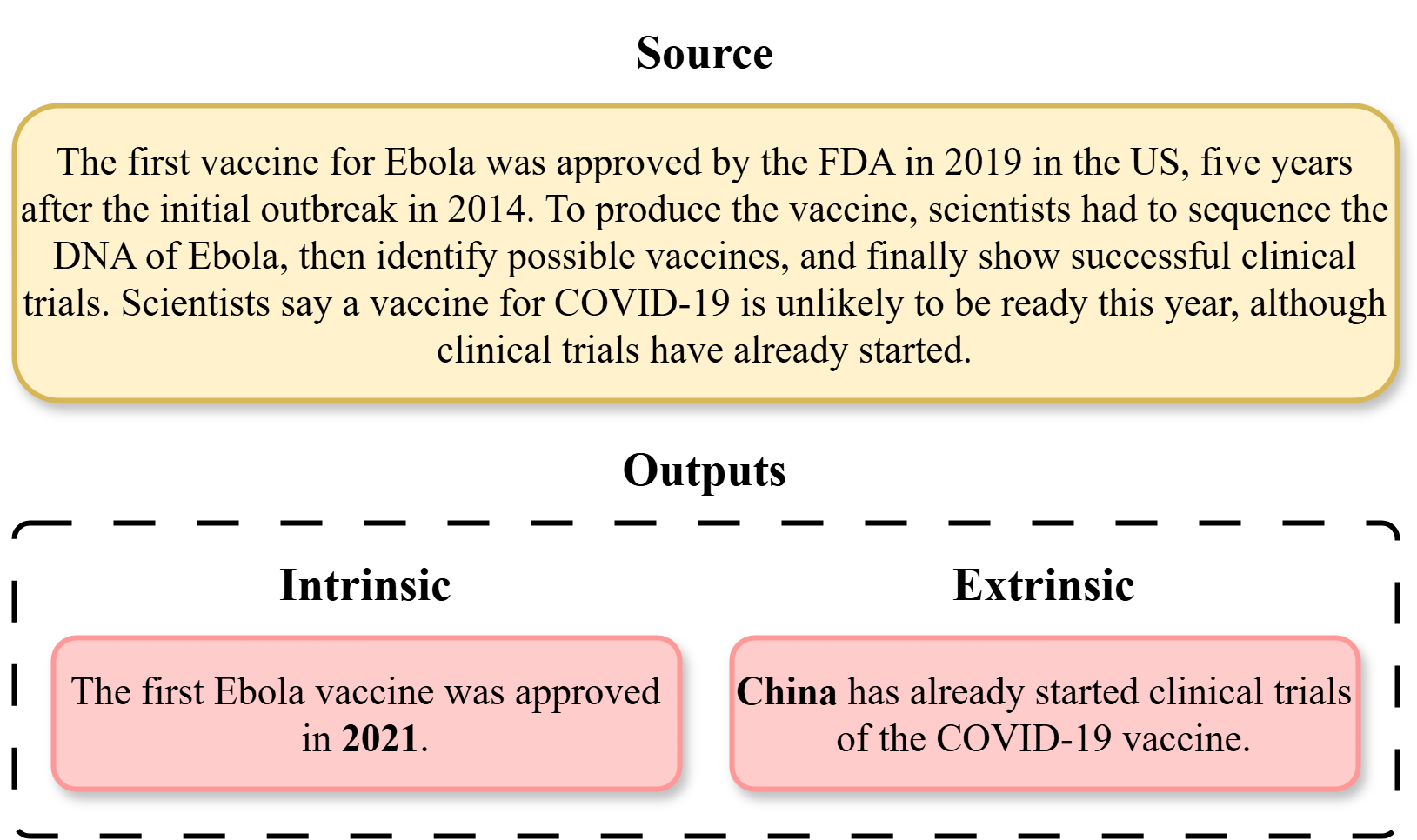
The image presents a textual document discussing vaccine development, specifically focusing on Ebola and COVID-19. It includes a source text block and two output statements categorized as "Intrinsic" and "Extrinsic".
### Components/Axes
The document is divided into three main sections:
1. **Source:** A paragraph providing background information.
2. **Outputs:** A section containing two statements, visually separated into "Intrinsic" and "Extrinsic" boxes.
3. **Visual Separators:** Dashed lines and brackets visually separate the sections and statements.
### Detailed Analysis or Content Details
**Source Text:**
"The first vaccine for Ebola was approved by the FDA in 2019 in the US, five years after the initial outbreak in 2014. To produce the vaccine, scientists had to sequence the DNA of Ebola, then identify possible vaccines, and finally show successful clinical trials. Scientists say a vaccine for COVID-19 is unlikely to be ready this year, although clinical trials have already started."
**Intrinsic Statement:**
"The first Ebola vaccine was approved in 2021."
**Extrinsic Statement:**
"China has already started clinical trials of the COVID-19 vaccine."
### Key Observations
* There is a discrepancy between the source text and the "Intrinsic" statement regarding the year the Ebola vaccine was approved. The source states 2019, while the "Intrinsic" statement claims 2021.
* The "Extrinsic" statement provides information not directly stated in the source text, indicating external knowledge.
* The visual presentation emphasizes a distinction between information directly derived from the source and information added from elsewhere.
### Interpretation
The document appears to be illustrating a process of information extraction and augmentation. The "Source" represents the initial data, while the "Outputs" demonstrate how that data can be interpreted and supplemented with external information. The discrepancy in the Ebola vaccine approval year suggests a potential error in the extraction or a deliberate alteration for demonstration purposes. The categorization into "Intrinsic" and "Extrinsic" highlights the importance of source attribution and transparency in information processing. The document suggests a workflow where information is first extracted from a source, then potentially verified or expanded upon with external data. The use of visual separators and boxes emphasizes the distinct nature of each information component.