## Screenshot: Case Study on the Effects of Question Paraphrasing
### Overview
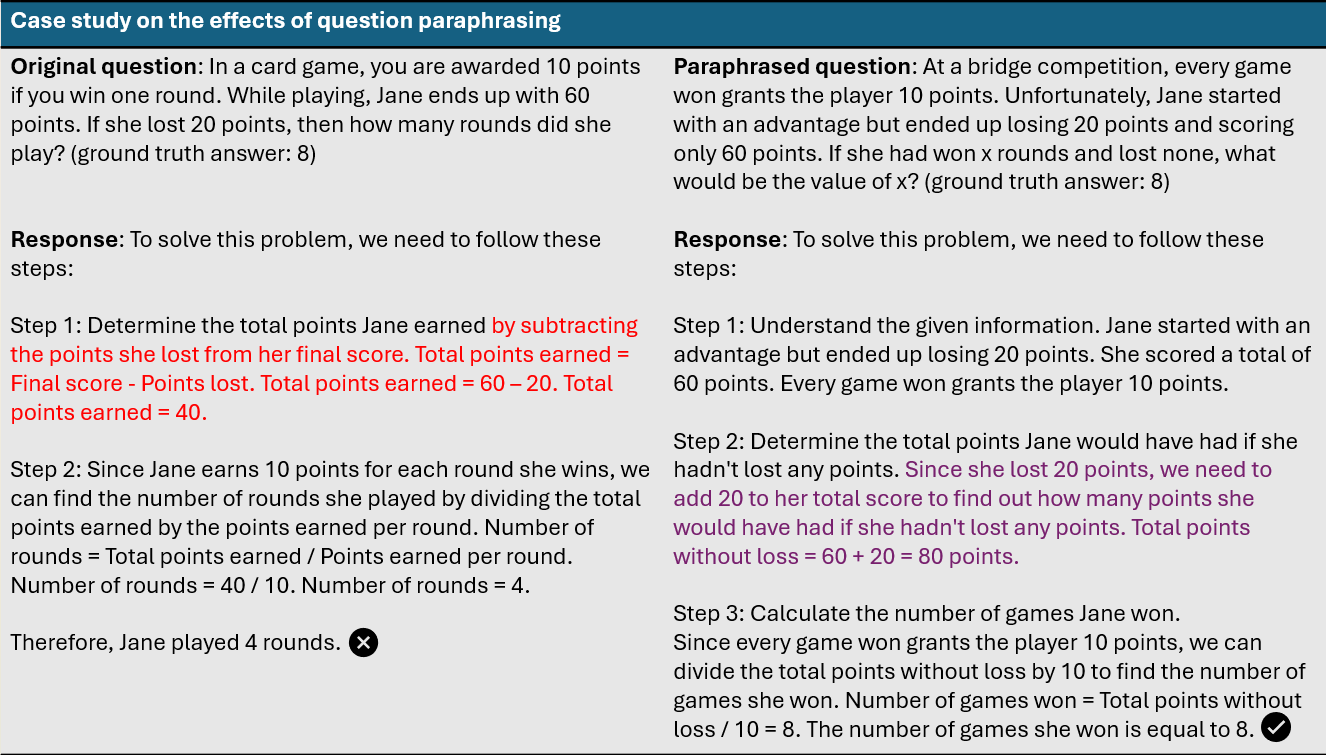
The image compares two versions of a problem-solving response: an **original question/response** (left column) and a **paraphrased question/response** (right column). Both sections include step-by-step reasoning, color-coded highlights (red for original, purple for paraphrased), and symbols (✗/✓) indicating correctness. The ground truth answer (8) is provided for both questions.
---
### Components/Axes
#### Left Column (Original Question/Response):
- **Original Question**:
- Text: "In a card game, you are awarded 10 points if you win one round. While playing, Jane ends up with 60 points. If she lost 20 points, then how many rounds did she play? (ground truth answer: 8)"
- **Response**:
- **Step 1**: "Determine the total points Jane earned by subtracting the points she lost from her final score. Total points earned = Final score - Points lost. Total points earned = 60 – 20. Total points earned = 40."
- Highlight: Red text for "subtracting the points she lost."
- **Step 2**: "Since Jane earns 10 points for each round she wins, we can find the number of rounds she played by dividing the total points earned by the points earned per round. Number of rounds = Total points earned / Points earned per round. Number of rounds = 40 / 10. Number of rounds = 4."
- **Conclusion**: "Therefore, Jane played 4 rounds."
- Symbol: ✗ (incorrect).
#### Right Column (Paraphrased Question/Response):
- **Paraphrased Question**:
- Text: "At a bridge competition, every game won grants the player 10 points. Unfortunately, Jane started with an advantage but ended up losing 20 points and scoring only 60 points. If she had won x rounds and lost none, what would be the value of x? (ground truth answer: 8)"
- **Response**:
- **Step 1**: "Understand the given information. Jane started with an advantage but ended up losing 20 points. She scored a total of 60 points. Every game won grants the player 10 points."
- **Step 2**: "Determine the total points Jane would have had if she hadn’t lost any points. Since she lost 20 points, we need to add 20 to her total score. Total points without loss = 60 + 20 = 80 points."
- Highlight: Purple text for "add 20 to her total score."
- **Step 3**: "Calculate the number of games Jane won. Since every game won grants the player 10 points, we can divide the total points without loss by 10 to find the number of games won. Number of games won = Total points without loss / 10 = 80 / 10 = 8."
- Highlight: Purple text for "divide the total points without loss by 10."
- **Conclusion**: "The number of games she won is equal to 8."
- Symbol: ✓ (correct).
---
### Detailed Analysis
#### Original Response:
1. **Step 1**:
- Calculation: `60 (final score) – 20 (points lost) = 40 (total points earned)`.
- Highlight: Red text emphasizes the subtraction of lost points.
2. **Step 2**:
- Calculation: `40 (total points earned) / 10 (points per round) = 4 (rounds played)`.
- Error: Concludes 4 rounds, conflicting with the ground truth answer (8).
#### Paraphrased Response:
1. **Step 1**:
- Restates the problem’s conditions without numerical calculations.
2. **Step 2**:
- Adjusts for lost points: `60 (scored) + 20 (lost) = 80 (total without loss)`.
- Highlight: Purple text clarifies the adjustment for lost points.
3. **Step 3**:
- Calculation: `80 (total without loss) / 10 (points per game) = 8 (games won)`.
- Matches the ground truth answer (8).
---
### Key Observations
1. **Divergent Approaches**:
- The original response subtracts lost points directly from the final score, leading to an incorrect conclusion (4 rounds).
- The paraphrased response adds lost points back to the final score before calculating wins, aligning with the ground truth (8 games).
2. **Color Coding**:
- Red highlights in the original response draw attention to the subtraction step, which introduces the error.
- Purple highlights in the paraphrased response emphasize the correction (adding lost points).
3. **Symbols**:
- The ✗ next to the original response and ✓ next to the paraphrased response visually validate the accuracy of each approach.
---
### Interpretation
1. **Impact of Paraphrasing**:
- The paraphrased question clarifies the problem’s conditions (e.g., "losing 20 points" vs. "ending up with 60 points"), reducing ambiguity. This leads to a correct solution.
- The original question’s phrasing ("if she lost 20 points") may mislead solvers into misinterpreting whether points are subtracted or added back.
2. **Error Source**:
- The original response incorrectly assumes that "losing 20 points" reduces the total points earned, rather than adjusting the final score to reflect the net gain.
3. **Ground Truth Alignment**:
- The paraphrased response’s conclusion (8 games) matches the ground truth, demonstrating that precise problem restatement improves accuracy.
4. **Visual Cues**:
- Color coding and symbols (✗/✓) serve as immediate indicators of correctness, aiding in rapid evaluation of problem-solving strategies.
---
**Conclusion**: Paraphrasing questions can enhance clarity and reduce misinterpretation, directly influencing the accuracy of solutions. The original response’s error stems from a misstep in handling lost points, while the paraphrased version’s structured adjustments yield the correct result.