## Diagram: Knowledge Graph Query Processing
### Overview
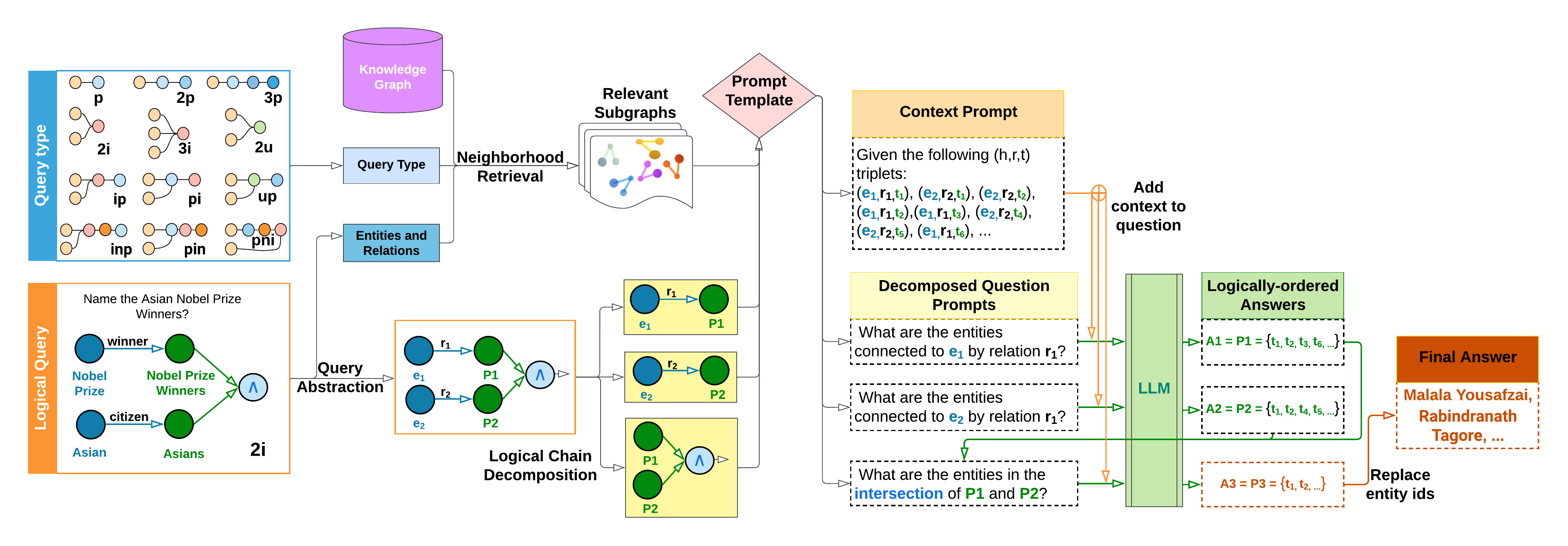
The image is a flowchart illustrating a process for querying a knowledge graph. It starts with a logical query, decomposes it into sub-queries, retrieves relevant subgraphs, and uses a prompt template to generate context prompts. These prompts are then used by a Large Language Model (LLM) to generate logically-ordered answers, which are combined to produce a final answer.
### Components/Axes
* **Top-Left**: "Query Type" - A table showing different query types represented as graphs.
* Rows: p, 2i, ip, inp
* Rows: 2p, 3i, pi, pin
* Rows: 3p, 2u, up, pni
* **Top-Center**: "Knowledge Graph" - A purple cylinder representing the knowledge graph.
* **Top-Center**: "Neighborhood Retrieval" - A process of retrieving relevant subgraphs from the knowledge graph.
* **Top-Center**: "Relevant Subgraphs" - A collection of subgraphs.
* **Top-Right**: "Prompt Template" - A diamond shape representing the prompt template.
* **Center-Left**: "Logical Query" - An orange box containing the question "Name the Asian Nobel Prize Winners?". It includes a graph with nodes labeled "Nobel Prize" (blue), "Nobel Prize Winners" (green), "citizen" (blue), and "Asians" (green), connected by edges labeled "winner".
* **Center-Left**: "Query Abstraction" - A process of abstracting the logical query into a graph representation.
* **Center-Left**: "Entities and Relations" - A blue box.
* **Center**: "Logical Chain Decomposition" - A process of decomposing the query into logical chains.
* **Center**: "Decomposed Question Prompts" - A yellow box containing questions derived from the logical chains.
* **Center-Right**: "Context Prompt" - A yellow box containing a set of (h,r,t) triplets.
* **Center-Right**: "LLM" - A green box representing the Large Language Model.
* **Right**: "Logically-ordered Answers" - A green box containing logically-ordered answers.
* **Right**: "Final Answer" - An orange box containing the final answer: "Malala Yousafzai, Rabindranath Tagore, ...".
### Detailed Analysis
1. **Query Type**:
* p: Two nodes connected by an edge.
* 2p: Three nodes, two connected to the central node.
* 3p: Four nodes, three connected to the central node.
* 2i: Two nodes connected to a central node.
* 3i: Three nodes connected to a central node.
* 2u: Two nodes connected to a central node.
* ip: Two nodes connected to a central node.
* pi: Two nodes connected to a central node.
* up: Two nodes connected to a central node.
* inp: Three nodes connected in a chain.
* pin: Three nodes connected in a chain.
* pni: Three nodes connected in a chain.
2. **Logical Query**:
* The query is "Name the Asian Nobel Prize Winners?".
* The query is represented as a graph with nodes "Nobel Prize", "Nobel Prize Winners", "citizen", and "Asians".
* The nodes are connected by edges labeled "winner".
3. **Logical Chain Decomposition**:
* The query is decomposed into logical chains involving entities e1, e2 and relations r1, r2.
* The chains are combined using a logical AND operation (Λ).
4. **Decomposed Question Prompts**:
* "What are the entities connected to e1 by relation r1?"
* "What are the entities connected to e2 by relation r1?"
* "What are the entities in the intersection of P1 and P2?"
5. **Context Prompt**:
* "Given the following (h,r,t) triplets: (e1,r1,t1), (e2,r2,t1), (e2,r2,t2), (e1,r1,t2), (e1,r1,t3), (e2,r2,t4), (e2,r2,t5), (e1,r1,t6), ..."
6. **Logically-ordered Answers**:
* A1 = P1 = {t1, t2, t3, t6, ...}
* A2 = P2 = {t1, t2, t4, t5, ...}
* A3 = P3 = {t1, t2, ...}
7. **Final Answer**:
* "Malala Yousafzai, Rabindranath Tagore, ..."
### Key Observations
* The diagram illustrates a multi-step process for answering complex questions using a knowledge graph and a large language model.
* The process involves decomposing the query into sub-queries, retrieving relevant information from the knowledge graph, and using a prompt template to generate context prompts for the LLM.
* The LLM generates logically-ordered answers, which are combined to produce the final answer.
### Interpretation
The diagram presents a sophisticated approach to question answering that leverages the strengths of both knowledge graphs and large language models. By decomposing complex queries into smaller, more manageable sub-queries, the system can effectively retrieve relevant information from the knowledge graph. The use of a prompt template ensures that the LLM receives the necessary context to generate accurate and logically-sound answers. The final answer is then constructed by combining the individual answers to the sub-queries. This approach is particularly useful for answering questions that require reasoning and inference over structured knowledge.