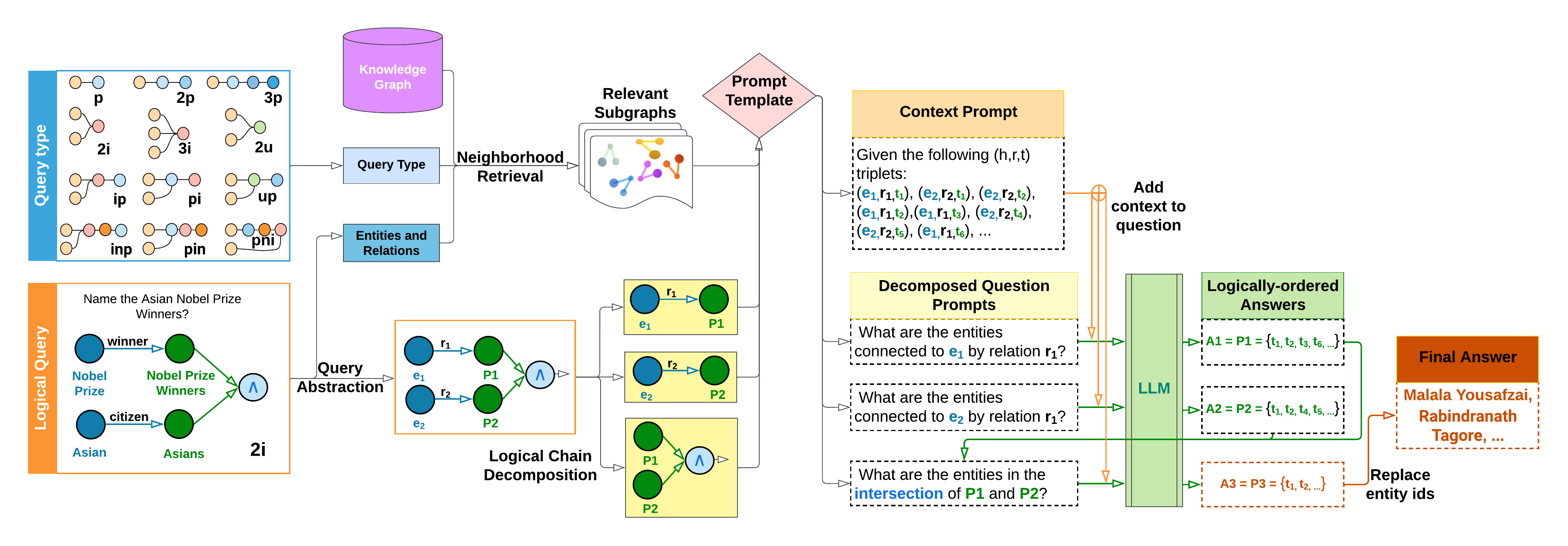
## Flowchart: Knowledge Graph Query Processing System
### Overview
The diagram illustrates a multi-stage pipeline for processing complex queries using knowledge graphs and logical decomposition. It begins with query abstraction, progresses through subgraph retrieval and prompt engineering, and culminates in LLM-based answer synthesis. The final output combines entity-level reasoning with contextual knowledge to produce human-readable answers.
### Components/Axes
1. **Left Panel (Query Abstraction)**
- **Query Type Matrix**:
- Contains 9 query patterns (2p, 3p, 2i, ip, pi, up, inp, pin, pini)
- Color-coded nodes (blue, green, orange) representing entity types
- **Logical Query Example**:
- "Name the Asian Nobel Prize Winners?"
- Visualized with entity-relationship graph (Asian → winner → Nobel Prize)
2. **Central Processing Flow**
- **Knowledge Graph** (purple cylinder)
- **Neighborhood Retrieval** (blue box)
- **Relevant Subgraphs** (wavy-edged box with colored nodes)
- **Prompt Template** (pink diamond)
3. **Right Panel (LLM Processing)**
- **Context Prompt** (orange box with triplet examples)
- **Decomposed Question Prompts** (yellow box with 3 sub-questions)
- **LLM Processing** (green vertical box)
- **Logically-ordered Answers** (green dashed boxes with A1-A3)
- **Final Answer** (orange box with Malala Yousafzai, Rabindranath Tagore)
### Detailed Analysis
1. **Query Type System**
- 9 distinct query patterns categorized by:
- Node count (2p=2 nodes, 3p=3 nodes)
- Relationship types (p=property, i=instance)
- Special cases (inp=inverse property, pin=inverse with negation)
2. **Knowledge Graph Integration**
- Central data source represented as a purple cylinder
- Connected to query abstraction and neighborhood retrieval
3. **Logical Decomposition**
- Original query broken into 3 sub-questions:
1. Entities connected to e₁ by r₁
2. Entities connected to e₂ by r₂
3. Intersection of P1 and P2 entity sets
4. **LLM Processing**
- Takes decomposed prompts and generates:
- A1 = {t₁, t₂, t₃, t₆...} (entities for P1)
- A2 = {t₁, t₂, t₄, t₅...} (entities for P2)
- A3 = {t₁, t₂...} (intersection set)
5. **Answer Synthesis**
- Final answer combines entity IDs with real-world names
- Example output: "Malala Yousafzai, Rabindranath Tagore..."
### Key Observations
1. **Hierarchical Processing**:
- Query abstraction → subgraph retrieval → prompt engineering → LLM processing → answer synthesis
2. **Entity-Relationship Focus**:
- All stages maintain explicit connections between entities (e₁, e₂) and relations (r₁, r₂)
3. **Temporal Logic**:
- Intersection operation (A3) suggests temporal or logical dependency between sub-answers
4. **Contextual Enrichment**:
- Triplets in context prompt provide background knowledge for answer interpretation
### Interpretation
This system demonstrates a sophisticated approach to knowledge graph querying that:
1. **Handles Complexity**: Breaks down multi-hop queries into manageable components
2. **Leverages LLM Capabilities**: Uses large language models for contextual understanding and answer synthesis
3. **Maintains Logical Consistency**: Ensures answers respect original query constraints through decomposition and intersection operations
4. **Bridges Formal and Natural Language**: Converts formal entity-relationship representations into human-readable names
The process reveals an intentional design to handle both the structural complexity of knowledge graphs and the semantic nuances required for accurate answer generation. The use of color-coded nodes and explicit decomposition steps suggests a focus on making the reasoning process transparent and verifiable.