## Flowchart: Image Processing and Analysis Workflow
### Overview
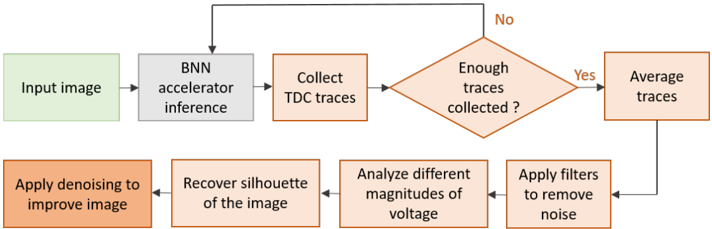
The flowchart depicts a multi-stage process for analyzing and enhancing an input image using a BNN (Binary Neural Network) accelerator, trace data collection, and iterative refinement steps. The workflow includes conditional logic, averaging operations, and post-processing techniques.
### Components/Axes
1. **Input Image** (Green block): Starting point of the process.
2. **BNN Accelerator Inference** (Gray block): Processes the input image.
3. **Collect TDC Traces** (Orange block): Gathers trace data after BNN inference.
4. **Decision Diamond**: "Enough traces collected?" with two branches:
- **Yes**: Proceeds to **Average Traces** (Peach block).
- **No**: Loops back to **Collect TDC Traces**.
5. **Post-Averaging Steps** (Orange blocks):
- **Apply Denoising to Improve Image**
- **Recover Silhouette of the Image**
- **Analyze Different Magnitudes of Voltage**
- **Apply Filters to Remove Noise**
### Detailed Analysis
- **Flow Direction**:
- Input → BNN Inference → Collect TDC Traces → Decision → (Yes → Average Traces → Post-Processing) or (No → Loop to Collect TDC Traces).
- **Color Coding**:
- Green: Input stage.
- Gray: BNN accelerator inference.
- Orange: Data collection and post-processing steps.
- Peach: Averaging traces.
### Key Observations
1. **Iterative Data Collection**: The process loops back to collect more traces if insufficient data is gathered initially.
2. **Conditional Averaging**: Averages traces only when sufficient data is confirmed.
3. **Post-Processing Focus**: Emphasizes image enhancement (denoising, silhouette recovery) and noise reduction.
4. **Voltage Analysis**: Explicitly includes analysis of voltage magnitudes, suggesting hardware or signal processing context.
### Interpretation
This workflow integrates machine learning (BNN accelerator) with hardware trace analysis to iteratively refine image quality. The decision diamond introduces a feedback loop, ensuring robustness by requiring sufficient trace data before proceeding. Post-averaging steps prioritize image clarity and noise mitigation, indicating applications in fields like medical imaging, surveillance, or scientific visualization where precision and noise reduction are critical. The inclusion of voltage magnitude analysis suggests integration with analog/digital hybrid systems, possibly for edge computing or embedded devices.
**Note**: No numerical data or explicit units are provided in the flowchart. The process emphasizes logical flow and conditional refinement rather than quantitative metrics.