## Diagram: Financial Knowledge Graph Extraction and Reasoning Pipeline
### Overview
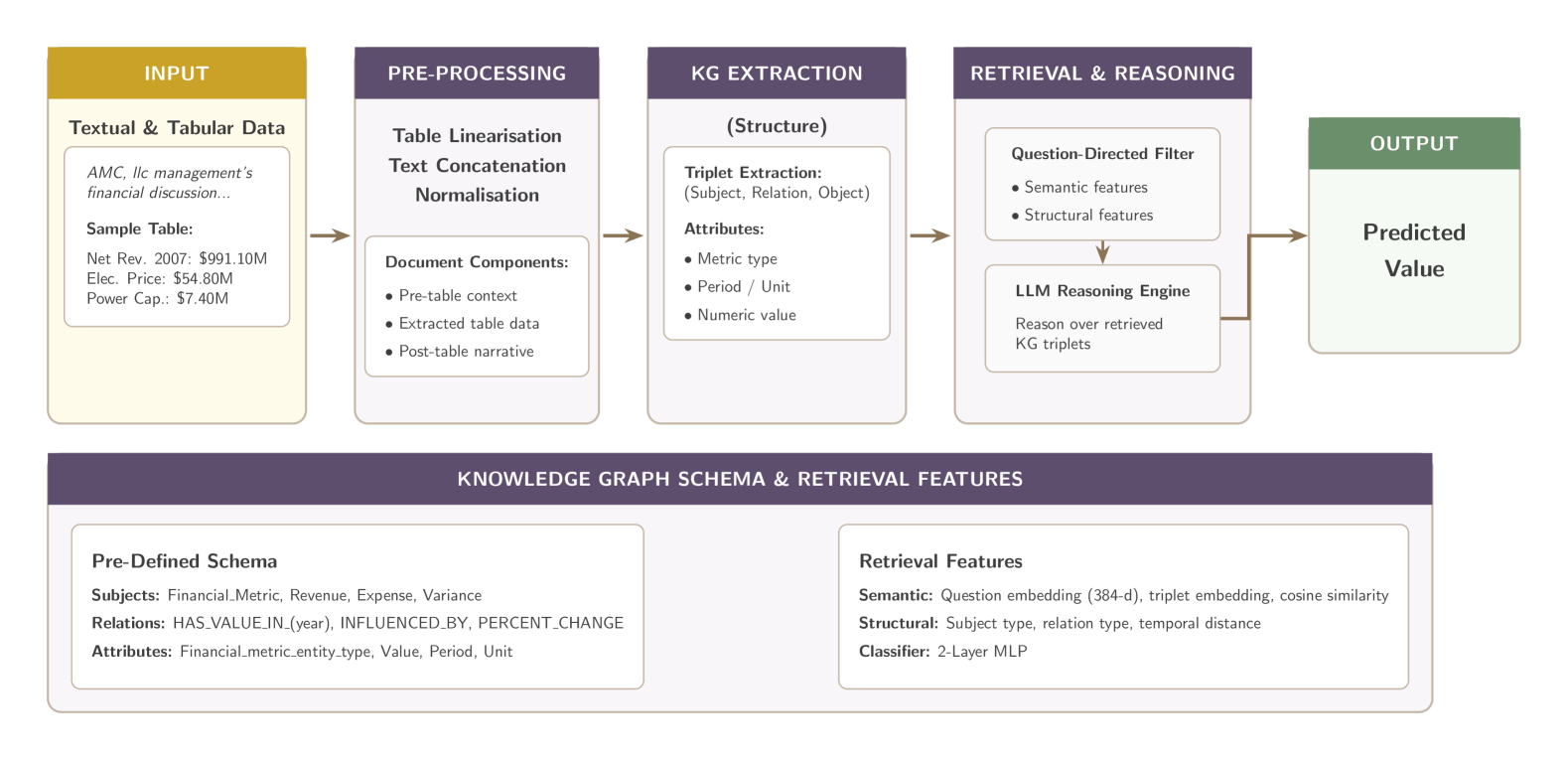
The image displays a technical flowchart illustrating a multi-stage pipeline for processing financial documents to produce a predicted value. The system extracts structured knowledge from unstructured text and tables, organizes it into a knowledge graph, and uses retrieval-augmented reasoning with a Large Language Model (LLM) to answer questions. The diagram is divided into a main horizontal process flow and a supporting section detailing the underlying knowledge graph schema and retrieval features.
### Components/Axes (Process Flow Stages)
The pipeline consists of five sequential stages, represented by colored boxes connected by right-pointing arrows:
1. **INPUT (Gold Header Box)**
* **Title:** INPUT
* **Content Box:** "Textual & Tabular Data"
* **Sample Content:**
* "AMC, llc management's financial discussion..."
* **Sample Table:**
* "Net Rev. 2007: $991.10M"
* "Elec. Price: $54.80M"
* "Power Cap.: $7.40M"
2. **PRE-PROCESSING (Purple Header Box)**
* **Title:** PRE-PROCESSING
* **Processes Listed:**
* "Table Linearisation"
* "Text Concatenation"
* "Normalisation"
* **Document Components Sub-box:**
* "Pre-table context"
* "Extracted table data"
* "Post-table narrative"
3. **KG EXTRACTION (Purple Header Box)**
* **Title:** KG EXTRACTION
* **Subtitle:** "(Structure)"
* **Triplet Extraction Sub-box:**
* "Triplet Extraction: (Subject, Relation, Object)"
* **Attributes Sub-box:**
* "Attributes:"
* "Metric type"
* "Period / Unit"
* "Numeric value"
4. **RETRIEVAL & REASONING (Purple Header Box)**
* **Title:** RETRIEVAL & REASONING
* **Question-Directed Filter Sub-box:**
* "Question-Directed Filter"
* "Semantic features"
* "Structural features"
* **LLM Reasoning Engine Sub-box:**
* "LLM Reasoning Engine"
* "Reason over retrieved KG triplets"
5. **OUTPUT (Green Header Box)**
* **Title:** OUTPUT
* **Content:** "Predicted Value"
### Detailed Analysis (Supporting Schema & Features)
Below the main flow is a wide purple header titled **"KNOWLEDGE GRAPH SCHEMA & RETRIEVAL FEATURES"**, containing two white boxes:
1. **Pre-Defined Schema Box (Left)**
* **Title:** "Pre-Defined Schema"
* **Subjects:** "Financial.Metric, Revenue, Expense, Variance"
* **Relations:** "HAS_VALUE_IN_(year), INFLUENCED_BY, PERCENT_CHANGE"
* **Attributes:** "Financial_metric_entity_type, Value, Period, Unit"
2. **Retrieval Features Box (Right)**
* **Title:** "Retrieval Features"
* **Semantic:** "Question embedding (384-d), triplet embedding, cosine similarity"
* **Structural:** "Subject type, relation type, temporal distance"
* **Classifier:** "2-Layer MLP"
### Key Observations
* **Process Flow:** The diagram clearly depicts a linear, sequential pipeline from raw data input to final prediction output.
* **Knowledge Graph Core:** The central innovation is the transformation of unstructured financial text and tables into a structured Knowledge Graph (KG) composed of triplets (Subject, Relation, Object) with typed attributes.
* **Hybrid Reasoning:** The system combines structured retrieval (using semantic and structural features) with the reasoning capabilities of an LLM.
* **Financial Domain Focus:** The sample data, schema subjects (Revenue, Expense), and relations (HAS_VALUE_IN_(year)) explicitly target financial document analysis.
* **Technical Specificity:** The diagram provides concrete technical details, such as the 384-dimensional question embedding and the use of a 2-Layer MLP classifier.
### Interpretation
This diagram outlines a sophisticated **Retrieval-Augmented Generation (RAG) system specialized for financial question answering**. Its purpose is to move beyond simple text retrieval by first constructing a structured, queryable knowledge graph from complex documents containing both prose and tables.
The **Pre-Defined Schema** acts as a constrained ontology, ensuring the extracted knowledge is consistent and meaningful for financial analysis (e.g., linking metrics to specific periods). The **Retrieval Features** show a dual approach: *semantic* features find relevant information based on meaning, while *structural* features leverage the graph's topology (e.g., how close two concepts are in the knowledge graph) to improve precision.
The **LLM Reasoning Engine** is not used for raw retrieval but for higher-order reasoning *over* the precisely retrieved KG triplets. This design aims to reduce hallucination and improve accuracy by grounding the LLM's response in verified, structured data extracted from the source document. The final "Predicted Value" output suggests the system is designed for tasks like forecasting, variance analysis, or extracting specific financial figures in response to a query. The entire pipeline represents a method to make unstructured financial disclosures machine-readable and computationally tractable.