\n
## Diagram: World Model Capabilities & Chain-of-Thought Formulations
### Overview
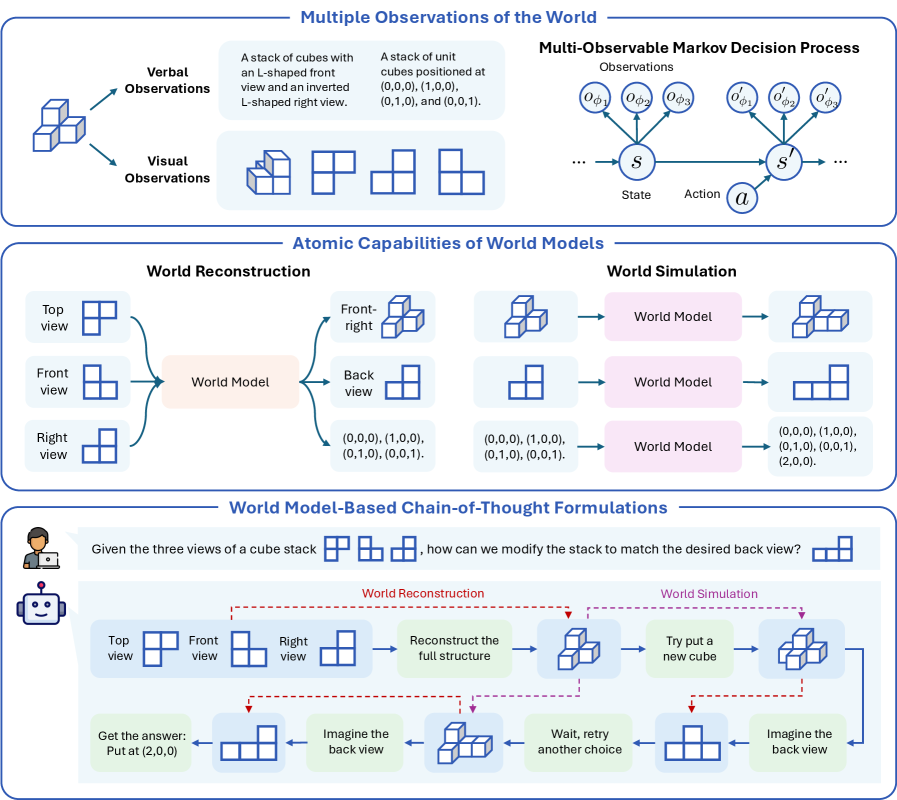
This diagram illustrates the capabilities of world models, specifically focusing on how they integrate verbal and visual observations, reconstruct and simulate worlds, and formulate chain-of-thought solutions to problems. It presents a framework for understanding how an agent can reason about and interact with its environment. The diagram is divided into three main sections: Multiple Observations of the World, Atomic Capabilities of World Models, and World Model-Based Chain-of-Thought Formulations.
### Components/Axes
The diagram consists of several interconnected components:
* **Multiple Observations of the World:** This section includes "Verbal Observations" (text descriptions) and "Visual Observations" (cube stack images).
* **Multi-Observable Markov Decision Process:** Depicts a state transition system with observations (σ), states (S), actions (α), and next states (S').
* **Atomic Capabilities of World Models:** Divided into "World Reconstruction" and "World Simulation" sections.
* **World Reconstruction:** Takes top, front, and right views of a cube stack as input and attempts to reconstruct the full structure.
* **World Simulation:** Uses a "World Model" to simulate the effects of actions on the reconstructed world.
* **World Model-Based Chain-of-Thought Formulations:** Demonstrates a step-by-step reasoning process to solve a cube stack problem.
* **Person Icon:** Represents the agent performing the task.
* **Cube Stack Images:** Used as visual inputs and outputs throughout the diagram.
* **Text Boxes:** Contain descriptions of the process and problem statements.
### Detailed Analysis or Content Details
**1. Multiple Observations of the World:**
* **Verbal Observations:** "A stack of cubes with an L-shaped front view and an inverted L-shaped right view." and "A stack of cubes positioned at (0,0,0), (1,0,0), (0,1,0), and (0,0,1)."
* **Visual Observations:** Two 3D cube stack arrangements are shown. The first is an L-shape, and the second is a set of four cubes at coordinates (0,0,0), (1,0,0), (0,1,0), and (0,0,1).
**2. Multi-Observable Markov Decision Process:**
* This section shows a sequence of observations (σ1, σ2, σ3…), a state (S), an action (α), and a resulting next state (S'). The ellipsis (…) indicates that this process continues iteratively.
**3. Atomic Capabilities of World Models:**
* **World Reconstruction:**
* Input Views: Top, Front, Right views of a cube stack.
* Intermediate Step: "World Model" is used to reconstruct the cube stack.
* Output: Reconstructed cube stack with coordinates (0,0,0), (1,0,0), (0,1,0), (0,0,1).
* **World Simulation:**
* Input: Reconstructed cube stack.
* Process: "World Model" simulates the effects of actions.
* Output: Simulated cube stack with coordinates (0,0,0), (1,0,0), (0,1,0), (2,0,0).
**4. World Model-Based Chain-of-Thought Formulations:**
* **Problem Statement:** "Given the three views of a cube stack… how can we modify the stack to match the desired back view?"
* **Chain-of-Thought Steps:**
* Step 1: Input Views (Top, Front, Right).
* Step 2: "Reconstruct the full structure" – resulting in a cube stack.
* Step 3: "Imagine the back view" – resulting in a cube stack.
* Step 4: "Try put a new cube" – resulting in a cube stack.
* Step 5: "Wait, retry another choice" – resulting in a cube stack.
* Step 6: "Imagine the back view" – resulting in a cube stack.
* Step 7: "Get the answer: Put at (2,0,0)" – resulting in a cube stack.
### Key Observations
* The diagram emphasizes the iterative nature of world modeling, with reconstruction and simulation steps being repeated.
* The chain-of-thought formulation demonstrates a problem-solving approach that involves hypothesis generation, testing, and refinement.
* The use of both verbal and visual observations highlights the importance of multi-modal input for world modeling.
* The Markov Decision Process section suggests that the agent's actions are based on observations and lead to state transitions.
### Interpretation
The diagram presents a conceptual framework for how an intelligent agent can build and utilize world models to understand and interact with its environment. The agent leverages both verbal and visual information to reconstruct a representation of the world, simulate potential actions, and formulate solutions to problems. The chain-of-thought approach demonstrates a deliberate reasoning process, where the agent explores different possibilities and refines its understanding based on feedback.
The Markov Decision Process component suggests that the agent operates within a probabilistic framework, where actions have uncertain outcomes. The world model serves as a crucial component in this process, allowing the agent to predict the consequences of its actions and make informed decisions.
The diagram highlights the importance of abstraction and representation in intelligent systems. The world model provides a simplified representation of the environment, enabling the agent to reason about complex scenarios without being overwhelmed by details. The use of coordinates (e.g., (0,0,0), (1,0,0)) suggests that the world model employs a symbolic representation of objects and their relationships.
The diagram's overall message is that effective world modeling requires the integration of multiple sources of information, a robust simulation capability, and a systematic reasoning process. This framework has implications for the development of artificial intelligence systems that can operate in complex and dynamic environments.