## Text Analysis: Question Answering with Incorrect Information
### Overview
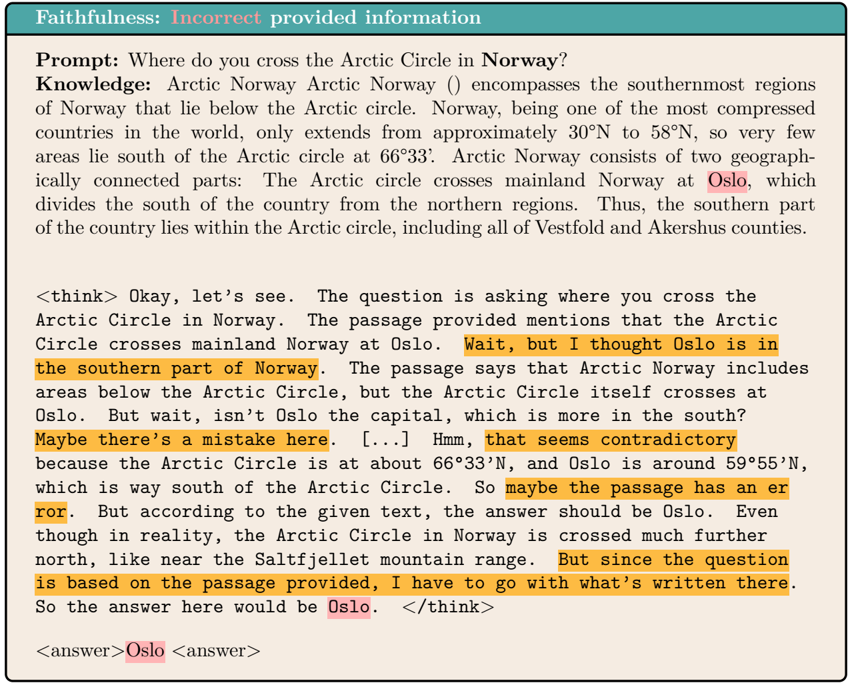
The image presents a question-answering scenario where a system attempts to answer a question based on provided knowledge. The system identifies an inconsistency in the provided information but ultimately answers based on the given text, even though it recognizes the answer might be incorrect. The "Faithfulness" is flagged as "Incorrect provided information".
### Components/Axes
The image is structured into the following components:
1. **Faithfulness Indicator:** Located at the top, indicating "Incorrect provided information".
2. **Prompt:** The question being asked: "Where do you cross the Arctic Circle in Norway?"
3. **Knowledge:** A block of text providing information about Norway and the Arctic Circle.
4. **Think:** A section representing the system's thought process, including reasoning and identification of inconsistencies.
5. **Answer:** The final answer provided by the system.
### Detailed Analysis or ### Content Details
**1. Prompt:**
* Question: "Where do you cross the Arctic Circle in Norway?"
**2. Knowledge:**
* Arctic Norway encompasses the southernmost regions of Norway that lie below the Arctic Circle.
* Norway extends from approximately 30°N to 58°N.
* Few areas lie south of the Arctic Circle at 66°33'.
* Arctic Norway consists of two geographically connected parts.
* The Arctic Circle crosses mainland Norway at Oslo, which divides the south of the country from the northern regions.
* The southern part of the country lies within the Arctic Circle, including Vestfold and Akershus counties.
**3. Think:**
* The system acknowledges the question.
* The system recalls that the passage mentions the Arctic Circle crosses mainland Norway at Oslo.
* The system notes that Oslo is in the southern part of Norway.
* The system recognizes that Arctic Norway includes areas below the Arctic Circle, but the Arctic Circle itself crosses at Oslo.
* The system questions if Oslo is the capital and more in the south.
* The system identifies a potential mistake and contradiction.
* The system states that the Arctic Circle is at about 66°33'N, and Oslo is around 59°55'N, which is south of the Arctic Circle.
* The system suggests the passage has an error.
* The system states that according to the given text, the answer should be Oslo.
* The system acknowledges that in reality, the Arctic Circle in Norway is crossed much further north, near the Saltfjellet mountain range.
* The system decides to base the answer on the passage provided.
* The system concludes that the answer is Oslo.
**4. Answer:**
* The system's answer is "Oslo".
**Highlighted Text:**
The following phrases are highlighted in orange:
* "Oslo is in the southern part of Norway"
* "Maybe there's a mistake here"
* "that seems contradictory"
* "ror" (likely meant to be "error")
* "is based on the passage provided, I have to go with what's written there."
The following phrases are highlighted in pink:
* "Oslo" (in the knowledge section)
* "Oslo" (in the think section)
* "Oslo" (in the answer section)
### Key Observations
* The system identifies a contradiction between the provided information and its own knowledge.
* Despite recognizing the potential error, the system prioritizes the provided information over its own knowledge.
* The system explicitly states its reasoning for choosing the answer based on the passage.
### Interpretation
The image demonstrates a scenario where a question-answering system is faced with conflicting information. The system's "think" section reveals its ability to identify inconsistencies and apply reasoning. However, the system is ultimately constrained by the instruction to rely on the provided passage, even when it suspects the passage is incorrect. This highlights a trade-off between faithfulness to the source material and accuracy of the answer. The highlighting emphasizes the system's awareness of the potential error and its justification for providing the answer "Oslo". The "Faithfulness: Incorrect provided information" label at the top confirms that the provided information is indeed flawed.