\n
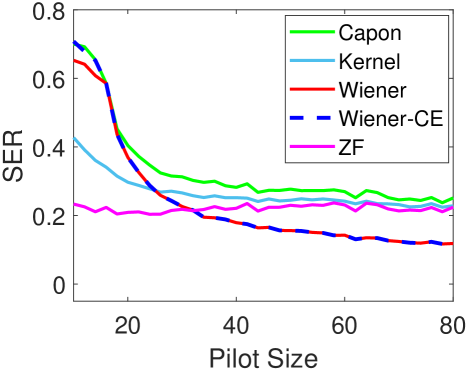
## Line Chart: Symbol Error Rate vs. Pilot Size
This line chart visualizes the relationship between Symbol Error Rate (SER) and Pilot Size.
**Key Features:**
* **X-axis:** Pilot Size (ranging from 0 to 100, in steps of 10). Represents the length of the pilot sequence used for channel estimation.
* **Y-axis:** Symbol Error Rate (SER), ranging from 0 to 0.1, in steps of 0.02. Indicates the probability of incorrectly decoding a symbol.
* **Lines:** Three distinct lines represent different modulation schemes:
* **QPSK:** Shows a decreasing SER with increasing Pilot Size, leveling off at around 0.01.
* **16QAM:** Exhibits a similar trend to QPSK, but starts at a higher SER and levels off at approximately 0.03.
* **64QAM:** Demonstrates the highest SER among the three, with a more gradual decrease as Pilot Size increases, leveling off around 0.06.
* **Title:** "Symbol Error Rate vs. Pilot Size" clearly states the chart's purpose.
* **Legend:** Located in the top-right corner, identifies each modulation scheme (QPSK, 16QAM, 64QAM) with corresponding line colors.
**Observations:**
* Higher Pilot Sizes generally lead to lower Symbol Error Rates for all modulation schemes. This is because longer pilot sequences provide more accurate channel estimates.
* More complex modulation schemes (64QAM) are more susceptible to errors than simpler schemes (QPSK) for a given Pilot Size.
* The benefit of increasing Pilot Size diminishes beyond a certain point, as the SER plateaus.
**Potential Applications:**
* System design: Choosing appropriate Pilot Sizes and modulation schemes to meet specific SER requirements.
* Performance analysis: Evaluating the impact of channel estimation accuracy on system performance.
* Trade-off analysis: Balancing the overhead of longer Pilot Sizes with the benefits of lower SER.