## Bar Chart: Accuracy and Error Metrics for Different Verification Types
### Overview
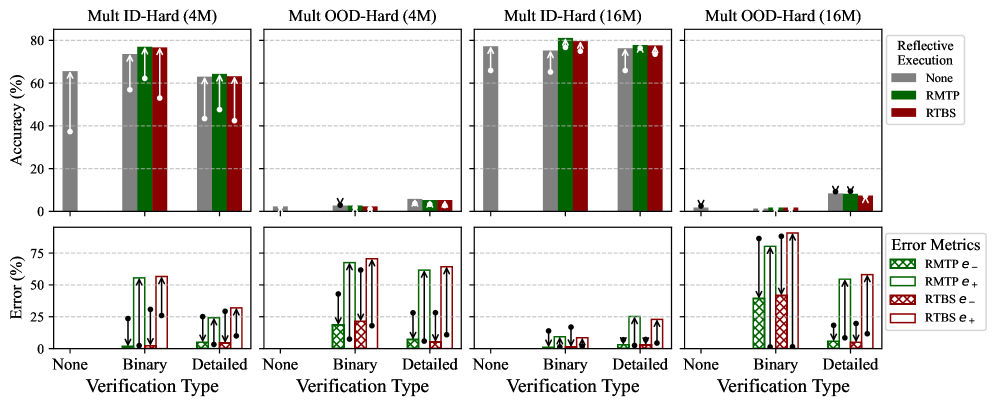
The image presents a set of bar charts comparing the accuracy and error rates of different verification types (None, Binary, Detailed) under various conditions. The charts are organized in a 2x2 grid, with the top row displaying accuracy (%) and the bottom row displaying error (%). The columns represent different scenarios: "Mult ID-Hard (4M)", "Mult OOD-Hard (4M)", "Mult ID-Hard (16M)", and "Mult OOD-Hard (16M)". The charts compare the performance of three reflective execution methods: None, RMTP, and RTBS. Error metrics are further broken down into e- and e+ for RMTP and RTBS.
### Components/Axes
* **Top Row (Accuracy):**
* **Y-axis:** "Accuracy (%)", ranging from 0 to 80 in increments of 20.
* **X-axis:** "Verification Type" with categories "None", "Binary", and "Detailed".
* **Legend (top-right):** "Reflective Execution" with the following mapping:
* Gray: "None"
* Green: "RMTP"
* Dark Red: "RTBS"
* White arrows with circles indicate the range of values for each bar.
* **Bottom Row (Error):**
* **Y-axis:** "Error (%)", ranging from 0 to 75 in increments of 25.
* **X-axis:** "Verification Type" with categories "None", "Binary", and "Detailed".
* **Legend (right):** "Error Metrics" with the following mapping:
* Green with cross pattern: "RMTP e-"
* Green: "RMTP e+"
* Dark Red with cross pattern: "RTBS e-"
* Dark Red: "RTBS e+"
* Black arrows with circles indicate the range of values for each bar.
* **Titles (top of each column):**
* Column 1: "Mult ID-Hard (4M)"
* Column 2: "Mult OOD-Hard (4M)"
* Column 3: "Mult ID-Hard (16M)"
* Column 4: "Mult OOD-Hard (16M)"
### Detailed Analysis
**Accuracy Charts (Top Row):**
* **Mult ID-Hard (4M):**
* "None" verification: Accuracy around 65% for "None", 70% for "RMTP", and 75% for "RTBS".
* "Binary" verification: Accuracy around 65% for "None", 70% for "RMTP", and 75% for "RTBS".
* "Detailed" verification: Accuracy around 65% for "None", 65% for "RMTP", and 65% for "RTBS".
* **Mult OOD-Hard (4M):**
* Accuracy is very low (close to 0%) for all verification types and reflective execution methods.
* **Mult ID-Hard (16M):**
* Accuracy is high (around 75%) for all verification types and reflective execution methods.
* **Mult OOD-Hard (16M):**
* Accuracy is very low (close to 0%) for all verification types and reflective execution methods.
**Error Charts (Bottom Row):**
* **Mult ID-Hard (4M):**
* "None" verification: Error is approximately 0% for all error metrics.
* "Binary" verification: "RMTP e-" is around 5%, "RMTP e+" is around 55%, "RTBS e-" is around 5%, and "RTBS e+" is around 60%.
* "Detailed" verification: "RMTP e-" is around 5%, "RMTP e+" is around 20%, "RTBS e-" is around 5%, and "RTBS e+" is around 25%.
* **Mult OOD-Hard (4M):**
* Error is low (around 0-5%) for all verification types and error metrics.
* **Mult ID-Hard (16M):**
* Error is low (around 0-5%) for all verification types and error metrics.
* **Mult OOD-Hard (16M):**
* "None" verification: Error is approximately 0% for all error metrics.
* "Binary" verification: "RMTP e-" is around 5%, "RMTP e+" is around 75%, "RTBS e-" is around 5%, and "RTBS e+" is around 80%.
* "Detailed" verification: "RMTP e-" is around 5%, "RMTP e+" is around 20%, "RTBS e-" is around 5%, and "RTBS e+" is around 30%.
### Key Observations
* **ID-Hard vs. OOD-Hard:** The "ID-Hard" scenarios (both 4M and 16M) generally show higher accuracy compared to the "OOD-Hard" scenarios, which have very low accuracy.
* **Impact of Verification Type:** For "ID-Hard (4M)", the "Binary" verification type shows a significant difference between e- and e+ error metrics for both RMTP and RTBS. "Detailed" verification reduces the error for e+ metrics.
* **Reflective Execution Methods:** In "ID-Hard (4M)", RTBS generally shows slightly higher accuracy than RMTP.
* **Memory Size (4M vs. 16M):** Increasing memory size from 4M to 16M significantly improves accuracy in the "ID-Hard" scenario, with accuracy reaching approximately 75% regardless of the verification type or reflective execution method.
### Interpretation
The data suggests that the "OOD-Hard" scenarios are significantly more challenging than the "ID-Hard" scenarios, resulting in very low accuracy regardless of the verification type or reflective execution method. For the "ID-Hard (4M)" scenario, using "Binary" verification introduces a large difference between e- and e+ error metrics, which is mitigated by using "Detailed" verification. Increasing the memory size to 16M significantly improves accuracy in the "ID-Hard" scenario, indicating that memory size is a crucial factor for performance in these tasks. The choice of reflective execution method (RMTP vs. RTBS) has a relatively small impact on accuracy compared to the other factors.