## Diagram: Real-world Spatio-temporal Agentic Reasoning Model: STAgent
### Overview
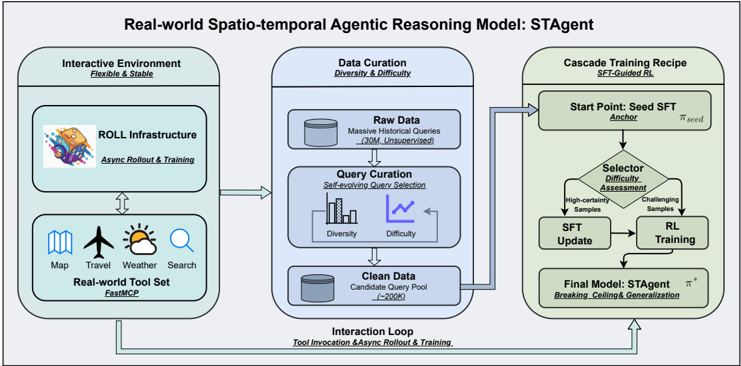
The image is a diagram illustrating the architecture and workflow of a "Real-world Spatio-temporal Agentic Reasoning Model" called STAgent. It outlines the process from data acquisition and curation to model training and deployment, emphasizing the interaction between the agent and its environment.
### Components/Axes
The diagram is divided into three main sections, arranged horizontally:
1. **Interactive Environment:** Represents the agent's interaction with the real world.
2. **Data Curation:** Describes the process of collecting and preparing data for training.
3. **Cascade Training Recipe:** Details the training methodology used for the STAgent model.
Each section contains several sub-components, which are described below.
### Detailed Analysis
**1. Interactive Environment (Left)**
* **Title:** Interactive Environment, with subtitle "Flexible & Stable"
* **ROLL Infrastructure:** Contains an image of a cartoon-like vehicle with dice. Label: "ROLL Infrastructure" and "Async Rollout & Training"
* **Real-world Tool Set:** Contains icons representing:
* Map
* Travel (airplane)
* Weather (sun and cloud)
* Search (magnifying glass)
* Label: "Real-world Tool Set" and "FastMCP"
**2. Data Curation (Center)**
* **Title:** Data Curation, with subtitle "Diversity & Difficulty"
* **Raw Data:** A cylinder icon labeled "Raw Data" and "Massive Historical Queries (~30M, Unsupervised)"
* **Query Curation:** A box labeled "Query Curation" and "Self-evolving Query Selection". Contains two small charts:
* A bar chart labeled "Diversity" with 4 bars of decreasing height.
* A line chart labeled "Difficulty" with a line that increases and then decreases.
* **Clean Data:** A cylinder icon labeled "Clean Data" and "Candidate Query Pool (~200K)"
**3. Cascade Training Recipe (Right)**
* **Title:** Cascade Training Recipe, with subtitle "SFT-Guided RL"
* **Start Point: Seed SFT:** A box labeled "Start Point: Seed SFT" and "Anchor". Contains the symbol "π_seed".
* **Selector Difficulty Assessment:** A diamond shape labeled "Selector" and "Difficulty Assessment".
* **SFT Update:** A box labeled "SFT Update". Connected to the Selector via "High-certainty Samples".
* **RL Training:** A box labeled "RL Training". Connected to the Selector via "Challenging Samples".
* **Final Model: STAgent:** A box labeled "Final Model: STAgent" and "Breaking Ceiling & Generalization". Contains the symbol "π*".
**Interaction Loop**
* A curved arrow connects the "Interactive Environment" to the "Data Curation" and then to the "Cascade Training Recipe". A curved arrow also connects the "Cascade Training Recipe" back to the "Interactive Environment", forming a loop.
* Label: "Interaction Loop" and "Tool Invocation & Async Rollout & Training"
### Key Observations
* The diagram illustrates a closed-loop system where the agent interacts with the environment, collects data, trains the model, and then uses the updated model to interact with the environment again.
* The data curation process emphasizes both diversity and difficulty of the queries.
* The training recipe uses a cascade approach, combining Supervised Fine-Tuning (SFT) and Reinforcement Learning (RL).
### Interpretation
The diagram presents a high-level overview of the STAgent model. The model is designed to learn from real-world interactions, continuously improve its performance through data curation and cascade training, and generalize to new situations. The interaction loop highlights the iterative nature of the learning process, where the agent's actions influence the data it collects, which in turn influences the model's training. The emphasis on diversity and difficulty in data curation suggests that the model is designed to handle complex and varied scenarios. The cascade training recipe indicates a strategy to leverage both supervised and reinforcement learning techniques for optimal performance.