\n
## Document: Error Message Example
### Overview
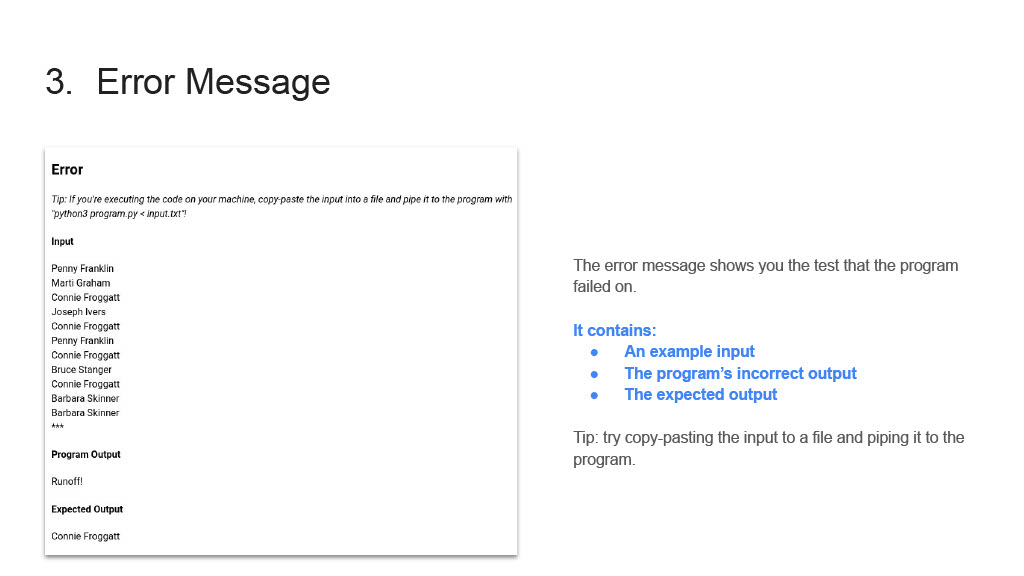
The image presents a document section titled "Error Message", illustrating an example of an error message encountered during program execution. It details the input provided to the program, the program's actual output, and the expected output. The document also provides instructions on how to reproduce the error.
### Components/Axes
The document is structured into the following sections:
* **Header:** "3. Error Message" (top-left)
* **Error Message Explanation:** A paragraph explaining the purpose of the error message.
* **Input:** A list of names.
* **Program Output:** The output generated by the program.
* **Expected Output:** The correct output the program should have produced.
* **Tip:** Instructions for reproducing the error.
### Detailed Analysis or Content Details
The document contains the following textual information:
**Error:**
"Tip: if you're executing the code on your machine, copy-paste the input into a file and pipe it to the program with 'python3 program.py < input.txt'?"
**Input:**
* Penny Franklin
* Marti Graham
* Connie Froggatt
* Joseph Ivers
* Connie Froggatt
* Penny Franklin
* Connie Froggatt
* Bruce Stanger
* Connie Froggatt
* Barbara Skinner
* Barbara Skinner
* ... (indicated by ellipsis)
**Program Output:**
"Runoff!"
**Expected Output:**
"Connie Froggatt"
**Error Message Explanation:**
"The error message shows you the test that the program failed on."
**It contains:**
* An example input
* The program's incorrect output (in blue)
* The expected output
**Tip:**
"Tip: try copy-pasting the input to a file and piping it to the program."
### Key Observations
The error message indicates that the program incorrectly identified the output for the given input. The program outputted "Runoff!", while the expected output was "Connie Froggatt". The input data consists of a list of names, with "Connie Froggatt" appearing multiple times. The ellipsis suggests the input list is longer than what is shown.
### Interpretation
This document serves as an instructional example for debugging a program. It demonstrates how error messages can pinpoint the discrepancy between the program's actual behavior and the desired behavior. The error message provides the necessary information – input, actual output, and expected output – to diagnose and fix the problem. The tip suggests a common method for testing programs with large inputs: redirecting input from a file. The repeated name "Connie Froggatt" in the input might be a key element in understanding the program's logic and the source of the error. The error likely stems from incorrect logic in identifying the correct output based on the input list of names.