## Screenshot: Programming Error Message
### Overview
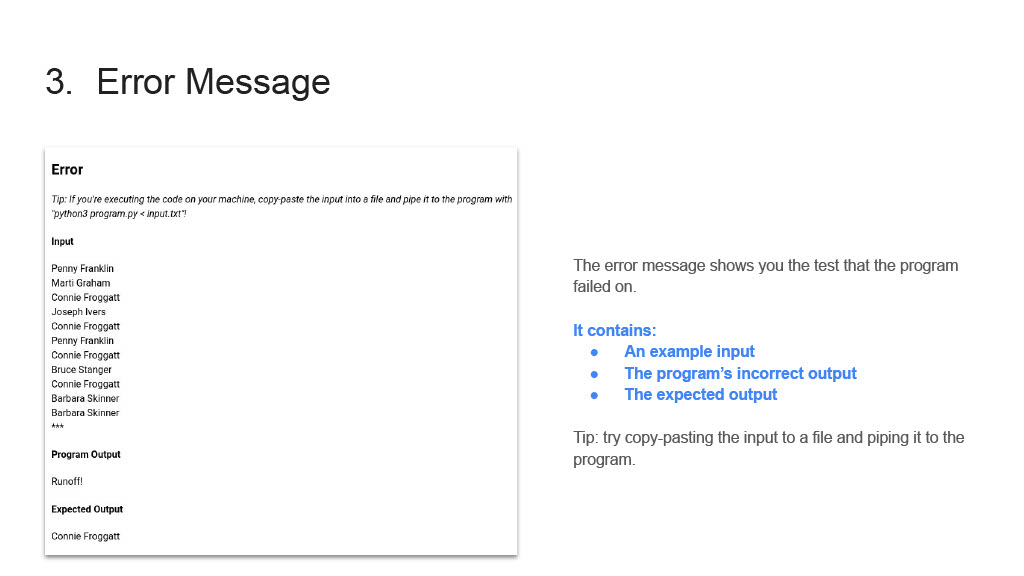
The image is a screenshot displaying a programming error message, likely from an automated testing or grading system. It shows a failed test case where a program's output does not match the expected output. The layout consists of a main error box on the left and explanatory text on the right.
### Components
The image is divided into two primary regions:
1. **Left Region (Error Box):** A bordered box containing the raw error details.
2. **Right Region (Explanatory Text):** A text block explaining the components of the error message.
**Left Region - Error Box Components:**
* **Header:** The word "Error" in bold.
* **Tip Section:** A line of italicized text providing execution advice.
* **Input Section:** A labeled list of names provided as input to the program.
* **Program Output Section:** A labeled section showing the output generated by the user's program.
* **Expected Output Section:** A labeled section showing the correct, expected output.
**Right Region - Explanatory Text Components:**
* A descriptive sentence.
* A bulleted list titled "It contains:".
* A final tip.
### Content Details
**1. Text from the Left Region (Error Box):**
* **Header:** `Error`
* **Tip:** `Tip: If you're executing the code on your machine, copy-paste the input into a file and pipe it to the program with 'python3 program.py < input.txt'`
* **Input Section:**
* Label: `Input`
* Data (List of names):
* Penny Franklin
* Marti Graham
* Connie Froggatt
* Joseph Ivers
* Connie Froggatt
* Penny Franklin
* Connie Froggatt
* Bruce Stanger
* Connie Froggatt
* Barbara Skinner
* Barbara Skinner
* `***` (This appears to be a delimiter or end-of-input marker)
* **Program Output Section:**
* Label: `Program Output`
* Value: `Runoff!`
* **Expected Output Section:**
* Label: `Expected Output`
* Value: `Connie Froggatt`
**2. Text from the Right Region (Explanatory Text):**
* `The error message shows you the test that the program failed on.`
* `It contains:`
* `An example input`
* `The program's incorrect output`
* `The expected output`
* `Tip: try copy-pasting the input to a file and piping it to the program.`
### Key Observations
1. **Clear Failure:** The program output (`Runoff!`) is completely different from the expected output (`Connie Froggatt`), indicating a fundamental logic error, not a minor formatting issue.
2. **Input Pattern:** The input list contains multiple occurrences of the name "Connie Froggatt" (4 times) and "Barbara Skinner" (2 times). Other names appear once. The expected output is the name that appears most frequently.
3. **Semantic Mismatch:** The program's output "Runoff!" suggests it might be printing a status message or the name of an algorithm (like a "runoff" voting system) instead of processing the input data to find the result.
4. **Instructional Design:** The error message is designed to be self-contained and helpful, providing the exact input that caused the failure and a tip for local debugging.
### Interpretation
This error message is from a programming exercise, likely related to an algorithm problem such as finding the most frequent element in a list or implementing a specific voting system (e.g., a "runoff" election). The test case checks if the program can correctly identify "Connie Froggatt" as the winner or most frequent name from the provided input list.
The program's incorrect output of "Runoff!" indicates one of several possible issues:
* The program is not reading or processing the input list correctly.
* The program is printing a debug statement or the name of the intended algorithm instead of performing the required computation.
* There is a control flow error where the program exits or prints prematurely.
The provided tip about using input redirection (`<`) is a standard method for testing command-line programs with file-based input, confirming this is a console-based programming task. The structure of the error message—showing input, actual output, and expected output—is a classic format used in automated code testing platforms to help developers diagnose failures efficiently.