## Voronoi Diagram: Region Decomposition - Exchange Pricing
### Overview
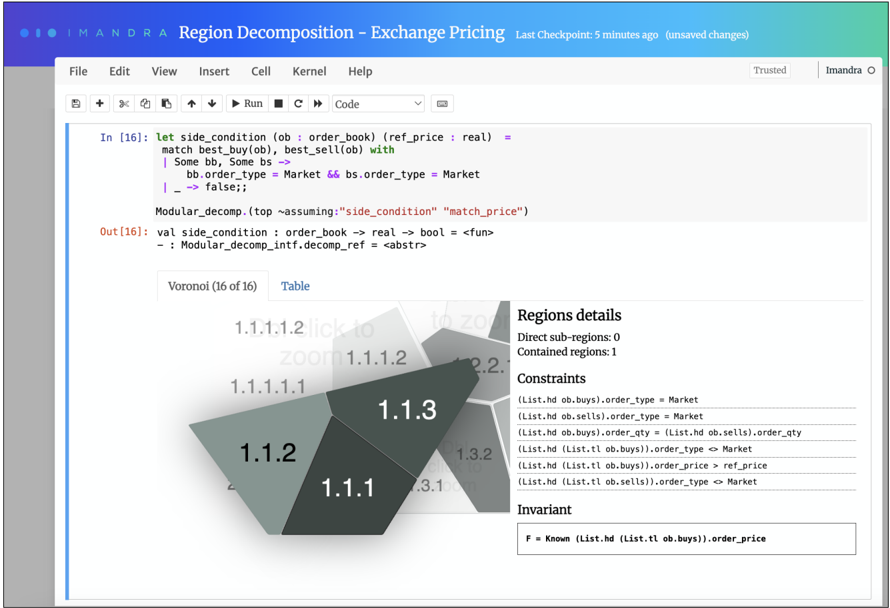
The image presents a screenshot of a software interface, likely related to financial modeling or algorithmic trading, featuring a Voronoi diagram, code snippets, and region details. The diagram visually represents a region decomposition, while the code defines a side condition and a modular decomposition. Constraints and invariants are also listed.
### Components/Axes
* **Header:** "IMANDRA Region Decomposition - Exchange Pricing" with "Last Checkpoint: 5 minutes ago (unsaved changes)" and "Trusted" and user "Imandra O"
* **Menu Bar:** "File Edit View Insert Cell Kernel Help"
* **Code Section:** Contains code snippets in a functional programming language (likely OCaml or similar). Includes definitions for `side_condition` and `Modular_decomp`.
* **Voronoi Diagram:** A diagram composed of several polygonal regions, each labeled with a numerical identifier (e.g., 1.1.1, 1.1.2, 1.1.3). The diagram is labeled "Voronoi (16 of 16)".
* **Regions Details:** A section providing information about the selected region. Includes "Direct sub-regions: 0" and "Contained regions: 1".
* **Constraints:** A list of constraints related to order types, quantities, and prices.
* **Invariant:** A statement of an invariant condition.
### Detailed Analysis or Content Details
**Code Section:**
* `In [16]: let side_condition (ob : order_book) (ref_price : real) =`
`match best_buy(ob), best_sell(ob) with`
`| Some bb, Some bs ->`
`bb.order_type = Market && bs.order_type = Market`
`| _ -> false;;`
* `Modular_decomp.(top ~assuming:"side_condition" "match_price")`
* `Out [16]: val side_condition : order_book -> real -> bool = <fun>`
`- : Modular_decomp_intf.decomp_ref = <abstr>`
**Voronoi Diagram:**
The diagram is composed of several regions, each with a label. The labels and approximate relative sizes are:
* 1.1.1: Darkest region, bottom-right.
* 1.1.2: Medium-dark region, left of 1.1.1.
* 1.1.3: Light region, top-right of 1.1.1.
* 1.1.1.1: Very light region, top-left of 1.1.1.
* 1.1.1.1.1: Very light region, top-left of 1.1.1.1.
* 1.1.1.1.2: Very light region, above 1.1.1.1.1.
* 1.3.2: Light region, right of 1.1.3.
* 2.2: Light region, above 1.1.3.
* 3.1: Light region, right of 1.1.1.
**Regions Details:**
* Direct sub-regions: 0
* Contained regions: 1
**Constraints:**
* `(List.hd ob.buys).order_type = Market`
* `(List.hd ob.sells).order_type = Market`
* `(List.hd ob.buys).order_qty = (List.hd ob.sells).order_qty`
* `(List.hd (List.tl ob.buys)).order_type = Market`
* `(List.hd (List.tl ob.buys)).order_price > ref_price`
* `(List.hd (List.tl ob.sells)).order_type = Market`
**Invariant:**
* `F = Known (List.hd (List.tl ob.buys)).order_price`
### Key Observations
* The code defines a `side_condition` function that checks if the order types of the best buy and best sell orders are both "Market".
* The Voronoi diagram visually partitions the space based on some criteria, likely related to the conditions defined in the code.
* The constraints specify relationships between order types, quantities, and prices, suggesting a system for managing and validating orders.
* The invariant states that the order price is known, implying that the system has a way to determine or track the price of orders.
### Interpretation
The image represents a system for analyzing and managing exchange pricing using region decomposition. The Voronoi diagram likely visualizes different regions or states in the order book, with the code defining the conditions and constraints that govern these regions. The constraints ensure that orders meet certain criteria, while the invariant provides a guarantee about the order price. This system could be used for algorithmic trading, risk management, or market surveillance. The "Region Decomposition" likely refers to partitioning the order book state space into regions with similar properties, allowing for more efficient analysis and decision-making. The "Exchange Pricing" aspect suggests that the system is focused on understanding and predicting price movements in the exchange.