## Line Chart: Model Accuracy on Math Problems
### Overview
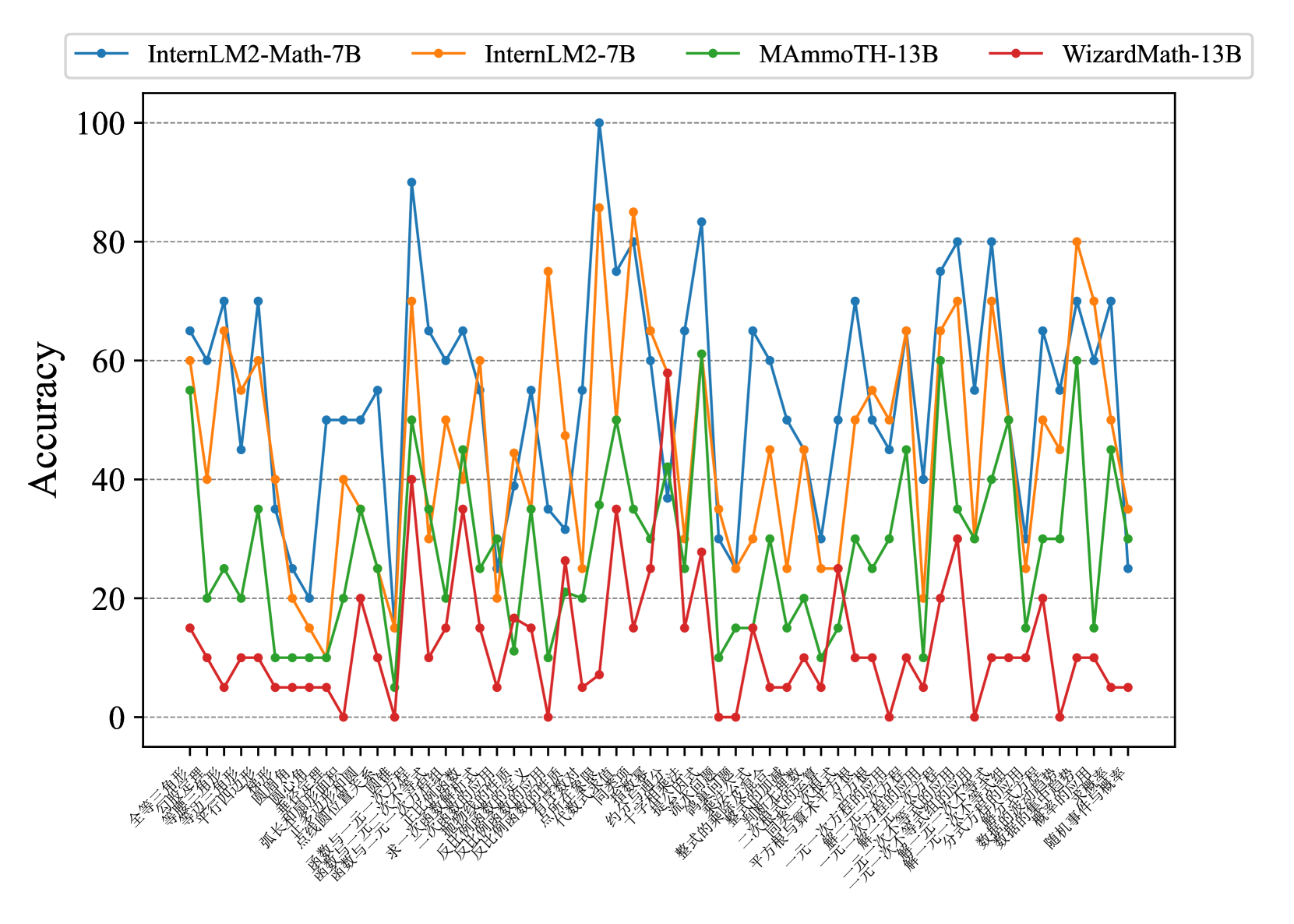
This image presents a line chart comparing the accuracy of four different language models – InternLM2-Math-7B, InternLM2-7B, MAmmoTH-13B, and WizardMath-13B – across a series of math problems. The x-axis represents the math problems (in Chinese), and the y-axis represents the accuracy, ranging from 0 to 100.
### Components/Axes
* **Y-axis Title:** Accuracy
* **X-axis Title:** (Chinese characters representing math problems - see "Detailed Analysis" for approximate translations)
* **Legend:** Located at the top-left of the chart.
* InternLM2-Math-7B (Blue Line)
* InternLM2-7B (Orange Line)
* MAmmoTH-13B (Green Line)
* WizardMath-13B (Red Line)
* **Gridlines:** Horizontal gridlines are present, spaced at 20-unit intervals on the y-axis.
* **Data Range:** Y-axis ranges from approximately 0 to 100.
### Detailed Analysis
The x-axis labels are in Chinese. Approximate translations (based on online resources) are provided below, but may not be perfectly accurate:
1. 全身滑轮组 (Pulley System)
2. 复式杠杆 (Compound Lever)
3. 减速 (Deceleration)
4. 滑轮组 (Pulley System)
5. 功 (Work)
6. 机械效率 (Mechanical Efficiency)
7. 功率 (Power)
8. 简单机械 (Simple Machines)
9. 杠杆原理 (Lever Principle)
10. 浮力 (Buoyancy)
11. 压强 (Pressure)
12. 液体压强 (Liquid Pressure)
13. 密度 (Density)
14. 质量 (Mass)
15. 重力 (Gravity)
16. 速度 (Velocity)
17. 匀速直线运动 (Uniform Linear Motion)
18. 运动和力 (Motion and Force)
19. 牛顿第一定律 (Newton's First Law)
20. 牛顿第二定律 (Newton's Second Law)
21. 牛顿第三定律 (Newton's Third Law)
22. 力的分解 (Force Decomposition)
23. 摩擦力 (Friction)
24. 能量守恒 (Conservation of Energy)
25. 热量 (Heat)
26. 热传递 (Heat Transfer)
27. 蒸发 (Evaporation)
28. 凝固 (Solidification)
29. 熔化 (Melting)
30. 电流 (Current)
31. 电压 (Voltage)
32. 电阻 (Resistance)
33. 电功率 (Electrical Power)
34. 电流的热效应 (Heating Effect of Current)
35. 电磁感应 (Electromagnetic Induction)
36. 电动机 (Electric Motor)
37. 发电机 (Generator)
38. 磁场 (Magnetic Field)
39. 磁铁 (Magnet)
40. 光的反射 (Reflection of Light)
41. 光的折射 (Refraction of Light)
42. 透镜 (Lens)
43. 人眼 (Human Eye)
44. 声音 (Sound)
45. 声音的传播 (Sound Propagation)
46. 振动和波 (Vibration and Waves)
47. 能量转换 (Energy Conversion)
**Data Trends and Values (Approximate):**
* **InternLM2-Math-7B (Blue):** Starts around 65, fluctuates significantly, peaking around 90 at problem 10 (浮力), then generally declines to around 60-70, with some dips below 50. Ends around 70.
* **InternLM2-7B (Orange):** Starts around 40, shows moderate fluctuations, peaking around 60-65 at several points (problems 6, 10, 12, 21), and generally stays between 20 and 60. Ends around 50.
* **MAmmoTH-13B (Green):** Starts around 30, exhibits substantial fluctuations, with a peak around 50-60 at problem 10 (浮力), and generally stays between 20 and 40. Ends around 30.
* **WizardMath-13B (Red):** Starts around 10, shows the most erratic fluctuations, with peaks around 30-40 at several points (problems 6, 10, 12, 21), and frequently dips close to 0. Ends around 10.
### Key Observations
* InternLM2-Math-7B consistently outperforms the other models across most problems.
* WizardMath-13B has the lowest accuracy and the most volatile performance.
* All models show a peak in accuracy around problem 10 (浮力 - Buoyancy), suggesting this type of problem is relatively easier for all models.
* The accuracy of all models fluctuates considerably across different problem types, indicating varying levels of difficulty.
### Interpretation
The chart demonstrates the varying capabilities of different language models in solving math problems. InternLM2-Math-7B appears to be the most proficient, likely due to its specialized training on mathematical tasks. The significant fluctuations in accuracy suggest that the models struggle with certain types of problems, and their performance is highly dependent on the specific mathematical concept being tested. The peak in accuracy for all models on buoyancy problems could indicate that this concept is well-represented in their training data or is inherently simpler to solve. The low and erratic performance of WizardMath-13B suggests it may not be well-suited for mathematical reasoning tasks. The Chinese labels on the x-axis indicate the problems cover a broad range of physics and math topics, from mechanics and thermodynamics to electricity and optics. This data could be used to identify areas where these models need improvement and to guide future research in mathematical reasoning for language models.