## Line Chart: ASR vs. Attack Ratio for Different Federated Learning Methods
### Overview
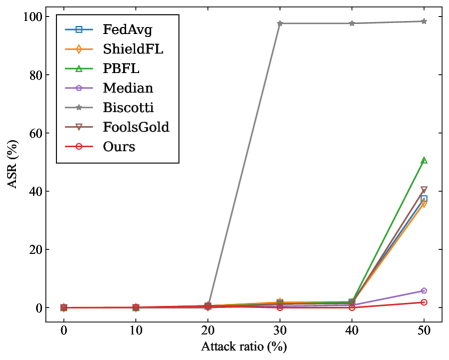
The image is a line chart comparing the Attack Success Rate (ASR) of different federated learning methods against varying attack ratios. The chart displays seven different methods: FedAvg, ShieldFL, PBFL, Median, Biscotti, FoolsGold, and Ours. The x-axis represents the attack ratio (percentage), and the y-axis represents the ASR (percentage).
### Components/Axes
* **X-axis:** Attack ratio (%), with markers at 0, 10, 20, 30, 40, and 50.
* **Y-axis:** ASR (%), with markers at 0, 20, 40, 60, 80, and 100.
* **Legend:** Located in the top-left corner, listing the seven federated learning methods with corresponding colors and markers:
* FedAvg (Blue, square marker)
* ShieldFL (Orange, diamond marker)
* PBFL (Green, triangle marker)
* Median (Purple, star marker)
* Biscotti (Gray, star marker)
* FoolsGold (Brown, triangle marker)
* Ours (Red, circle marker)
### Detailed Analysis
* **FedAvg (Blue):** The line remains relatively flat near 0% ASR until an attack ratio of 40%, then increases to approximately 1% at 50% attack ratio.
* (0, ~0), (10, ~0), (20, ~0), (30, ~0), (40, ~0), (50, ~1)
* **ShieldFL (Orange):** Similar to FedAvg, the line stays near 0% ASR until an attack ratio of 40%, then increases to approximately 2% at 50% attack ratio.
* (0, ~0), (10, ~0), (20, ~0), (30, ~0), (40, ~0), (50, ~2)
* **PBFL (Green):** The line remains near 0% ASR until an attack ratio of 40%, then increases sharply to approximately 50% at 50% attack ratio.
* (0, ~0), (10, ~0), (20, ~0), (30, ~0), (40, ~0), (50, ~50)
* **Median (Purple):** The line remains near 0% ASR until an attack ratio of 40%, then increases to approximately 5% at 50% attack ratio.
* (0, ~0), (10, ~0), (20, ~0), (30, ~0), (40, ~0), (50, ~5)
* **Biscotti (Gray):** The line increases sharply from 20% attack ratio to approximately 98% ASR, and then remains relatively flat.
* (0, ~0), (10, ~0), (20, ~0), (30, ~98), (40, ~98), (50, ~98)
* **FoolsGold (Brown):** The line remains near 0% ASR until an attack ratio of 40%, then increases to approximately 40% at 50% attack ratio.
* (0, ~0), (10, ~0), (20, ~0), (30, ~0), (40, ~0), (50, ~40)
* **Ours (Red):** The line remains consistently near 0% ASR across all attack ratios.
* (0, ~0), (10, ~0), (20, ~0), (30, ~0), (40, ~0), (50, ~0)
### Key Observations
* Biscotti is highly vulnerable to attacks, showing a near-100% ASR after a 20% attack ratio.
* PBFL and FoolsGold show significant increases in ASR at higher attack ratios (50%).
* FedAvg, ShieldFL, Median, and Ours appear to be more resilient to attacks, with relatively low ASR even at higher attack ratios.
* The "Ours" method demonstrates the lowest ASR across all attack ratios, suggesting it is the most robust against the attacks tested.
### Interpretation
The chart illustrates the vulnerability of different federated learning methods to adversarial attacks. Biscotti is highly susceptible, while "Ours" appears to be the most resilient. The other methods show varying degrees of vulnerability, with PBFL and FoolsGold exhibiting a significant increase in ASR at higher attack ratios. The data suggests that the choice of federated learning method significantly impacts the system's robustness against attacks. The "Ours" method may incorporate defense mechanisms that mitigate the impact of the attacks. The sharp increase in ASR for some methods after a certain attack ratio threshold (e.g., 40% for PBFL, FoolsGold, FedAvg, ShieldFL, and Median) suggests a critical point where the attack becomes effective.