## Line Chart: Accuracy vs. Top η (%)
### Overview
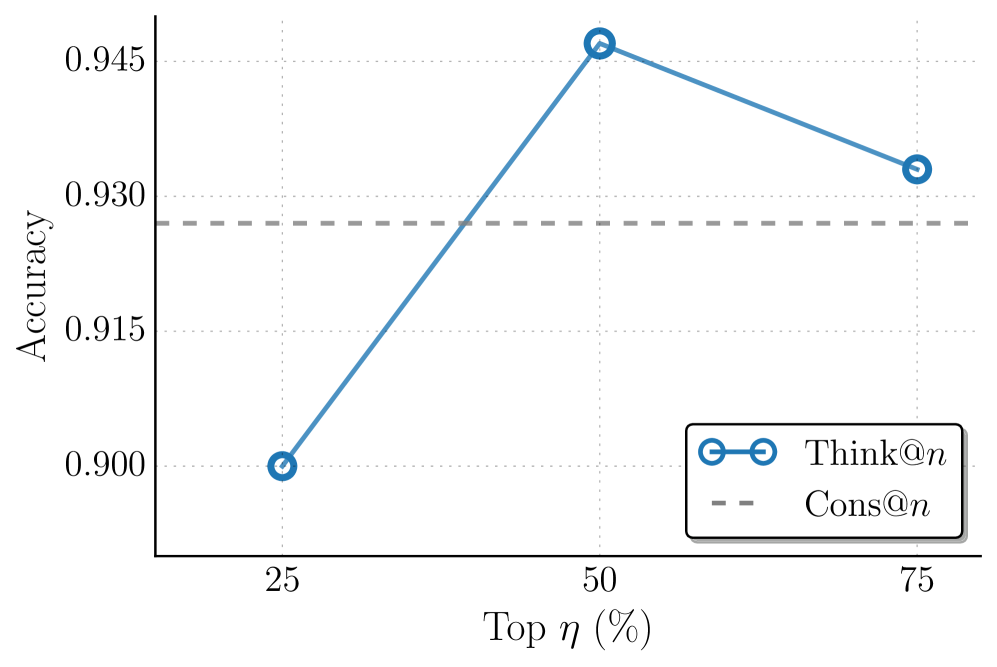
The image is a line chart showing the relationship between "Accuracy" and "Top η (%)". There are two data series plotted: "Think@n" represented by a solid blue line with circle markers, and "Cons@n" represented by a dashed gray line. The chart shows how accuracy changes as the top η percentage varies.
### Components/Axes
* **X-axis (Horizontal):** "Top η (%)" with markers at 25, 50, and 75.
* **Y-axis (Vertical):** "Accuracy" with markers at 0.900, 0.915, 0.930, and 0.945.
* **Legend:** Located in the bottom-right corner, it identifies the two data series:
* "Think@n": Solid blue line with circle markers.
* "Cons@n": Dashed gray line.
### Detailed Analysis
* **Think@n (Solid Blue Line):**
* At Top η = 25%, Accuracy ≈ 0.900
* At Top η = 50%, Accuracy ≈ 0.946
* At Top η = 75%, Accuracy ≈ 0.931
* Trend: The line slopes upward from 25% to 50%, then slopes downward from 50% to 75%.
* **Cons@n (Dashed Gray Line):**
* The line is horizontal and constant across all values of Top η.
* Accuracy ≈ 0.928 for all Top η values.
### Key Observations
* The "Think@n" series shows a peak accuracy at Top η = 50%.
* The "Cons@n" series maintains a constant accuracy level regardless of the Top η value.
* At 25% Top η, Think@n has the lowest accuracy.
* At 50% Top η, Think@n has the highest accuracy.
* At 75% Top η, Think@n has an accuracy between its values at 25% and 50%.
### Interpretation
The chart suggests that the "Think@n" method performs best when considering the top 50% of the data, as it achieves the highest accuracy at this point. The "Cons@n" method provides a consistent level of accuracy, but it does not reach the peak accuracy of "Think@n" at 50% Top η. The performance of "Think@n" drops when considering the top 75% compared to the top 50%, indicating that including the additional 25% of data negatively impacts the accuracy of this method. The "Cons@n" method may be more stable, but less accurate than "Think@n" at its peak.