## Knowledge Hierarchy Diagram: Question Categorization
### Overview
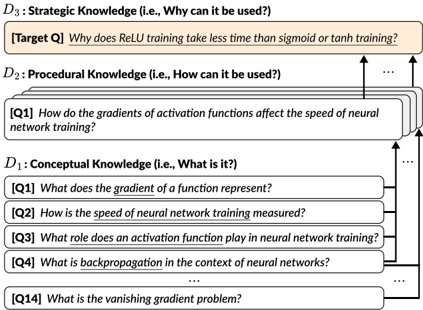
The image presents a diagram illustrating a hierarchy of knowledge types, categorized as Conceptual, Procedural, and Strategic. Each category is associated with example questions, demonstrating the type of knowledge it represents. The diagram shows how answering questions at lower levels (Conceptual) can contribute to answering questions at higher levels (Strategic).
### Components/Axes
* **Title:** The diagram is implicitly titled as a knowledge hierarchy.
* **Knowledge Categories:**
* D1: Conceptual Knowledge (i.e., What is it?)
* D2: Procedural Knowledge (i.e., How can it be used?)
* D3: Strategic Knowledge (i.e., Why can it be used?)
* **Questions:** Each knowledge category contains example questions.
* D1:
* [Q1] What does the gradient of a function represent?
* [Q2] How is the speed of neural network training measured?
* [Q3] What role does an activation function play in neural network training?
* [Q4] What is backpropagation in the context of neural networks?
* [Q14] What is the vanishing gradient problem?
* ... (Indicates more questions exist)
* D2:
* [Q1] How do the gradients of activation functions affect the speed of neural network training?
* ... (Indicates more questions exist)
* D3:
* [Target Q] Why does ReLU training take less time than sigmoid or tanh training?
* **Arrows:** Arrows point from the questions in D1 and D2 to the question in D3, indicating a relationship or dependency.
### Detailed Analysis or ### Content Details
* **Conceptual Knowledge (D1):** This level focuses on understanding fundamental concepts. The example questions cover gradients, training speed, activation functions, backpropagation, and the vanishing gradient problem.
* **Procedural Knowledge (D2):** This level focuses on how to use the concepts. The example question asks how gradients of activation functions affect training speed.
* **Strategic Knowledge (D3):** This level focuses on the "why" behind the concepts and procedures. The example question asks why ReLU training is faster than sigmoid or tanh training.
* **Relationships:** The arrows indicate that answering the conceptual and procedural questions can help in answering the strategic question. The questions in D1 and D2 are prerequisites to answering the question in D3.
### Key Observations
* The diagram illustrates a hierarchical structure of knowledge, moving from basic concepts to more complex strategic understanding.
* The example questions are specific to the field of neural network training.
* The "..." notation indicates that the lists of questions are not exhaustive.
### Interpretation
The diagram demonstrates a structured approach to learning and problem-solving. It suggests that a solid foundation of conceptual knowledge (understanding "what" things are) and procedural knowledge (understanding "how" to use them) is essential for developing strategic knowledge (understanding "why" things work the way they do). In the context of neural networks, this means understanding the underlying mathematical concepts and training procedures before being able to reason about the effectiveness of different training techniques like ReLU. The diagram highlights the importance of breaking down complex problems into smaller, more manageable questions that address different levels of knowledge.