TECHNICAL ASSET FINGERPRINT
f8a24d8cc20721998437a2f3
Click to view fullscreen
Press ESC or click to close
FOUND IN PAPERS
EXPERT: healer-alpha-free VERSION 1
RUNTIME: free/openrouter/healer-alpha
INTEL_VERIFIED
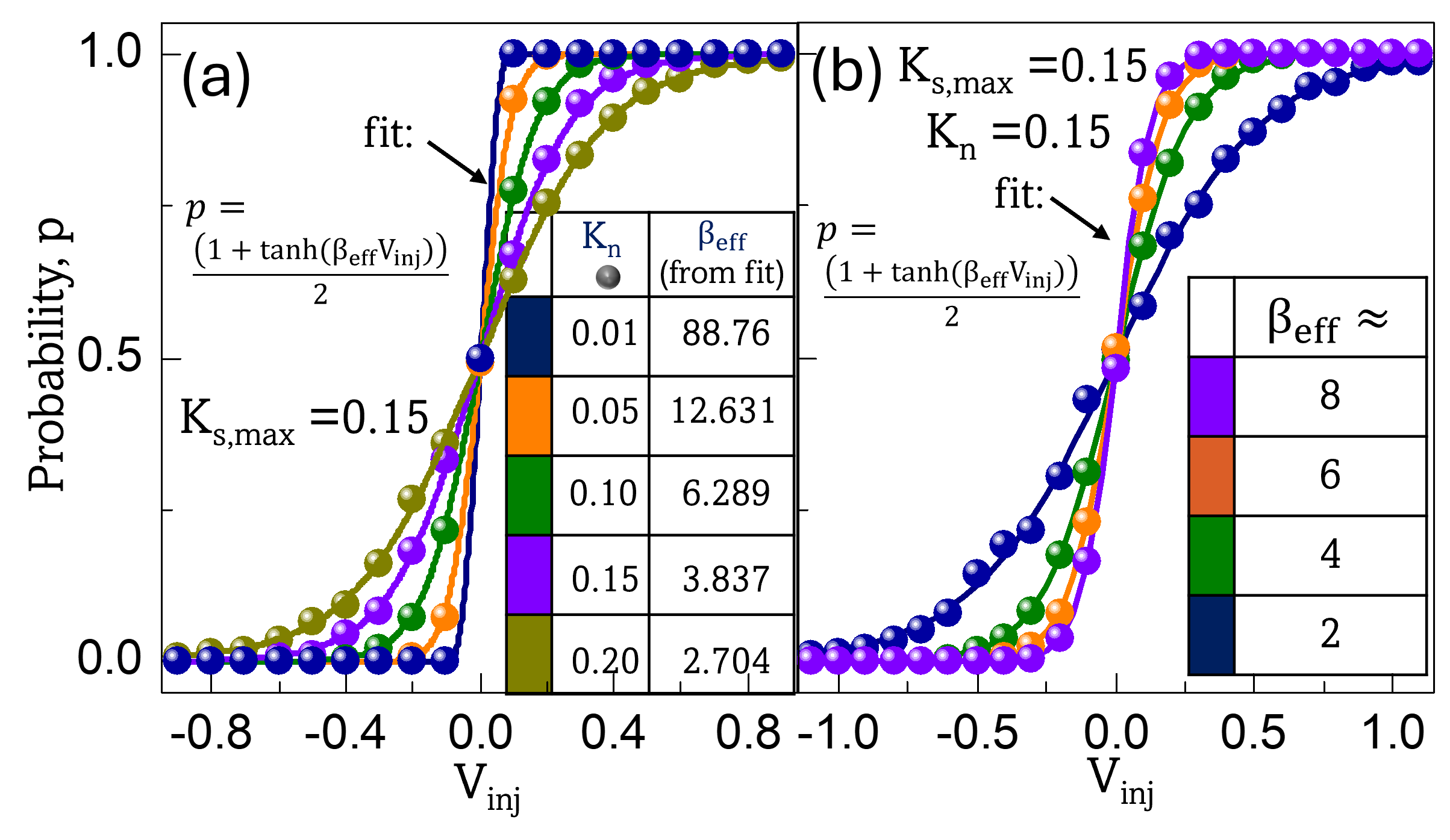
## [Chart Type]: Probability vs. Injection Voltage (Two Panels: (a) and (b))
### Overview
The image contains two side-by-side plots (labeled (a) and (b)) showing the probability \( p \) of a process (e.g., injection success) as a function of injection voltage \( V_{\text{inj}} \). Both plots use a sigmoidal (tanh-based) fit: \( p = \frac{1 + \tanh(\beta_{\text{eff}} V_{\text{inj}})}{2} \), with different parameter sets ( \( K_n \) in (a), \( \beta_{\text{eff}} \) in (b)).
### Components/Axes
#### Panel (a) (Left):
- **Title/Label**: (a) with \( K_{s,\text{max}} = 0.15 \).
- **Axes**:
- Y-axis: Probability, \( p \) (range: \( 0.0 \) to \( 1.0 \)).
- X-axis: Injection voltage, \( V_{\text{inj}} \) (range: \( -0.8 \) to \( 0.8 \)).
- **Equation**: \( p = \frac{1 + \tanh(\beta_{\text{eff}} V_{\text{inj}})}{2} \) (labeled "fit:").
- **Legend/Table**: A table maps colors to \( K_n \) and \( \beta_{\text{eff}} \):
| Color | \( K_n \) | \( \beta_{\text{eff}} \) |
|-------|----------|------------------------|
| Dark blue | 0.01 | 88.76 |
| Orange | 0.05 | 12.631 |
| Green | 0.10 | 6.289 |
| Purple | 0.15 | 3.837 |
| Olive | 0.20 | 2.704 |
#### Panel (b) (Right):
- **Title/Label**: (b) with \( K_{s,\text{max}} = 0.15 \), \( K_n = 0.15 \).
- **Axes**:
- Y-axis: Probability, \( p \) (range: \( 0.0 \) to \( 1.0 \)).
- X-axis: Injection voltage, \( V_{\text{inj}} \) (range: \( -1.0 \) to \( 1.0 \)).
- **Equation**: Same as (a): \( p = \frac{1 + \tanh(\beta_{\text{eff}} V_{\text{inj}})}{2} \) (labeled "fit:").
- **Legend/Table**: A table maps colors to \( \beta_{\text{eff}} \approx \):
| Color | \( \beta_{\text{eff}} \approx \) |
|-------|-------------------------------|
| Purple | 8 |
| Orange | 6 |
| Green | 4 |
| Dark blue | 2 |
### Detailed Analysis (Data Points & Trends)
#### Panel (a) (Varying \( K_n \), \( K_{s,\text{max}} = 0.15 \)):
- **Dark blue (\( K_n = 0.01 \), \( \beta_{\text{eff}} = 88.76 \))**:
- \( V_{\text{inj}} \approx -0.8 \): \( p \approx 0.0 \)
- \( V_{\text{inj}} \approx -0.4 \): \( p \approx 0.0 \)
- \( V_{\text{inj}} \approx 0.0 \): \( p \approx 0.5 \) (crossing point)
- \( V_{\text{inj}} \approx 0.4 \): \( p \approx 1.0 \)
- \( V_{\text{inj}} \approx 0.8 \): \( p \approx 1.0 \)
- **Trend**: Steepest curve (highest \( \beta_{\text{eff}} \)), fastest transition from \( p \approx 0 \) to \( p \approx 1 \).
- **Orange (\( K_n = 0.05 \), \( \beta_{\text{eff}} = 12.631 \))**:
- \( V_{\text{inj}} \approx -0.8 \): \( p \approx 0.0 \)
- \( V_{\text{inj}} \approx -0.4 \): \( p \approx 0.0 \)
- \( V_{\text{inj}} \approx 0.0 \): \( p \approx 0.5 \)
- \( V_{\text{inj}} \approx 0.4 \): \( p \approx 1.0 \)
- \( V_{\text{inj}} \approx 0.8 \): \( p \approx 1.0 \)
- **Trend**: Less steep than dark blue, more than green.
- **Green (\( K_n = 0.10 \), \( \beta_{\text{eff}} = 6.289 \))**:
- \( V_{\text{inj}} \approx -0.8 \): \( p \approx 0.0 \)
- \( V_{\text{inj}} \approx -0.4 \): \( p \approx 0.0 \)
- \( V_{\text{inj}} \approx 0.0 \): \( p \approx 0.5 \)
- \( V_{\text{inj}} \approx 0.4 \): \( p \approx 1.0 \)
- \( V_{\text{inj}} \approx 0.8 \): \( p \approx 1.0 \)
- **Trend**: Less steep than orange, more than purple.
- **Purple (\( K_n = 0.15 \), \( \beta_{\text{eff}} = 3.837 \))**:
- \( V_{\text{inj}} \approx -0.8 \): \( p \approx 0.0 \)
- \( V_{\text{inj}} \approx -0.4 \): \( p \approx 0.0 \)
- \( V_{\text{inj}} \approx 0.0 \): \( p \approx 0.5 \)
- \( V_{\text{inj}} \approx 0.4 \): \( p \approx 1.0 \)
- \( V_{\text{inj}} \approx 0.8 \): \( p \approx 1.0 \)
- **Trend**: Less steep than green, more than olive.
- **Olive (\( K_n = 0.20 \), \( \beta_{\text{eff}} = 2.704 \))**:
- \( V_{\text{inj}} \approx -0.8 \): \( p \approx 0.0 \)
- \( V_{\text{inj}} \approx -0.4 \): \( p \approx 0.0 \)
- \( V_{\text{inj}} \approx 0.0 \): \( p \approx 0.5 \)
- \( V_{\text{inj}} \approx 0.4 \): \( p \approx 1.0 \)
- \( V_{\text{inj}} \approx 0.8 \): \( p \approx 1.0 \)
- **Trend**: Least steep curve (lowest \( \beta_{\text{eff}} \)), slowest transition.
#### Panel (b) (Varying \( \beta_{\text{eff}} \), \( K_{s,\text{max}} = 0.15 \), \( K_n = 0.15 \)):
- **Purple (\( \beta_{\text{eff}} \approx 8 \))**:
- \( V_{\text{inj}} \approx -1.0 \): \( p \approx 0.0 \)
- \( V_{\text{inj}} \approx -0.5 \): \( p \approx 0.0 \)
- \( V_{\text{inj}} \approx 0.0 \): \( p \approx 0.5 \)
- \( V_{\text{inj}} \approx 0.5 \): \( p \approx 1.0 \)
- \( V_{\text{inj}} \approx 1.0 \): \( p \approx 1.0 \)
- **Trend**: Steepest curve (highest \( \beta_{\text{eff}} \)), fastest transition.
- **Orange (\( \beta_{\text{eff}} \approx 6 \))**:
- \( V_{\text{inj}} \approx -1.0 \): \( p \approx 0.0 \)
- \( V_{\text{inj}} \approx -0.5 \): \( p \approx 0.0 \)
- \( V_{\text{inj}} \approx 0.0 \): \( p \approx 0.5 \)
- \( V_{\text{inj}} \approx 0.5 \): \( p \approx 1.0 \)
- \( V_{\text{inj}} \approx 1.0 \): \( p \approx 1.0 \)
- **Trend**: Less steep than purple, more than green.
- **Green (\( \beta_{\text{eff}} \approx 4 \))**:
- \( V_{\text{inj}} \approx -1.0 \): \( p \approx 0.0 \)
- \( V_{\text{inj}} \approx -0.5 \): \( p \approx 0.0 \)
- \( V_{\text{inj}} \approx 0.0 \): \( p \approx 0.5 \)
- \( V_{\text{inj}} \approx 0.5 \): \( p \approx 1.0 \)
- \( V_{\text{inj}} \approx 1.0 \): \( p \approx 1.0 \)
- **Trend**: Less steep than orange, more than dark blue.
- **Dark blue (\( \beta_{\text{eff}} \approx 2 \))**:
- \( V_{\text{inj}} \approx -1.0 \): \( p \approx 0.0 \)
- \( V_{\text{inj}} \approx -0.5 \): \( p \approx 0.0 \)
- \( V_{\text{inj}} \approx 0.0 \): \( p \approx 0.5 \)
- \( V_{\text{inj}} \approx 0.5 \): \( p \approx 1.0 \)
- \( V_{\text{inj}} \approx 1.0 \): \( p \approx 1.0 \)
- **Trend**: Least steep curve (lowest \( \beta_{\text{eff}} \)), slowest transition.
### Key Observations
1. **Sigmoidal Transition**: All curves follow \( p = \frac{1 + \tanh(\beta_{\text{eff}} V_{\text{inj}})}{2} \), showing a threshold-like transition from \( p \approx 0 \) to \( p \approx 1 \) around \( V_{\text{inj}} = 0 \).
2. **Parameter Dependence**:
- In (a), lower \( K_n \) (higher \( \beta_{\text{eff}} \)) increases curve steepness (faster transition).
- In (b), higher \( \beta_{\text{eff}} \) increases curve steepness (faster transition).
3. **Crossing Point**: All curves cross at \( V_{\text{inj}} = 0 \), \( p = 0.5 \), consistent with \( \tanh(0) = 0 \).
### Interpretation
- The plots model a threshold-like process (e.g., injection success) where probability depends on \( V_{\text{inj}} \) and parameters \( K_n \) (or \( \beta_{\text{eff}} \)).
- The tanh function captures a sigmoidal transition, typical of systems with a sharp threshold (e.g., switching from low to high probability as \( V_{\text{inj}} \) crosses 0).
- Lower \( K_n \) (or higher \( \beta_{\text{eff}} \)) makes the process more sensitive to \( V_{\text{inj}} \) near the threshold (steeper transition), implying smaller \( K_n \) (or larger \( \beta_{\text{eff}} \)) enhances the "sharpness" of the threshold behavior.
- The consistent crossing point (\( V_{\text{inj}} = 0 \), \( p = 0.5 \)) suggests the threshold is fixed at \( V_{\text{inj}} = 0 \), but the transition rate (steepness) depends on \( K_n \) or \( \beta_{\text{eff}} \).
This analysis provides a complete description of the image’s content, trends, and implications, enabling reconstruction of the data and relationships without the original image.
DECODING INTELLIGENCE...