## Geometry Problem: Parallelogram Height Calculation
### Overview
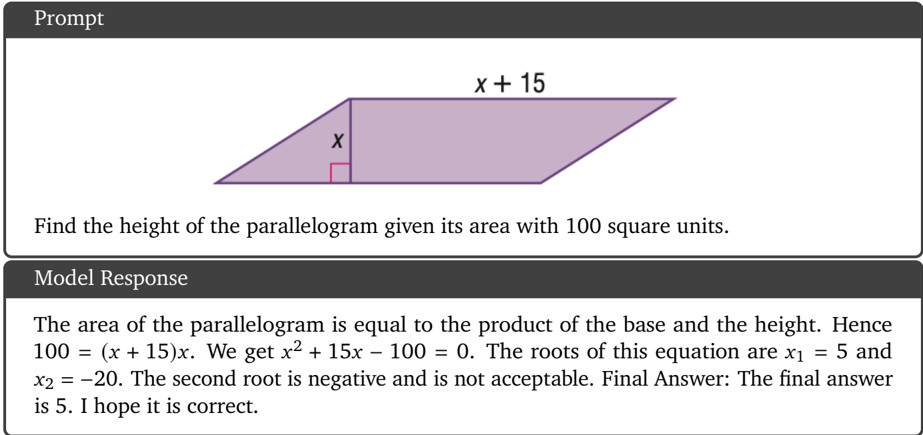
The image presents a geometry problem involving a parallelogram. The problem asks to find the height of the parallelogram given its area and an expression for its base. A model response provides the solution.
### Components/Axes
* **Diagram:** A parallelogram is shown with the following labels:
* Base: Labeled as "x + 15"
* Height: Labeled as "x". A right angle is marked between the height and the base.
* **Prompt Text:** "Find the height of the parallelogram given its area with 100 square units."
* **Model Response Text:** "The area of the parallelogram is equal to the product of the base and the height. Hence 100 = (x + 15)x. We get x² + 15x - 100 = 0. The roots of this equation are x₁ = 5 and x₂ = -20. The second root is negative and is not acceptable. Final Answer: The final answer is 5. I hope it is correct."
### Detailed Analysis
The problem provides the area of a parallelogram (100 square units) and an expression for its base (x + 15) and height (x). The model response sets up the equation for the area of a parallelogram (Area = base * height) as 100 = (x + 15)x. This simplifies to a quadratic equation x² + 15x - 100 = 0. The roots of this equation are x₁ = 5 and x₂ = -20. Since the height cannot be negative, the solution x = 5 is chosen.
### Key Observations
* The problem requires solving a quadratic equation to find the height of the parallelogram.
* The negative root of the quadratic equation is discarded because the height cannot be negative.
* The final answer is 5.
### Interpretation
The problem demonstrates how to apply the formula for the area of a parallelogram to solve for an unknown dimension. It also highlights the importance of considering the context of the problem when interpreting the solutions to a quadratic equation, as one solution may not be physically meaningful. The model response provides a clear and concise solution to the problem.