\n
## Diagram: Parallelogram Area Problem
### Overview
The image presents a geometry problem involving a parallelogram. It includes a diagram of a parallelogram with labeled sides and height, along with a textual problem statement and a model response providing the solution.
### Components/Axes
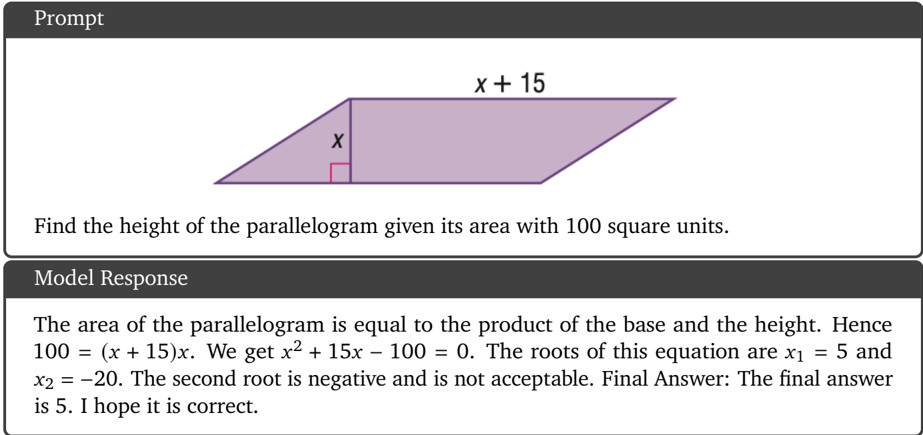
* **Diagram:** A parallelogram is depicted.
* Base: Labeled as "x + 15".
* Height: Labeled as "x".
* Right Angle Symbol: Indicates the height is perpendicular to the base.
* **Problem Statement:** "Find the height of the parallelogram given its area with 100 square units."
* **Model Response:** A textual solution to the problem.
### Detailed Analysis or Content Details
The model response provides the following steps:
1. **Area Formula:** States that the area of a parallelogram is equal to the product of the base and the height.
2. **Equation Setup:** Sets up the equation: 100 = (x + 15)x
3. **Quadratic Equation:** Expands the equation to: x² + 15x - 100 = 0
4. **Roots:** Finds the roots of the quadratic equation: x₁ = 5 and x₂ = -20
5. **Root Selection:** Discards the negative root (-20) as unacceptable for a height.
6. **Final Answer:** States the final answer is 5.
### Key Observations
The problem is a straightforward application of the area formula for a parallelogram, leading to a quadratic equation. The solution correctly identifies and discards the negative root, recognizing that height cannot be negative.
### Interpretation
The problem demonstrates the relationship between the area, base, and height of a parallelogram. The solution process illustrates how to translate a geometric problem into an algebraic equation and solve it. The discarding of the negative root highlights the importance of considering the physical constraints of the problem (height must be positive). The final answer of 5 indicates that the height of the parallelogram is 5 units, and the base is 20 units (5 + 15).