## Mathematical Problem Diagram: Parallelogram Area Calculation
### Overview
The image is a screenshot displaying a two-part mathematical problem and solution. The top section, labeled "Prompt," presents a geometry problem involving a parallelogram. The bottom section, labeled "Model Response," provides a step-by-step algebraic solution to find the height of the parallelogram.
### Components/Axes
The image is divided into two distinct rectangular sections with dark gray headers and white content areas.
**1. Prompt Section (Top):**
* **Header:** A dark gray bar at the top contains the white text "Prompt".
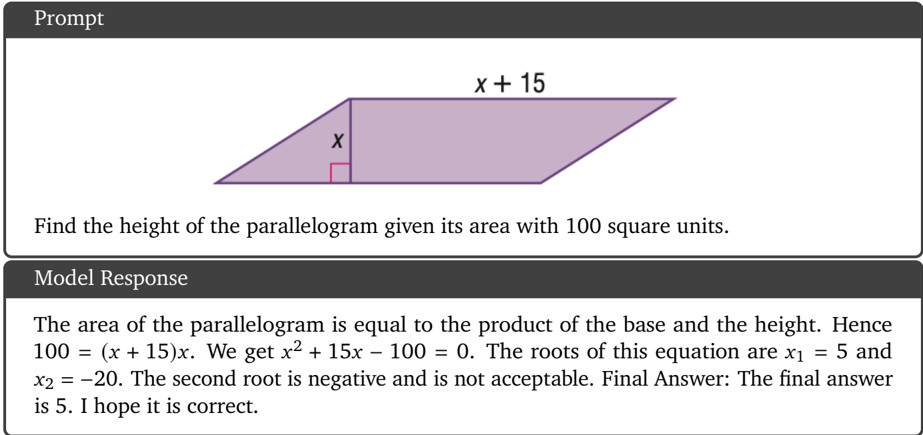
* **Diagram:** A purple parallelogram is drawn in the center. It has:
* A vertical line segment inside, dropping from the top-left vertex to the base, labeled with the variable **`x`**. This represents the height.
* A small red square symbol at the base of this line, indicating a right angle (90 degrees).
* The top side of the parallelogram is labeled with the expression **`x + 15`**. This represents the length of the base.
* **Question Text:** Below the diagram, the following text is written in a serif font: "Find the height of the parallelogram given its area with 100 square units."
**2. Model Response Section (Bottom):**
* **Header:** A dark gray bar contains the white text "Model Response".
* **Solution Text:** The following paragraph is written in a serif font:
"The area of the parallelogram is equal to the product of the base and the height. Hence 100 = (x + 15)x. We get x² + 15x – 100 = 0. The roots of this equation are x₁ = 5 and x₂ = –20. The second root is negative and is not acceptable. Final Answer: The final answer is 5. I hope it is correct."
### Detailed Analysis
The problem and solution are presented as a complete unit.
* **Given Information:**
* Shape: Parallelogram
* Base length: `x + 15` units
* Height: `x` units
* Area: 100 square units
* **Mathematical Process (from Model Response):**
1. **Formula:** Area = base × height
2. **Equation Setup:** `100 = (x + 15) * x`
3. **Quadratic Equation:** `x² + 15x - 100 = 0`
4. **Solution:** The quadratic formula or factoring yields two roots: `x₁ = 5` and `x₂ = -20`.
5. **Interpretation:** The negative root (`x = -20`) is rejected because a geometric length (height) cannot be negative.
6. **Final Answer:** The height `x` is **5** units.
### Key Observations
* The diagram is a standard geometric representation used to visualize the relationship between the base, height, and area of a parallelogram.
* The solution correctly applies the area formula and solves the resulting quadratic equation.
* The solution includes a critical step of rejecting the extraneous negative root, demonstrating an understanding of the physical constraints of the problem.
* The concluding phrase, "I hope it is correct," suggests the response may be generated by an AI or a student, adding a note of uncertainty not present in the mathematical steps themselves.
### Interpretation
This image captures a common pedagogical interaction: a problem statement followed by a worked solution. The core mathematical content is sound and demonstrates a standard approach to solving for an unknown dimension given an area.
The problem tests the ability to:
1. Translate a geometric scenario into an algebraic equation.
2. Solve a quadratic equation.
3. Apply contextual reasoning to select the valid solution.
The "Model Response" header implies this may be an output from an AI system or a sample answer key. The solution's structure is logical and correct, moving from the general formula to a specific equation, solving it, and interpreting the results. The only non-mathematical element is the final sentence expressing hope, which is irrelevant to the factual correctness of the solution but may indicate the source or context of the response. The image, as a whole, serves as a clear example of solving a basic geometry-algebra word problem.