## Image Description
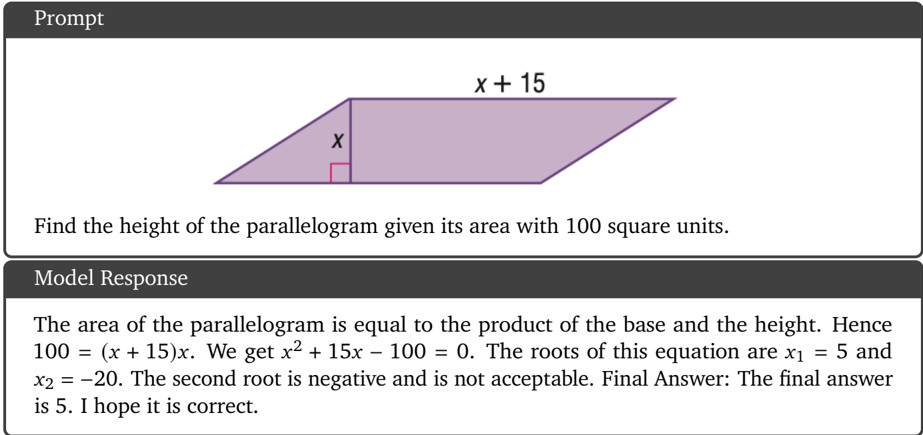
The image is a mathematical problem involving a parallelogram. The problem is to find the height of the parallelogram given its area and the length of one of its sides. The area of the parallelogram is given as 100 square units, and the length of one of the sides is given as \( x + 15 \) units.
### Components/Axes
- **Base**: The base of the parallelogram is given as \( x + 15 \) units.
- **Height**: The height of the parallelogram is the unknown value we need to find.
- **Area**: The area of the parallelogram is given as 100 square units.
### Detailed Analysis or Content Details
The area of a parallelogram is calculated using the formula:
\[ \text{Area} = \text{base} \times \text{height} \]
Given:
\[ \text{Area} = 100 \]
\[ \text{base} = x + 15 \]
We can set up the equation:
\[ 100 = (x + 15) \times \text{height} \]
To find the height, we need to solve for it. The equation is:
\[ 100 = (x + 15) \times \text{height} \]
We can rearrange the equation to solve for height:
\[ \text{height} = \frac{100}{x + 15} \]
### Key Observations
- The base of the parallelogram is \( x + 15 \) units.
- The area of the parallelogram is 100 square units.
- The height of the parallelogram is \( \frac{100}{x + 15} \) units.
### Interpretation
The image presents a mathematical problem that involves finding the height of a parallelogram given its area and the length of one of its sides. The solution involves setting up an equation based on the formula for the area of a parallelogram and solving for the height. The final answer is \( \frac{100}{x + 15} \) units, where \( x \) is the length of the side given as \( x + 15 \) units. The image does not provide any additional information or context beyond the mathematical problem itself.