## Screenshot: Mathematical Problem and Solution
### Overview
The image contains a two-part technical document:
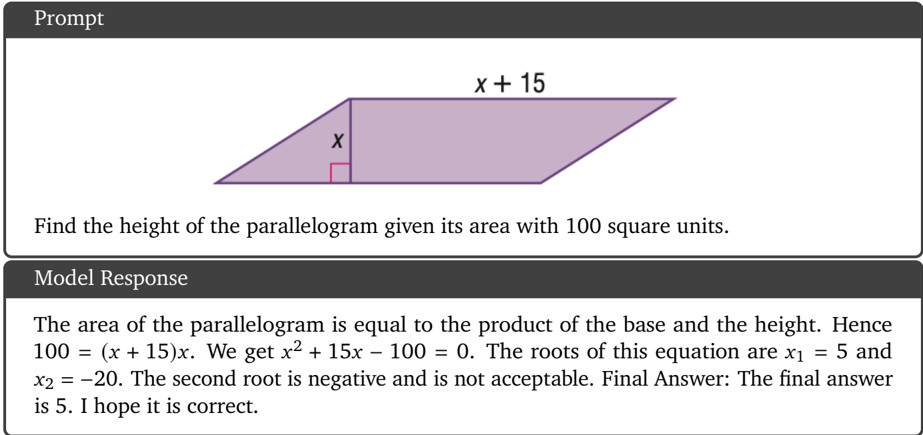
1. **Prompt Section**: A geometric problem involving a parallelogram with labeled dimensions and an area constraint.
2. **Model Response Section**: A step-by-step algebraic solution to the problem.
---
### Components/Axes
#### Prompt Section
- **Diagram Labels**:
- Base of parallelogram: `x + 15` (top edge).
- Height of parallelogram: `x` (vertical dashed line with a right-angle symbol).
- **Textual Content**:
- Problem statement: *"Find the height of the parallelogram given its area with 100 square units."*
#### Model Response Section
- **Textual Content**:
- Explanation of the area formula: *"The area of the parallelogram is equal to the product of the base and the height."*
- Equation setup: `100 = (x + 15)x`.
- Quadratic equation: `x² + 15x - 100 = 0`.
- Roots of the equation: `x₁ = 5` and `x₂ = -20`.
- Final answer: `5` (discarding the negative root).
---
### Detailed Analysis
#### Prompt Section
- The parallelogram diagram visually represents the relationship between the base (`x + 15`) and height (`x`).
- The area constraint (`100` square units) is explicitly stated.
#### Model Response Section
1. **Equation Derivation**:
- The area formula `Area = base × height` is applied:
`100 = (x + 15) × x`.
- Expanded to quadratic form:
`x² + 15x - 100 = 0`.
2. **Root Calculation**:
- Solved using factoring or quadratic formula (not explicitly shown but implied).
- Roots: `x₁ = 5` (valid) and `x₂ = -20` (invalid, as height cannot be negative).
3. **Final Answer**:
- Height = `5` units.
---
### Key Observations
- The problem tests understanding of geometric area formulas and algebraic problem-solving.
- The negative root (`x₂ = -20`) is correctly discarded, emphasizing domain-specific constraints (height > 0).
- The solution assumes integer roots, though the quadratic could have non-integer solutions if the discriminant were not a perfect square.
---
### Interpretation
- **Mathematical Rigor**: The solution demonstrates correct application of the area formula and quadratic solving techniques.
- **Logical Consistency**: The rejection of the negative root aligns with real-world constraints (physical dimensions cannot be negative).
- **Assumptions**: The problem implicitly assumes the height is an integer, which may not always hold in generalized cases.
- **Educational Value**: Highlights the importance of contextual reasoning (e.g., discarding non-physical solutions).
---
**Note**: No numerical trends, charts, or data tables are present. The image focuses on textual problem-solving and algebraic reasoning.