## Diagram: Constrained BFS-tree Transformation
### Overview
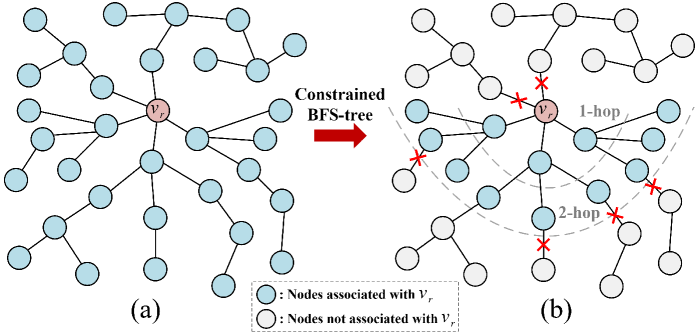
The image illustrates the transformation of a Breadth-First Search (BFS) tree into a constrained BFS-tree. The diagram shows a network of nodes, with a central node labeled "vr". The transformation involves removing certain connections and nodes based on constraints, resulting in a modified network structure.
### Components/Axes
* **Nodes:** Represented by circles.
* Light Blue circles: "Nodes associated with vr"
* White circles: "Nodes not associated with vr"
* Central Node: Labeled "vr", colored light red.
* **Edges:** Represented by black lines, indicating connections between nodes.
* **Red 'X' Marks:** Indicate removed connections.
* **Dashed Gray Arcs:** Indicate 1-hop and 2-hop distances from the central node "vr".
* **Arrow:** A thick red arrow pointing from the left diagram to the right diagram, labeled "Constrained BFS-tree".
* **Labels:**
* (a): Label for the initial BFS-tree diagram (left).
* (b): Label for the constrained BFS-tree diagram (right).
* **Legend:** Located at the bottom-left of the image.
* Light Blue circle with black outline: "Nodes associated with vr"
* White circle with black outline: "Nodes not associated with vr"
### Detailed Analysis or Content Details
**Left Diagram (a): Initial BFS-tree**
* The central node "vr" (light red) is connected to multiple light blue nodes.
* The light blue nodes are further connected to other light blue nodes, forming a tree-like structure.
* All nodes in this initial tree are light blue, indicating they are all associated with "vr".
**Right Diagram (b): Constrained BFS-tree**
* The central node "vr" (light red) remains.
* Some connections from "vr" and between other nodes have been removed, indicated by red 'X' marks.
* Some nodes have changed from light blue to white, indicating they are no longer associated with "vr".
* Dashed gray arcs indicate 1-hop and 2-hop distances from "vr".
* The 1-hop arc shows nodes directly connected to "vr".
* The 2-hop arc shows nodes two connections away from "vr".
* Several white nodes are present in the constrained tree, particularly at the periphery.
### Key Observations
* The transformation from the initial BFS-tree to the constrained BFS-tree involves removing connections and changing the association of some nodes with "vr".
* The constraints appear to be related to hop distance from "vr", as indicated by the 1-hop and 2-hop arcs.
* Nodes that are further away from "vr" are more likely to be disassociated (changed to white).
### Interpretation
The diagram illustrates a process of constraining a BFS-tree, likely for optimization or to meet specific network requirements. The constraints involve removing connections and disassociating nodes from the central node "vr". The hop distance from "vr" seems to play a role in determining which connections and nodes are removed. This suggests that the constrained BFS-tree might be designed to limit the scope or reach of the network originating from "vr", possibly to improve efficiency or reduce interference. The transformation highlights the difference between a standard BFS-tree, which explores all reachable nodes, and a constrained version, which selectively limits the network based on predefined criteria.