\n
## Document: Visual Question Answering (VQA) Example
### Overview
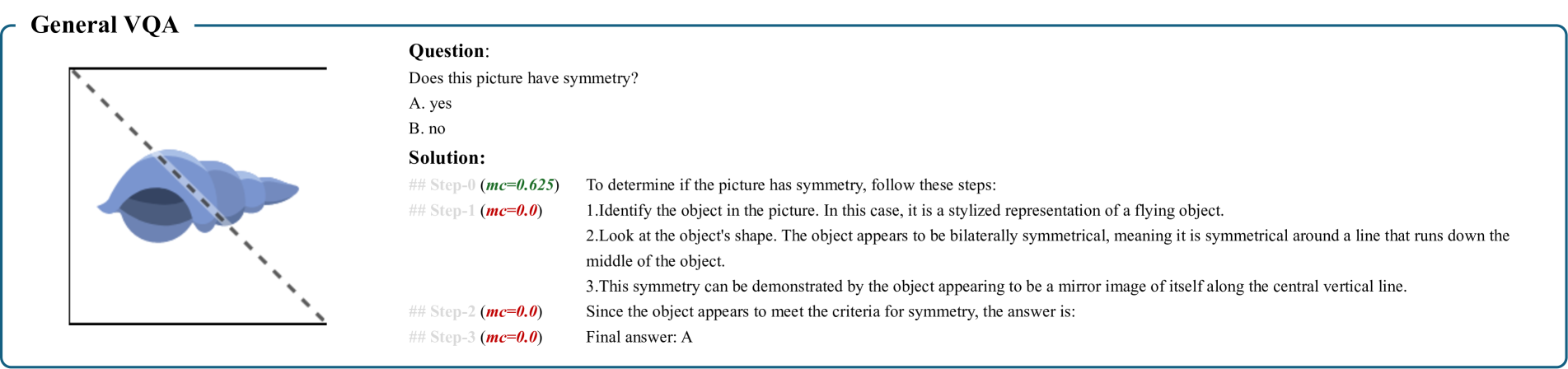
The image presents a document illustrating a Visual Question Answering (VQA) problem. It includes a stylized image of a flying object (appearing as a dashed arrow), a question about the image's symmetry, multiple-choice answers, and a step-by-step solution.
### Components/Axes
The document is structured into three main sections:
1. **Image:** A dashed arrow representing a flying object, positioned on the left side of the document.
2. **Question & Answers:** Located in the center-right, presenting the question "Does this picture have symmetry?" with answer choices A. yes and B. no.
3. **Solution:** Occupying the right side of the document, detailing the steps to determine the answer. The solution is broken down into numbered steps.
### Content Details
The text content is transcribed as follows:
**Header:** General VQA
**Question:**
Does this picture have symmetry?
A. yes
B. no
**Solution:**
To determine if the picture has symmetry, follow these steps:
## Step-1 (mc=0.625)
1. Identify the object in the picture. In this case, it is a stylized representation of a flying object.
2. Look at the object's shape. The object appears to be bilaterally symmetrical, meaning it is symmetrical around a line that runs down the middle of the object.
3. This symmetry can be demonstrated by the object appearing to be a mirror image of itself along the central vertical line.
## Step-2 (mc=0.0)
Since the object appears to meet the criteria for symmetry, the answer is:
## Step-3 (mc=0.0)
Final answer: A
The values `mc=0.625` and `mc=0.0` appear next to "Step-1" and "Step-2" respectively. These likely represent machine confidence scores or similar metrics associated with each step in the solution process.
### Key Observations
The solution explicitly states the object is bilaterally symmetrical. The final answer is "A. yes", indicating the image does possess symmetry. The `mc` values suggest a higher confidence in the first step of the solution compared to the second.
### Interpretation
This document demonstrates a VQA task where a model is presented with an image and a question, and then provides a reasoned solution. The inclusion of confidence scores (`mc`) suggests this is part of a system that evaluates its own reasoning process. The problem is designed to test the model's ability to recognize symmetry in a visual representation. The step-by-step solution provides a clear explanation of the reasoning process, making it easy to understand how the model arrived at the answer. The fact that the confidence score is higher for identifying the object and its symmetry than for concluding the answer suggests that the initial visual analysis is more reliable than the final decision-making step.