## Screenshot: Visual Question Answering (VQA) Task
### Overview
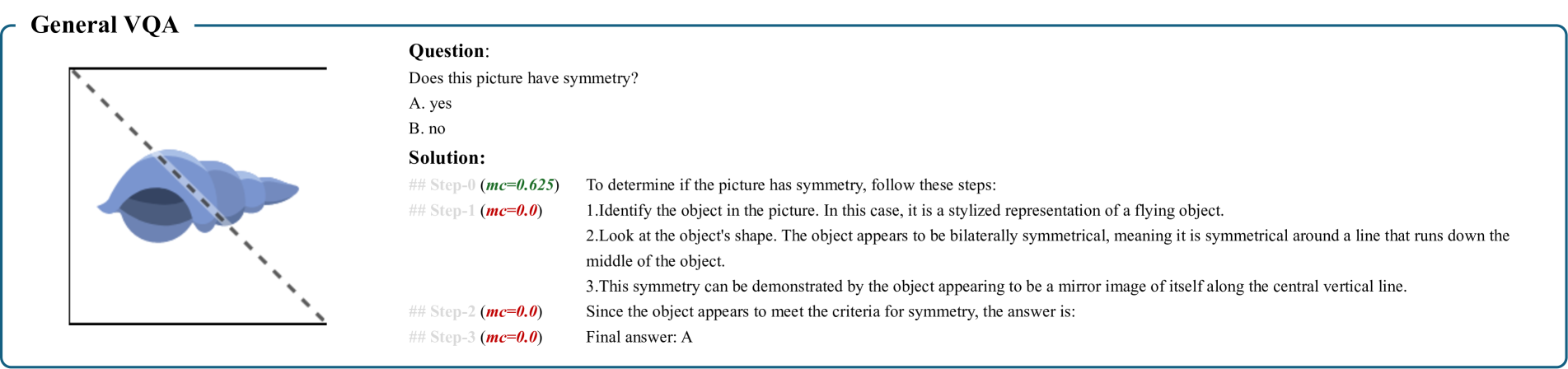
The image depicts a Visual Question Answering (VQA) interface. It includes a stylized blue shell graphic with a dashed diagonal line, a question about symmetry, multiple-choice options, and a step-by-step solution with confidence metrics.
### Components/Axes
- **Header**:
- Text: "General VQA" (top-left corner, blue border).
- **Main Content**:
- **Image**: Stylized blue shell with a dashed diagonal line (top-left quadrant).
- **Question**: "Does this picture have symmetry?"
- **Options**:
- A. yes
- B. no
- **Solution Section**:
- Step-0: `(mc=0.625)` - Instruction to determine symmetry via steps.
- Step-1: `(mc=0.0)` - Identify object (stylized flying object) and check bilateral symmetry.
- Step-2: `(mc=0.0)` - Confirm symmetry via mirror image along central vertical line.
- Step-3: `(mc=0.0)` - Final answer: A (yes).
### Detailed Analysis
- **Image**:
- The shell is positioned in the top-left quadrant, partially overlapping the dashed diagonal line. The line runs from the top-left to bottom-right corner of the image.
- **Question and Options**:
- The question asks about symmetry, with two binary choices (A: yes, B: no).
- **Solution Steps**:
- **Step-0**: High confidence (`mc=0.625`) in the initial instruction to follow symmetry-checking steps.
- **Step-1**: Low confidence (`mc=0.0`) in identifying the object as a stylized flying object and assessing bilateral symmetry.
- **Step-2**: Low confidence (`mc=0.0`) in confirming symmetry via mirroring along the central vertical line.
- **Step-3**: Low confidence (`mc=0.0`) in the final answer (A: yes).
### Key Observations
- The dashed diagonal line may represent a proposed symmetry axis, but the solution emphasizes vertical symmetry.
- Confidence metrics (`mc`) are inconsistent: Step-0 has moderate confidence, while subsequent steps have zero confidence.
- The final answer (A: yes) contradicts the low confidence in later steps, suggesting potential model uncertainty.
### Interpretation
The VQA task demonstrates how an AI model evaluates symmetry in an image. Despite the model’s low confidence in later steps, it concludes symmetry exists (A: yes). This discrepancy highlights potential limitations in the model’s reasoning process, such as over-reliance on initial instructions (Step-0) or misalignment between visual cues (dashed line) and textual reasoning. The dashed line’s diagonal orientation conflicts with the described vertical symmetry axis, indicating possible ambiguity in the task design or model interpretation.