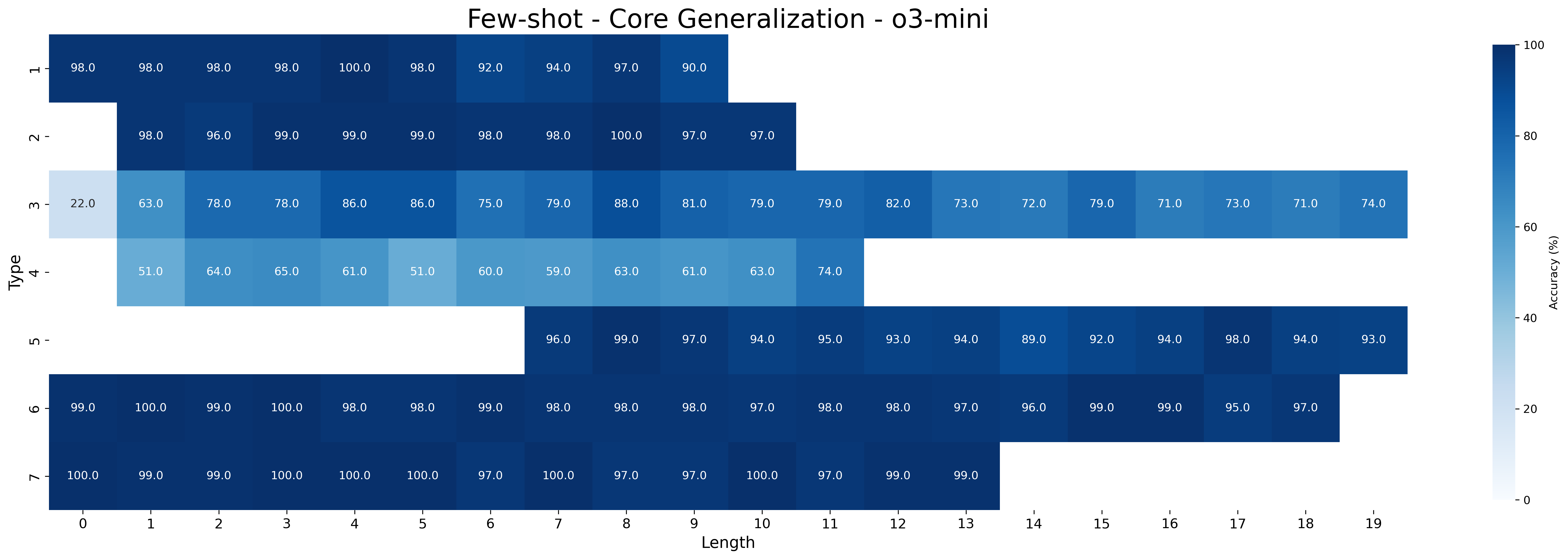
## Heatmap: Few-shot - Core Generalization - o3-mini
### Overview
This image is a heatmap visualizing the accuracy (in percentage) of a model named "o3-mini" on a "Few-shot - Core Generalization" task. The performance is broken down by two categorical variables: "Type" (y-axis) and "Length" (x-axis). The chart uses a blue color gradient to represent accuracy, with darker blue indicating higher accuracy. The data is presented in a grid where each cell contains the exact accuracy value for a specific Type-Length combination.
### Components/Axes
* **Title:** "Few-shot - Core Generalization - o3-mini" (centered at the top).
* **Y-Axis (Vertical):** Labeled "Type". It lists 7 distinct categories, numbered 1 through 7 from top to bottom.
* **X-Axis (Horizontal):** Labeled "Length". It lists 20 discrete values, numbered 0 through 19 from left to right.
* **Legend/Color Bar:** Located on the far right. It is a vertical gradient bar labeled "Accuracy (%)". The scale runs from 0 (lightest blue/white) at the bottom to 100 (darkest blue) at the top, with tick marks at 0, 20, 40, 60, 80, and 100.
* **Data Grid:** The main body of the chart. Each cell corresponds to a unique (Type, Length) pair. The cell's background color corresponds to the accuracy value shown within it, mapped to the color bar. Some cells are empty (white), indicating no data for that combination.
### Detailed Analysis
The following table reconstructs the data from the heatmap. An empty cell is denoted by "N/A".
| Type | Length 0 | Length 1 | Length 2 | Length 3 | Length 4 | Length 5 | Length 6 | Length 7 | Length 8 | Length 9 | Length 10 | Length 11 | Length 12 | Length 13 | Length 14 | Length 15 | Length 16 | Length 17 | Length 18 | Length 19 |
| :--- | :--- | :--- | :--- | :--- | :--- | :--- | :--- | :--- | :--- | :--- | :--- | :--- | :--- | :--- | :--- | :--- | :--- | :--- | :--- | :--- |
| **1** | 98.0 | 98.0 | 98.0 | 98.0 | 100.0 | 98.0 | 92.0 | 94.0 | 97.0 | 90.0 | N/A | N/A | N/A | N/A | N/A | N/A | N/A | N/A | N/A | N/A |
| **2** | N/A | 98.0 | 96.0 | 99.0 | 99.0 | 99.0 | 98.0 | 98.0 | 100.0 | 97.0 | 97.0 | N/A | N/A | N/A | N/A | N/A | N/A | N/A | N/A | N/A |
| **3** | 22.0 | 63.0 | 78.0 | 78.0 | 86.0 | 86.0 | 75.0 | 79.0 | 88.0 | 81.0 | 79.0 | 79.0 | 82.0 | 73.0 | 72.0 | 79.0 | 71.0 | 73.0 | 71.0 | 74.0 |
| **4** | N/A | 51.0 | 64.0 | 65.0 | 61.0 | 51.0 | 60.0 | 59.0 | 63.0 | 61.0 | 63.0 | 74.0 | N/A | N/A | N/A | N/A | N/A | N/A | N/A | N/A |
| **5** | N/A | N/A | N/A | N/A | N/A | N/A | N/A | 96.0 | 99.0 | 97.0 | 94.0 | 95.0 | 93.0 | 94.0 | 89.0 | 92.0 | 94.0 | 98.0 | 94.0 | 93.0 |
| **6** | 99.0 | 100.0 | 99.0 | 100.0 | 98.0 | 98.0 | 99.0 | 98.0 | 98.0 | 98.0 | 97.0 | 98.0 | 98.0 | 97.0 | 96.0 | 99.0 | 99.0 | 95.0 | 97.0 | N/A |
| **7** | 100.0 | 99.0 | 99.0 | 100.0 | 100.0 | 100.0 | 97.0 | 100.0 | 97.0 | 97.0 | 100.0 | 97.0 | 99.0 | 99.0 | N/A | N/A | N/A | N/A | N/A | N/A |
### Key Observations
1. **Performance Tiers:** The data shows distinct performance clusters.
* **High Performers (Types 1, 2, 6, 7):** These types consistently achieve accuracy above 90%, frequently reaching 98-100%. Their performance is stable across the lengths for which data is available.
* **Moderate Performer (Type 4):** Accuracy ranges from 51% to 74%, with no clear upward or downward trend across lengths.
* **Variable Performer (Type 3):** Shows the most dramatic change. It starts very poorly (22% at Length 0) but improves rapidly to the 70-80% range by Length 2 and remains there.
* **Late-Starting High Performer (Type 5):** Data only begins at Length 7, but from that point onward, it performs at a high level (89-99%), similar to the top tier.
2. **Data Sparsity:** The heatmap is not a complete rectangle. Data is missing for:
* Type 1: Lengths 10-19.
* Type 2: Length 0 and Lengths 11-19.
* Type 4: Length 0 and Lengths 12-19.
* Type 5: Lengths 0-6.
* Type 6: Length 19.
* Type 7: Lengths 14-19.
3. **Length Sensitivity:** For the high-performing types (1,2,6,7), accuracy does not appear to degrade significantly as Length increases within their available data range. Type 3 is the only one showing a strong positive correlation between Length and accuracy in the early stages (Lengths 0-2).
### Interpretation
This heatmap likely evaluates how well the "o3-mini" model generalizes to different problem "Types" when given a few examples ("Few-shot"), and how this generalization holds as the problem "Length" (possibly sequence length, number of steps, or complexity) varies.
* **Core Finding:** The model exhibits highly type-dependent performance. It has mastered certain problem types (1,2,6,7) to near-perfect accuracy regardless of length (within tested bounds). Other types (3,4) present a greater challenge.
* **The "Length" Variable:** For most types, increasing length does not harm performance, suggesting robustness. The exception is Type 3, where very short lengths (0,1) are particularly problematic, but the model quickly adapts as length increases. This could indicate that Type 3 problems require a minimum amount of context or steps to be solvable.
* **Missing Data Implications:** The pattern of missing data is not random. It suggests the evaluation was designed with specific length ranges in mind for each type. For example, Type 5 was only tested on longer sequences (Length ≥7), implying it might be a problem category that only manifests or is relevant at greater lengths.
* **Overall Model Capability:** The "o3-mini" model demonstrates strong few-shot core generalization capabilities for a majority of the tested types, maintaining high accuracy across varying lengths. The primary areas for potential improvement are in the specific categories represented by Types 3 and 4.