## Box Plot Charts: 5-gram Repetition Rate and Lexical Diversity by MATH-500 Level
### Overview
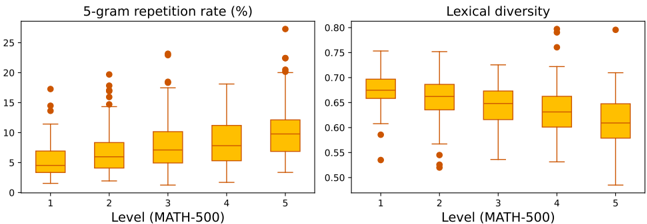
The image displays two side-by-side box plot charts analyzing linguistic properties of text associated with the MATH-500 dataset, categorized by difficulty level (1 through 5). The left chart measures "5-gram repetition rate (%)" and the right chart measures "Lexical diversity." Both charts use the same x-axis, "Level (MATH-500)."
### Components/Axes
**Shared X-Axis:**
* **Label:** `Level (MATH-500)`
* **Categories/Ticks:** `1`, `2`, `3`, `4`, `5` (positioned at the bottom of each chart).
**Left Chart: 5-gram repetition rate (%)**
* **Title:** `5-gram repetition rate (%)` (positioned at the top center of the left chart).
* **Y-Axis Label:** Implicit from title (percentage).
* **Y-Axis Scale:** Linear scale from 0 to 25, with major ticks at `0`, `5`, `10`, `15`, `20`, `25`.
* **Data Representation:** Five yellow box plots with orange whiskers and outlier points.
**Right Chart: Lexical diversity**
* **Title:** `Lexical diversity` (positioned at the top center of the right chart).
* **Y-Axis Label:** Implicit from title (ratio, likely Type-Token Ratio or similar).
* **Y-Axis Scale:** Linear scale from 0.50 to 0.80, with major ticks at `0.50`, `0.55`, `0.60`, `0.65`, `0.70`, `0.75`, `0.80`.
* **Data Representation:** Five yellow box plots with orange whiskers and outlier points.
**Legend/Color Key:**
* There is no separate legend. The color scheme is consistent: yellow boxes represent the interquartile range (IQR), orange lines within boxes represent the median, orange whiskers extend to the most extreme data points not considered outliers, and orange dots represent individual outlier points.
### Detailed Analysis
**Left Chart: 5-gram Repetition Rate (%)**
* **Trend Verification:** The median repetition rate shows a clear upward trend as the MATH-500 level increases. The spread (IQR and range) of the data also generally increases with level.
* **Level 1:** Median ≈ 4%. IQR ≈ 2% to 6%. Whiskers extend from ≈1% to ≈8%. Outliers cluster between ≈13% and ≈17%.
* **Level 2:** Median ≈ 5%. IQR ≈ 4% to 8%. Whiskers extend from ≈2% to ≈14%. A dense cluster of outliers exists between ≈15% and ≈20%.
* **Level 3:** Median ≈ 7%. IQR ≈ 5% to 10%. Whiskers extend from ≈1% to ≈17%. Outliers are present at ≈18% and ≈23%.
* **Level 4:** Median ≈ 8%. IQR ≈ 6% to 11%. Whiskers extend from ≈2% to ≈18%. No distinct outliers are plotted beyond the whiskers.
* **Level 5:** Median ≈ 10%. IQR ≈ 7% to 12%. Whiskers extend from ≈3% to ≈20%. Outliers are present at ≈22% and ≈27%.
**Right Chart: Lexical Diversity**
* **Trend Verification:** The median lexical diversity shows a slight downward trend as the MATH-500 level increases. The spread of the data appears to narrow slightly at higher levels.
* **Level 1:** Median ≈ 0.68. IQR ≈ 0.66 to 0.70. Whiskers extend from ≈0.61 to ≈0.75. Outliers are present at ≈0.54 and ≈0.59.
* **Level 2:** Median ≈ 0.67. IQR ≈ 0.64 to 0.69. Whiskers extend from ≈0.57 to ≈0.75. Outliers are present at ≈0.52 and ≈0.53.
* **Level 3:** Median ≈ 0.65. IQR ≈ 0.62 to 0.68. Whiskers extend from ≈0.54 to ≈0.73. No distinct outliers are plotted.
* **Level 4:** Median ≈ 0.64. IQR ≈ 0.61 to 0.67. Whiskers extend from ≈0.53 to ≈0.71. Outliers are present at ≈0.76 and ≈0.80.
* **Level 5:** Median ≈ 0.62. IQR ≈ 0.58 to 0.65. Whiskers extend from ≈0.49 to ≈0.71. An outlier is present at ≈0.80.
### Key Observations
1. **Inverse Relationship:** There is a clear inverse relationship between the two metrics across difficulty levels. As the MATH-500 level increases, the 5-gram repetition rate increases while lexical diversity decreases.
2. **Increased Variability at Higher Levels (Repetition):** The 5-gram repetition rate shows greater variability (wider IQR and range) at levels 4 and 5 compared to level 1.
3. **Notable Outliers:** Both charts feature significant outliers. The repetition rate has high-value outliers, especially at levels 2 and 5. The lexical diversity chart has both low-value outliers (levels 1, 2) and high-value outliers (levels 4, 5), indicating some texts at each level deviate strongly from the central tendency.
4. **Median Shift:** The median for repetition rate shifts upward by approximately 6 percentage points from level 1 to 5. The median for lexical diversity shifts downward by approximately 0.06 over the same range.
### Interpretation
The data suggests a linguistic shift in the text associated with the MATH-500 dataset as problem difficulty increases. Higher-level (more difficult) problems are associated with text that uses more repeated 5-word phrases and exhibits less varied vocabulary.
This pattern is consistent with the nature of advanced mathematical discourse. Complex problems likely require precise, formulaic language and repeated use of specific technical terminology and constructions, leading to higher repetition and lower lexical diversity. Conversely, text for introductory problems may use more varied, explanatory, and pedagogical language.
The presence of outliers indicates that this trend is not absolute. Some texts at lower levels may already use highly repetitive, technical language (high repetition outliers), while some texts at higher levels manage to maintain high lexical diversity (high diversity outliers). This could reflect differences in writing style, source material, or the specific sub-topics within each difficulty level.
**In summary, the charts provide quantitative evidence that the language describing mathematical problems becomes more formulaic and less lexically diverse as the problems become more difficult, reflecting the specialized and precise nature of advanced mathematical communication.**