## Heatmap: Addition Accuracy by Number of Operands
### Overview
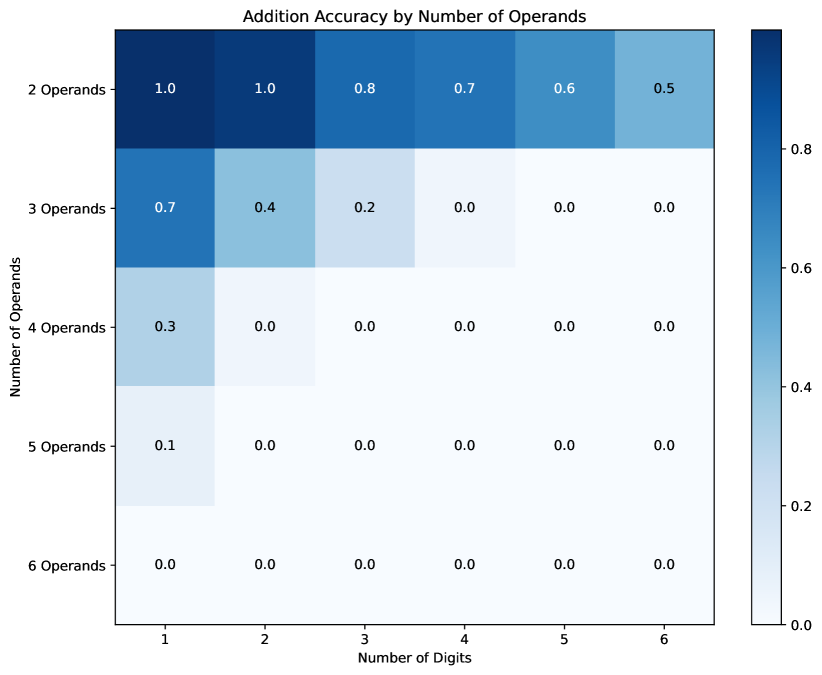
The image is a heatmap visualizing the addition accuracy based on the number of operands and the number of digits. The x-axis represents the number of digits, ranging from 1 to 6. The y-axis represents the number of operands, ranging from 2 to 6. The color intensity represents the accuracy, with darker blue indicating higher accuracy and lighter blue indicating lower accuracy. A colorbar on the right side of the heatmap shows the mapping between color intensity and accuracy values, ranging from 0.0 to 1.0.
### Components/Axes
* **Title:** Addition Accuracy by Number of Operands
* **X-axis:** Number of Digits, with ticks at 1, 2, 3, 4, 5, and 6.
* **Y-axis:** Number of Operands, with labels "2 Operands", "3 Operands", "4 Operands", "5 Operands", and "6 Operands".
* **Colorbar:** Ranges from 0.0 (lightest blue) to 1.0 (darkest blue), with ticks at 0.0, 0.2, 0.4, 0.6, 0.8.
### Detailed Analysis
The heatmap displays accuracy values for each combination of the number of operands and the number of digits.
* **2 Operands:**
* 1 Digit: 1.0
* 2 Digits: 1.0
* 3 Digits: 0.8
* 4 Digits: 0.7
* 5 Digits: 0.6
* 6 Digits: 0.5
* **3 Operands:**
* 1 Digit: 0.7
* 2 Digits: 0.4
* 3 Digits: 0.2
* 4 Digits: 0.0
* 5 Digits: 0.0
* 6 Digits: 0.0
* **4 Operands:**
* 1 Digit: 0.3
* 2 Digits: 0.0
* 3 Digits: 0.0
* 4 Digits: 0.0
* 5 Digits: 0.0
* 6 Digits: 0.0
* **5 Operands:**
* 1 Digit: 0.1
* 2 Digits: 0.0
* 3 Digits: 0.0
* 4 Digits: 0.0
* 5 Digits: 0.0
* 6 Digits: 0.0
* **6 Operands:**
* 1 Digit: 0.0
* 2 Digits: 0.0
* 3 Digits: 0.0
* 4 Digits: 0.0
* 5 Digits: 0.0
* 6 Digits: 0.0
### Key Observations
* Accuracy generally decreases as the number of digits increases for a fixed number of operands.
* Accuracy decreases as the number of operands increases for a fixed number of digits.
* The highest accuracy is achieved with 2 operands and 1 or 2 digits (accuracy = 1.0).
* For 4 or more operands, the accuracy is 0.0 for 2 or more digits.
### Interpretation
The heatmap suggests that addition accuracy is significantly affected by both the number of operands and the number of digits. The model performs best with fewer operands and fewer digits. As the complexity of the addition problem increases (more operands and more digits), the accuracy drops considerably, indicating a potential limitation in the model's ability to handle complex arithmetic operations. The sharp drop in accuracy with more than 3 operands suggests a possible threshold in the model's capacity or a need for more sophisticated training data for complex additions.