## Text Block: Audio Caption Rewriting Instructions
### Overview
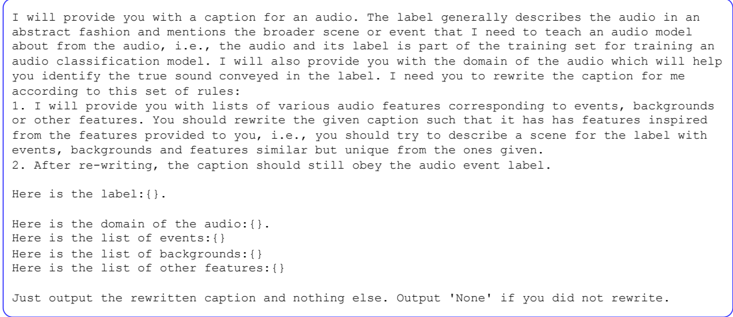
The image contains a structured template for rewriting audio captions to train an audio classification model. It outlines rules for incorporating domain-specific features (events, backgrounds, other features) while preserving the original audio event label.
### Components/Axes
- **Text Structure**:
- **Header**: Instructions for caption rewriting (rules 1 and 2).
- **Placeholders**:
- `{label}`: Abstract audio description (e.g., "birdsong in a forest").
- `{domain}`: Contextual domain (e.g., "outdoor wildlife recording").
- `{events}`, `{backgrounds}`, `{other features}`: Lists of audio features to incorporate.
- **Output Directive**: Rewritten caption or "None" if no changes are made.
### Detailed Analysis
- **Rule 1**:
- Rewrite the caption to include features from the provided lists (events, backgrounds, other features).
- Ensure the rewritten caption is unique but inspired by the given features.
- **Rule 2**:
- The rewritten caption must still align with the original audio event label.
- **Placeholders**:
- All placeholders (`{label}`, `{domain}`, `{events}`, etc.) are empty in the example, indicating they are to be filled dynamically.
### Key Observations
- The template enforces a balance between creativity (Rule 1) and fidelity to the original label (Rule 2).
- Placeholders suggest modularity, allowing adaptation to different audio datasets.
- No numerical data or visual elements (e.g., charts) are present.
### Interpretation
This template is designed for **audio classification model training**, where captions must reflect both the specific audio content (e.g., "dog barking") and broader contextual features (e.g., "urban environment, daytime"). By requiring feature diversity while preserving the label, it ensures the model learns nuanced relationships between audio events and their descriptions. The absence of pre-filled placeholders implies this is a reusable framework, not a static dataset.
**Note**: No charts, diagrams, or numerical data are present in the image. All information is textual and procedural.