## Diagram: AEMA Framework
### Overview
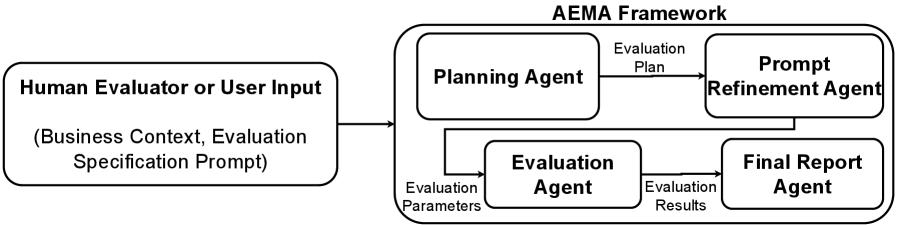
The image is a diagram illustrating the AEMA Framework. It depicts a flow of information and processes between different agents, starting with human input and leading to a final report.
### Components/Axes
* **Title:** AEMA Framework (located at the top-right)
* **Input:** Human Evaluator or User Input (Business Context, Evaluation Specification Prompt) - located on the left.
* **Agents (within the AEMA Framework):**
* Planning Agent (top-left within the framework)
* Prompt Refinement Agent (top-right within the framework)
* Evaluation Agent (bottom-left within the framework)
* Final Report Agent (bottom-right within the framework)
* **Flows:**
* Input to Planning Agent
* Evaluation Plan: Planning Agent to Prompt Refinement Agent
* Evaluation Parameters: Input to Evaluation Agent and from Evaluation Agent back to Planning Agent
* Evaluation Results: Evaluation Agent to Final Report Agent
### Detailed Analysis
* **Human Evaluator or User Input:** This block represents the initial input to the system. It includes the business context, evaluation specification prompt.
* **Planning Agent:** Receives input from the Human Evaluator. Sends an "Evaluation Plan" to the Prompt Refinement Agent. Receives "Evaluation Parameters" from the Evaluation Agent.
* **Prompt Refinement Agent:** Receives the "Evaluation Plan" from the Planning Agent.
* **Evaluation Agent:** Receives input from the Human Evaluator in the form of "Evaluation Parameters". Sends "Evaluation Results" to the Final Report Agent. Sends "Evaluation Parameters" back to the Planning Agent.
* **Final Report Agent:** Receives "Evaluation Results" from the Evaluation Agent.
### Key Observations
* The diagram illustrates a cyclical process, with the Evaluation Agent providing feedback ("Evaluation Parameters") to the Planning Agent.
* The Human Evaluator provides direct input to both the Planning Agent and the Evaluation Agent.
* The AEMA Framework encapsulates the Planning Agent, Prompt Refinement Agent, Evaluation Agent, and Final Report Agent.
### Interpretation
The AEMA Framework diagram outlines a system for automated evaluation and reporting. The process begins with human input, which is used by the Planning Agent to create an evaluation plan. This plan is refined by the Prompt Refinement Agent. The Evaluation Agent then uses the evaluation parameters (also derived from the initial human input) to generate evaluation results, which are sent to the Final Report Agent. A feedback loop exists where the Evaluation Agent sends evaluation parameters back to the Planning Agent, suggesting an iterative refinement process. The framework appears designed to automate and streamline the evaluation process, leveraging both human input and automated agents.