\n
## Diagram: AEMA Framework
### Overview
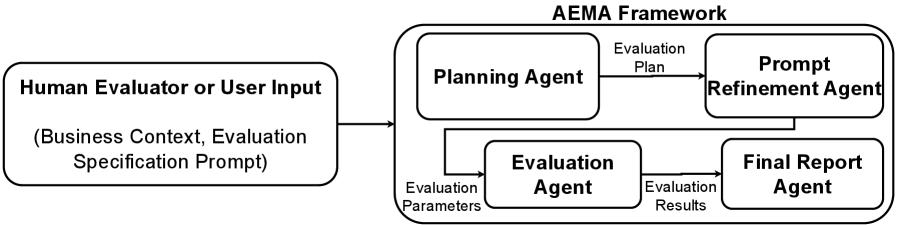
The image depicts a block diagram illustrating the AEMA (likely Automated Evaluation and Model Assessment) Framework. It shows the interaction between a "Human Evaluator or User Input" and four internal agents within the framework: Planning Agent, Prompt Refinement Agent, Evaluation Agent, and Final Report Agent. The diagram emphasizes the flow of information and control between these components.
### Components/Axes
The diagram consists of the following components:
* **Human Evaluator or User Input:** An oval shape on the left side, providing input to the framework.
* **AEMA Framework:** A rectangular box encompassing the four internal agents.
* **Planning Agent:** A rectangular box within the AEMA Framework.
* **Prompt Refinement Agent:** A rectangular box within the AEMA Framework.
* **Evaluation Agent:** A rectangular box within the AEMA Framework.
* **Final Report Agent:** A rectangular box within the AEMA Framework.
* **Arrows:** Indicate the flow of information and control between the components.
* **Text Labels:** Accompanying each component, describing its function or the data it processes.
The diagram does not have traditional axes or scales. Instead, it uses spatial arrangement and arrows to convey relationships.
### Detailed Analysis or Content Details
The diagram illustrates the following flow:
1. **Input:** The "Human Evaluator or User Input" provides "(Business Context, Evaluation Specification Prompt)" to the AEMA Framework.
2. **Planning:** The Planning Agent receives the input and generates an "Evaluation Plan," which is then sent to the Prompt Refinement Agent.
3. **Prompt Refinement:** The Prompt Refinement Agent receives the "Evaluation Plan" from the Planning Agent.
4. **Evaluation Parameters:** The Planning Agent also sends "Evaluation Parameters" to the Evaluation Agent.
5. **Evaluation:** The Evaluation Agent receives both "Evaluation Parameters" and input from the "Human Evaluator or User Input".
6. **Evaluation Results:** The Evaluation Agent generates "Evaluation Results" and sends them to the Final Report Agent.
7. **Final Report:** The Final Report Agent receives "Evaluation Results" and produces a final report.
The diagram does not contain numerical data. It is a conceptual representation of a process.
### Key Observations
The diagram highlights a cyclical process where human input initiates a series of automated steps (planning, prompt refinement, evaluation) culminating in a final report. The Planning Agent appears to be central, coordinating both the prompt refinement and evaluation processes. The diagram suggests a modular design, with each agent performing a specific task.
### Interpretation
The AEMA Framework diagram illustrates a system designed to automate the evaluation of models or systems. The framework aims to leverage human expertise (through the initial input) while streamlining the evaluation process through automated agents. The separation of concerns into distinct agents (Planning, Prompt Refinement, Evaluation, Reporting) suggests a focus on maintainability and scalability. The flow of information indicates a structured approach to evaluation, starting with defining the evaluation criteria (Planning Agent), refining the prompts used for evaluation (Prompt Refinement Agent), conducting the evaluation (Evaluation Agent), and summarizing the results (Final Report Agent). The diagram implies that the framework is intended to provide a more objective and consistent evaluation process compared to purely manual evaluation. The diagram does not provide details on the specific algorithms or techniques used within each agent, but it outlines the overall architecture and data flow.