## Flowchart: AEMA Framework
### Overview
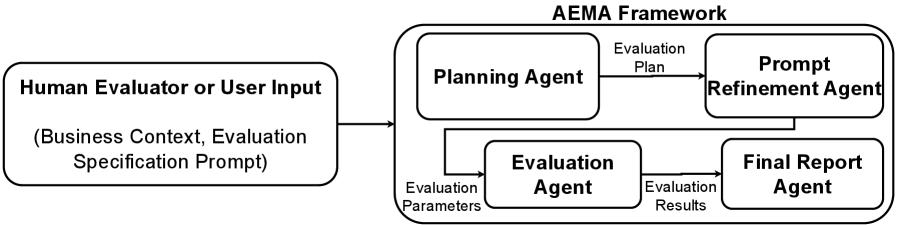
The image depicts a technical workflow diagram titled "AEMA Framework," illustrating the interaction between human input and automated agents in an evaluation process. The diagram uses rectangular boxes to represent components and arrows to denote data flow.
### Components/Axes
- **Key Components**:
1. **Human Evaluator or User Input** (leftmost box, with subtitle: *"(Business Context, Evaluation Specification Prompt)"*).
2. **Planning Agent** (central-top box).
3. **Prompt Refinement Agent** (top-right box).
4. **Evaluation Agent** (bottom-center box).
5. **Final Report Agent** (bottom-right box).
- **Arrows/Labels**:
- **Evaluation Plan**: Arrow from *Planning Agent* to *Prompt Refinement Agent*.
- **Evaluation Parameters**: Arrow from *Evaluation Agent* to *Planning Agent* (feedback loop).
- **Evaluation Results**: Arrow from *Evaluation Agent* to *Final Report Agent*.
### Detailed Analysis
- **Flow Direction**:
1. Input from the *Human Evaluator or User Input* (left) feeds into the *Planning Agent*.
2. The *Planning Agent* generates an **Evaluation Plan**, which is sent to the *Prompt Refinement Agent*.
3. The *Evaluation Agent* processes **Evaluation Parameters** (feedback from the *Planning Agent*) and produces **Evaluation Results**.
4. The *Final Report Agent* receives **Evaluation Results** to generate a final output.
5. A feedback loop exists where **Evaluation Parameters** are sent back to the *Planning Agent* for iterative refinement.
### Key Observations
- The diagram emphasizes **iterative refinement** through the feedback loop between the *Evaluation Agent* and *Planning Agent*.
- The *Prompt Refinement Agent* acts as an intermediary between planning and evaluation stages.
- No numerical data or trends are present; the focus is on process flow and component interactions.
### Interpretation
The AEMA Framework outlines a structured, cyclical process for evaluation tasks:
1. **Input**: Human/user input defines the business context and evaluation criteria.
2. **Planning**: The *Planning Agent* designs an evaluation strategy.
3. **Refinement**: The *Prompt Refinement Agent* adjusts prompts based on the plan.
4. **Execution**: The *Evaluation Agent* runs the evaluation using parameters from the planning stage.
5. **Output**: Results are compiled into a final report.
6. **Feedback**: Parameters are refined iteratively to improve future evaluations.
This framework highlights automation in evaluation workflows, with human input and agent collaboration ensuring adaptability and precision. The absence of numerical data suggests the diagram is conceptual, focusing on process design rather than quantitative analysis.