## Conceptual Diagram: Nested Ecosystems and Interactions
### Overview
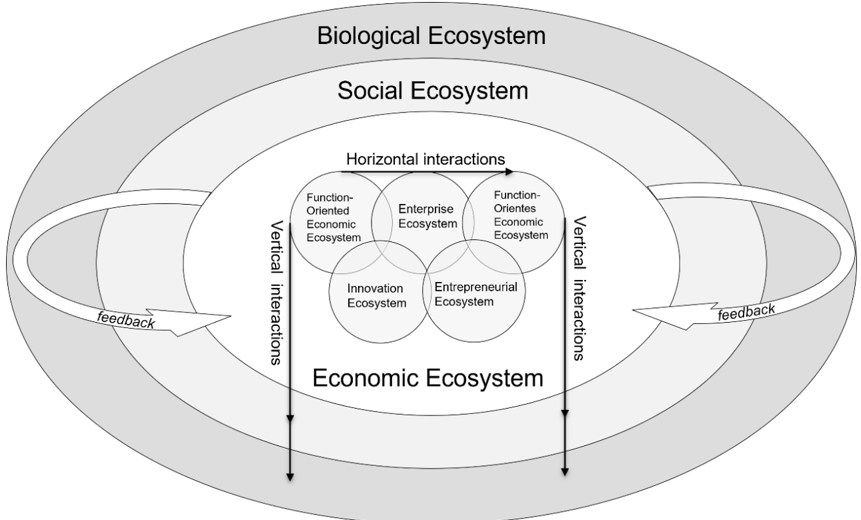
The image is a black-and-white conceptual diagram illustrating a hierarchical and interconnected model of ecosystems. It depicts three major nested systems (Biological, Social, Economic) and details the internal structure and interaction dynamics within the innermost Economic Ecosystem. The diagram emphasizes both vertical and horizontal interactions and includes feedback loops between the systems.
### Components/Axes
The diagram is composed of nested ovals and internal circles, with text labels and directional arrows.
**1. Nested Ovals (from outermost to innermost):**
* **Outermost Oval:** Labeled "Biological Ecosystem" at the top center. This is the largest, encompassing all other elements.
* **Middle Oval:** Labeled "Social Ecosystem" at the top center, positioned inside the Biological Ecosystem.
* **Innermost Oval:** Labeled "Economic Ecosystem" at the bottom center, positioned inside the Social Ecosystem.
**2. Internal Circles (within the Economic Ecosystem):**
Five overlapping circles are arranged in a cluster in the center of the Economic Ecosystem oval.
* **Top-Left Circle:** Labeled "Function-Oriented Economic Ecosystem".
* **Top-Center Circle:** Labeled "Enterprise Ecosystem".
* **Top-Right Circle:** Labeled "Function-Oriented Economic Ecosystem" (identical label to the top-left circle).
* **Bottom-Left Circle:** Labeled "Innovation Ecosystem".
* **Bottom-Right Circle:** Labeled "Entrepreneurial Ecosystem".
**3. Interaction Arrows and Labels:**
* **Horizontal Interactions:** A horizontal, double-headed arrow spans the top of the three upper circles (Function-Oriented, Enterprise, Function-Oriented). It is labeled "Horizontal interactions" above the arrow.
* **Vertical Interactions (Left):** A vertical, double-headed arrow runs along the left side of the inner circle cluster, connecting the "Function-Oriented Economic Ecosystem" (top-left) and "Innovation Ecosystem" (bottom-left). It is labeled "Vertical interactions" to its left.
* **Vertical Interactions (Right):** A vertical, double-headed arrow runs along the right side of the inner circle cluster, connecting the "Function-Oriented Economic Ecosystem" (top-right) and "Entrepreneurial Ecosystem" (bottom-right). It is labeled "Vertical interactions" to its right.
* **Feedback Loops:** Two large, curved arrows originate from the outer edge of the Social Ecosystem oval and point inward toward the Economic Ecosystem.
* **Left Feedback Arrow:** Curves from the left side of the Social Ecosystem into the left side of the Economic Ecosystem. It is labeled "feedback" along its curve.
* **Right Feedback Arrow:** Curves from the right side of the Social Ecosystem into the right side of the Economic Ecosystem. It is labeled "feedback" along its curve.
### Detailed Analysis
The diagram presents a systems-thinking model where broader ecosystems contain and influence more specific ones.
* **Hierarchy:** The structure is strictly hierarchical: Biological > Social > Economic. This suggests the Economic Ecosystem is a subset of the Social Ecosystem, which itself exists within the broader context of the Biological Ecosystem.
* **Economic Ecosystem Composition:** The Economic Ecosystem is not monolithic but is composed of five interconnected sub-systems. The overlapping circles indicate these sub-systems are not isolated; they share functions, resources, or participants. The duplication of the "Function-Oriented Economic Ecosystem" label on both the left and right suggests it may represent a common or bridging function.
* **Interaction Dynamics:**
* **Horizontal:** The "Horizontal interactions" arrow indicates communication, collaboration, or competition between the three upper-tier economic sub-systems (Function-Oriented, Enterprise, Function-Oriented).
* **Vertical:** The "Vertical interactions" arrows indicate a two-way flow or relationship between the upper-tier (Function-Oriented) and lower-tier (Innovation, Entrepreneurial) sub-systems on each side.
* **Feedback:** The "feedback" arrows are critical. They show that the Social Ecosystem provides input or responses back into the Economic Ecosystem, creating a closed-loop system where the economic activities influence the social context, which in turn feeds back to shape the economy.
### Key Observations
1. **Encapsulation:** Each system is fully contained within the next, implying dependency. The Economic Ecosystem cannot exist independently of the Social and Biological contexts.
2. **Symmetry and Repetition:** The diagram is largely symmetrical, with mirrored vertical interactions and feedback loops. The repetition of the "Function-Oriented Economic Ecosystem" label is a notable design choice, emphasizing its dual role or presence.
3. **Central Focus:** Despite the nested structure, the visual and conceptual focus is on the complex interactions *within* the Economic Ecosystem, highlighted by the detailed circle cluster and interaction arrows.
4. **Directionality:** All interaction arrows are double-headed, emphasizing reciprocal relationships rather than one-way causation.
### Interpretation
This diagram models a complex adaptive system where economic activity is deeply embedded in and influenced by social and biological realities.
* **What it Suggests:** It argues against viewing the economy in isolation. Economic functions, enterprises, innovation, and entrepreneurship are interdependent processes that operate within a social framework (governed by norms, laws, culture) which itself exists within the physical constraints and resources of the biological world.
* **Relationships:** The "feedback" loops are the most significant relational element. They imply that economic outputs (products, services, pollution, wealth distribution) alter the social ecosystem, and these social changes then create new conditions, demands, or constraints for the economy. This is a model of continuous adaptation.
* **Notable Implications:** The model has implications for policy and analysis. For example, to foster an "Innovation Ecosystem," one must consider not only the "Enterprise Ecosystem" (horizontal interaction) but also the "Function-Oriented" support systems (vertical interaction) and the broader social feedback (e.g., public acceptance, educational output). An anomaly or shock in the Biological Ecosystem (e.g., climate change, resource depletion) would propagate inward, ultimately affecting all economic sub-systems. The diagram is a visual argument for holistic, interdisciplinary approaches to economic and social planning.