\n
## Diagram: Nested Ecosystems
### Overview
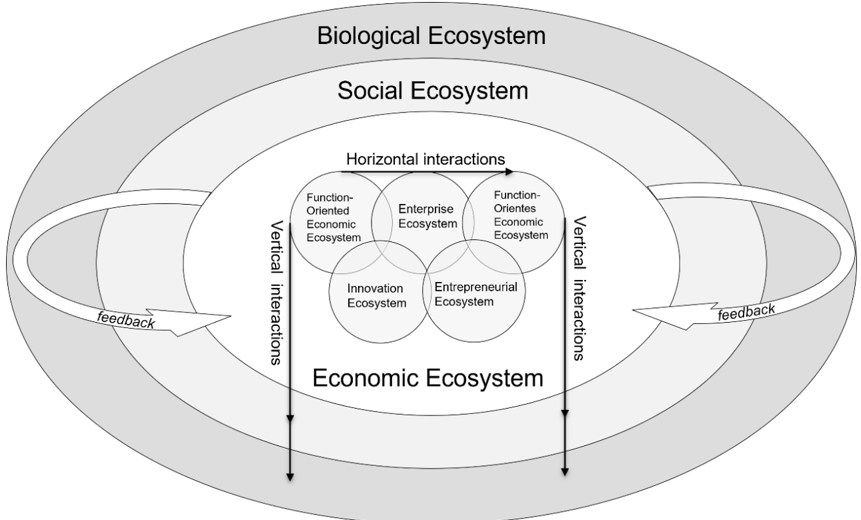
The image is a diagram illustrating a nested ecosystem model. It depicts four interconnected ecosystems – Biological, Social, Economic, and various types within the Economic ecosystem – arranged in concentric, overlapping shapes. The diagram emphasizes both horizontal and vertical interactions between these ecosystems, with feedback loops indicated by curved arrows.
### Components/Axes
The diagram consists of the following labeled components:
* **Biological Ecosystem:** The outermost, largest, and lightest gray oval.
* **Social Ecosystem:** A medium-sized, medium gray oval nested within the Biological Ecosystem.
* **Economic Ecosystem:** The innermost, darkest gray oval, nested within the Social Ecosystem.
* **Horizontal Interactions:** Label positioned centrally within the Social Ecosystem, pointing to the four sub-ecosystems within the Economic Ecosystem.
* **Vertical Interactions:** Labels positioned on the left and right sides of the diagram, with arrows indicating flow between the ecosystems.
* **Feedback:** Labels positioned on the top-left and top-right of the diagram, with curved arrows indicating cyclical processes.
* **Sub-Ecosystems within Economic Ecosystem:**
* Function-Oriented Economic Ecosystem
* Enterprise Ecosystem
* Function-Oriented Economic Ecosystem (appears twice)
* Innovation Ecosystem
* Entrepreneurial Ecosystem
### Detailed Analysis / Content Details
The diagram shows a hierarchical relationship between the ecosystems. The Biological Ecosystem encompasses the Social Ecosystem, which in turn encompasses the Economic Ecosystem. The Economic Ecosystem is further divided into five sub-ecosystems, arranged in a circular pattern.
* **Biological Ecosystem:** This is the broadest system, providing the foundation for the others.
* **Social Ecosystem:** This system operates within the constraints of the biological environment and influences the economic system.
* **Economic Ecosystem:** This is the most focused system, operating within the social and biological contexts.
* **Horizontal Interactions:** These interactions occur *within* the Economic Ecosystem, between its constituent sub-ecosystems.
* **Vertical Interactions:** These interactions occur *between* the different levels of ecosystems (Biological, Social, Economic). The arrows indicate a two-way flow of influence.
* **Feedback:** The feedback loops suggest that the outcomes of interactions at one level can influence the conditions at other levels.
The sub-ecosystems within the Economic Ecosystem are arranged roughly equally spaced around the center. The two "Function-Oriented Economic Ecosystem" labels are positioned on opposite sides of the central circle.
### Key Observations
The diagram emphasizes the interconnectedness and interdependence of different ecosystems. The nested structure suggests that each ecosystem is embedded within and influenced by the larger systems surrounding it. The presence of feedback loops indicates a dynamic and self-regulating system. The repetition of "Function-Oriented Economic Ecosystem" might indicate its importance or a specific focus within the model.
### Interpretation
This diagram presents a systems thinking approach to understanding the relationships between biological, social, and economic factors. It suggests that economic activity is not isolated but is deeply embedded within broader social and biological contexts. The model highlights the importance of considering the interactions and feedback loops between these different levels when analyzing complex systems. The emphasis on horizontal interactions within the economic ecosystem suggests that different types of economic activity (e.g., enterprise, innovation) are interconnected and influence each other.
The diagram is a conceptual model rather than a quantitative representation. It does not provide specific data or measurements, but rather a framework for understanding the relationships between different systems. The model could be used to analyze the impact of economic policies on social and biological systems, or to identify opportunities for creating more sustainable and resilient ecosystems. The model's strength lies in its holistic perspective, which encourages a broader understanding of complex phenomena.