## Diagram: Ecosystem Interactions Model
### Overview
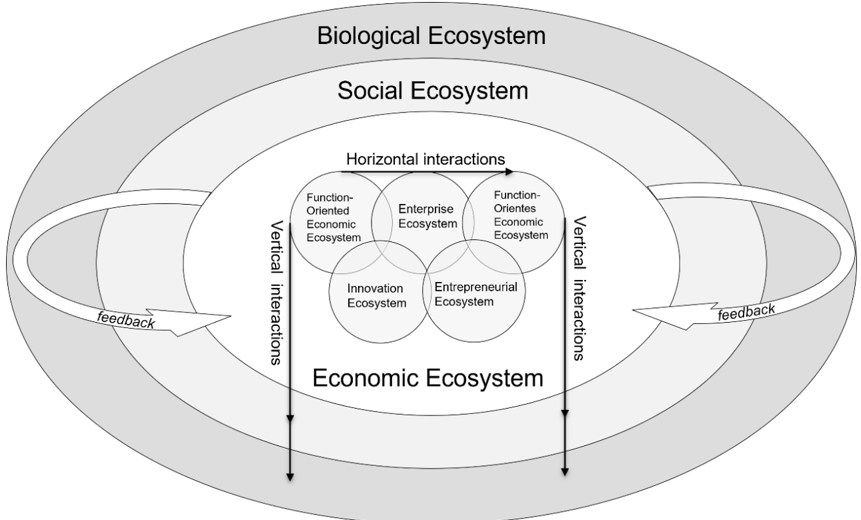
The diagram illustrates a layered ecosystem model with three concentric ovals representing the **Biological Ecosystem**, **Social Ecosystem**, and **Economic Ecosystem**. Arrows indicate **horizontal interactions** (within layers) and **vertical interactions** (between layers), with **feedback loops** connecting the layers. The Social Ecosystem contains four overlapping sub-ecosystems, while the Economic Ecosystem is nested within the Social Ecosystem.
---
### Components/Axes
1. **Main Layers**:
- **Biological Ecosystem**: Outermost layer (light gray).
- **Social Ecosystem**: Middle layer (medium gray).
- **Economic Ecosystem**: Innermost layer (white).
2. **Sub-Ecosystems within Social Ecosystem**:
- **Function-Oriented Economic Ecosystem** (appears twice, overlapping).
- **Enterprise Ecosystem**.
- **Innovation Ecosystem**.
- **Entrepreneurial Ecosystem**.
3. **Interactions**:
- **Horizontal Interactions**: Arrows between sub-ecosystems within the Social Ecosystem.
- **Vertical Interactions**: Arrows connecting the Social Ecosystem to the Economic Ecosystem.
- **Feedback Loops**: Curved arrows connecting the Economic Ecosystem to the Social Ecosystem and then to the Biological Ecosystem.
---
### Detailed Analysis
- **Sub-Ecosystem Overlaps**: The four sub-ecosystems within the Social Ecosystem overlap, suggesting interdependencies. The duplication of "Function-Oriented Economic Ecosystem" may indicate a focus on its dual role or a labeling error.
- **Feedback Mechanisms**: Feedback loops flow from the Economic Ecosystem → Social Ecosystem → Biological Ecosystem, implying cyclical influence (e.g., economic activity shapes social structures, which in turn affect biological systems).
- **Layered Hierarchy**: The Economic Ecosystem is nested within the Social Ecosystem, which is nested within the Biological Ecosystem, reflecting a top-down dependency.
---
### Key Observations
1. **Redundant Labeling**: The "Function-Oriented Economic Ecosystem" appears twice in the Social Ecosystem, which may suggest a mislabeling or intentional emphasis on its role.
2. **Bidirectional Feedback**: Feedback loops are not unidirectional; they create a closed system where changes in one layer propagate to others.
3. **Central Role of Economic Ecosystem**: The Economic Ecosystem acts as a mediator between the Social and Biological layers, highlighting its systemic importance.
---
### Interpretation
This model emphasizes the interconnectedness of ecological, social, and economic systems. The feedback loops suggest that economic activities (e.g., innovation, entrepreneurship) influence social structures, which in turn impact biological systems (e.g., resource use, pollution). The overlapping sub-ecosystems within the Social layer imply that economic functions (e.g., enterprise, innovation) are not isolated but interdependent. The model could be used to analyze sustainability challenges, where disruptions in one layer (e.g., economic inequality) ripple across others (e.g., social cohesion, environmental health). The duplication of "Function-Oriented Economic Ecosystem" warrants clarification but may reflect a focus on its dual role in both economic and social contexts.