## Prompt: Solution Generation During Dataset Compilation
### Overview
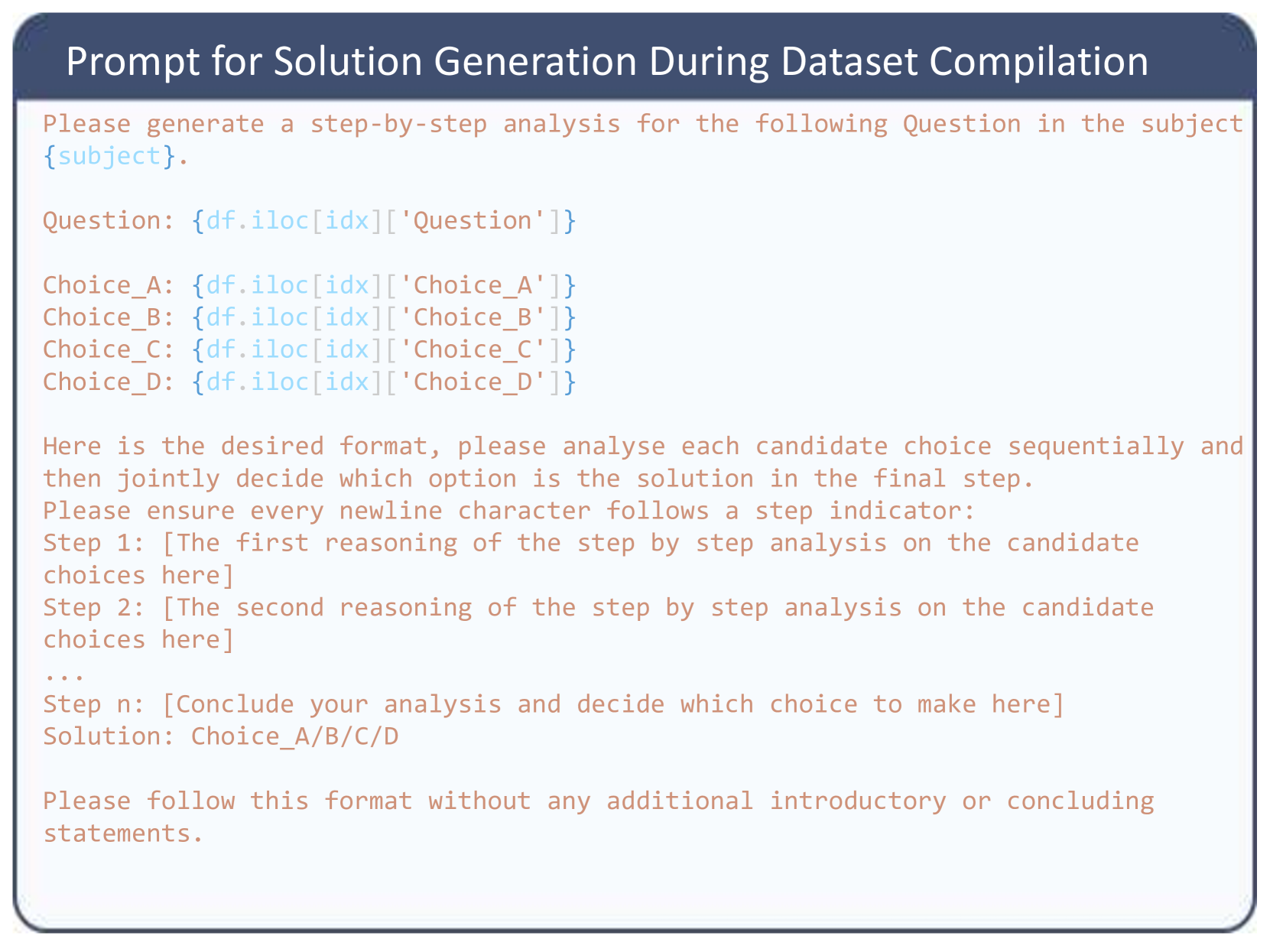
The image presents a prompt designed for generating step-by-step solutions during dataset compilation. It outlines the desired format for analyzing a question and its multiple-choice answers, emphasizing a sequential analysis of each choice followed by a joint decision on the final solution.
### Components/Axes
* **Title:** Prompt for Solution Generation During Dataset Compilation
* **Prompt Instructions:**
* Generate a step-by-step analysis for a given question in a specified subject.
* Question: {df.iloc[idx]['Question']}
* Choice_A: {df.iloc[idx]['Choice_A']}
* Choice_B: {df.iloc[idx]['Choice_B']}
* Choice_C: {df.iloc[idx]['Choice_C']}
* Choice_D: {df.iloc[idx]['Choice_D']}
* Analyze each candidate choice sequentially.
* Decide which option is the solution in the final step.
* Ensure every newline character follows a step indicator.
* Step 1: [The first reasoning of the step by step analysis on the candidate choices here]
* Step 2: [The second reasoning of the step by step analysis on the candidate choices here]
* ...
* Step n: [Conclude your analysis and decide which choice to make here]
* Solution: Choice_A/B/C/D
* Follow the format without any additional introductory or concluding statements.
### Detailed Analysis or ### Content Details
The prompt provides a template for generating solutions. It uses placeholders like `{subject}`, `{df.iloc[idx]['Question']}`, `{df.iloc[idx]['Choice_A']}`, etc., indicating that these values will be dynamically populated from a dataframe (`df`) using the index `idx`. The core of the prompt is the step-by-step analysis, where each step provides reasoning for evaluating the candidate choices. The final step requires a conclusion and a decision on the correct choice (A, B, C, or D).
### Key Observations
* The prompt is designed for automated solution generation, likely within a data processing pipeline.
* The use of placeholders suggests integration with a data source (dataframe).
* The emphasis on step-by-step reasoning aims to provide explainability for the generated solutions.
* The prompt enforces a specific format to maintain consistency in the generated solutions.
### Interpretation
The prompt serves as a blueprint for creating a solution generation system. It aims to automate the process of answering multiple-choice questions by providing a structured approach to analyzing each choice and arriving at a final decision. The step-by-step reasoning component is crucial for understanding the logic behind the generated solutions, making the system more transparent and reliable. The prompt's design suggests a focus on data-driven decision-making, where the answers are derived from information stored in a dataframe.