\n
## Text Block: Prompt for Solution Generation During Dataset Compilation
### Overview
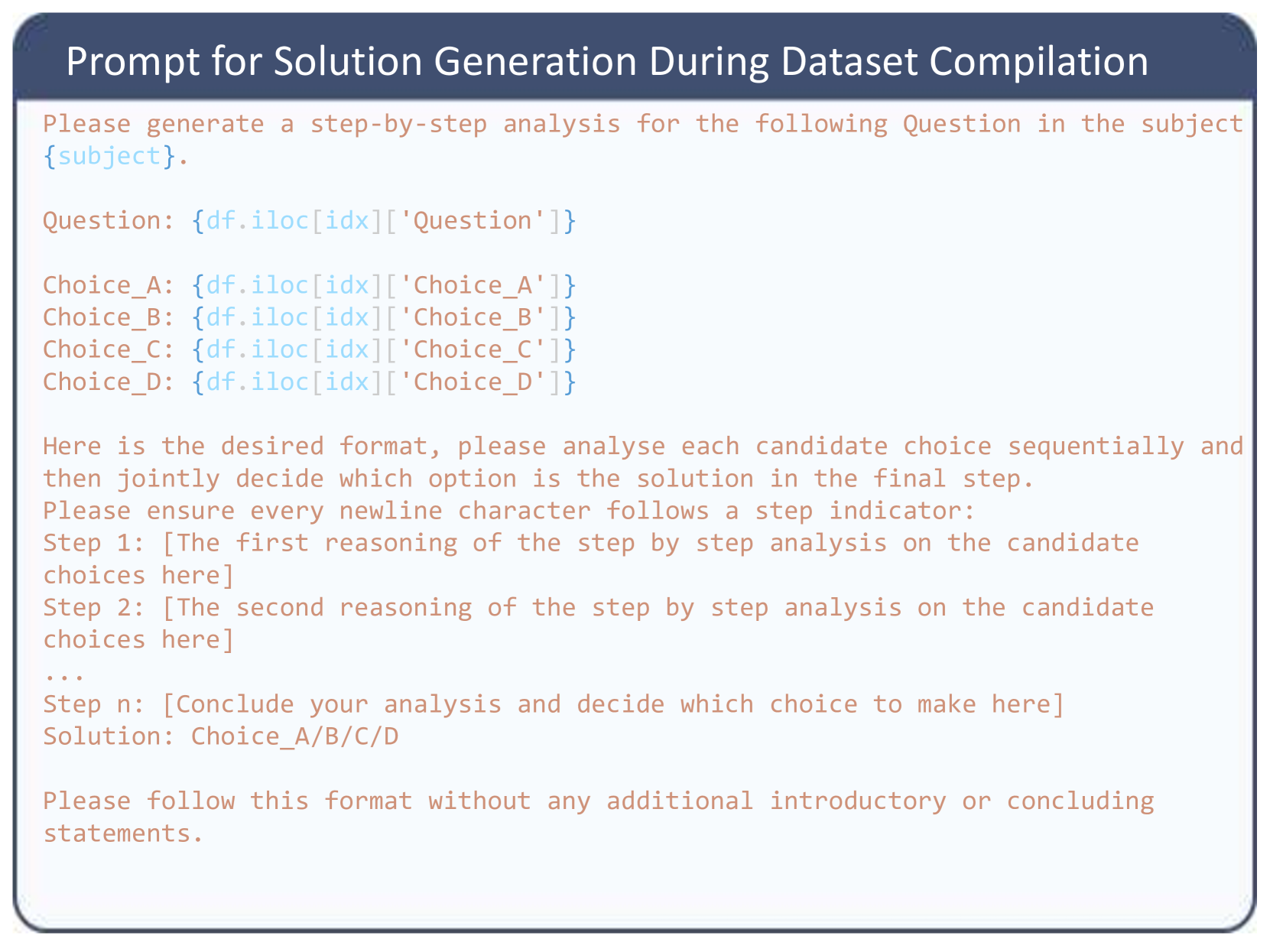
The image contains a text block outlining a prompt for generating step-by-step solutions for questions during dataset compilation. It details the expected input format (question and choices) and the desired output format (sequential analysis of each choice leading to a final solution).
### Content Details
The text block can be transcribed as follows:
"Prompt for Solution Generation During Dataset Compilation
Please generate a step-by-step analysis for the following Question in the subject {subject}.
Question: {df.iloc[idx]['Question']}
Choice_A: {df.iloc[idx]['Choice_A']}
Choice_B: {df.iloc[idx]['Choice_B']}
Choice_C: {df.iloc[idx]['Choice_C']}
Choice_D: {df.iloc[idx]['Choice_D']}
Here is the desired format, please analyse each candidate choice sequentially and then jointly decide which option is the solution in the final step.
Please ensure every newline character follows a step indicator:
Step 1: [The first reasoning of the step by step analysis on the candidate choices here]
Step 2: [The second reasoning of the step by step analysis on the candidate choices here]
...
Step n: [Conclude your analysis and decide which choice to make here]
Solution: Choice_A/B/C/D
Please follow this format without any additional introductory or concluding statements."
### Key Observations
The text uses placeholders like `{subject}`, `{df.iloc[idx]['Question']}`, and `{df.iloc[idx]['Choice_A']}` indicating that this is a template or a set of instructions for a program or process that will dynamically populate these fields. The format is very specific, emphasizing a sequential, step-by-step reasoning process.
### Interpretation
This text describes a methodology for automated solution generation, likely within the context of creating a dataset for training a machine learning model. The prompt is designed to elicit a chain of thought, mimicking human problem-solving. The use of `df.iloc[idx]` suggests the data is stored in a Pandas DataFrame (a common data structure in Python data science). The goal is to create a dataset where not only the correct answer is known, but also the *reasoning* behind it, which is crucial for training models capable of explaining their decisions. The strict formatting requirement is likely to facilitate automated parsing and evaluation of the generated solutions. The prompt is designed to avoid extraneous text, focusing solely on the analytical steps and the final solution.