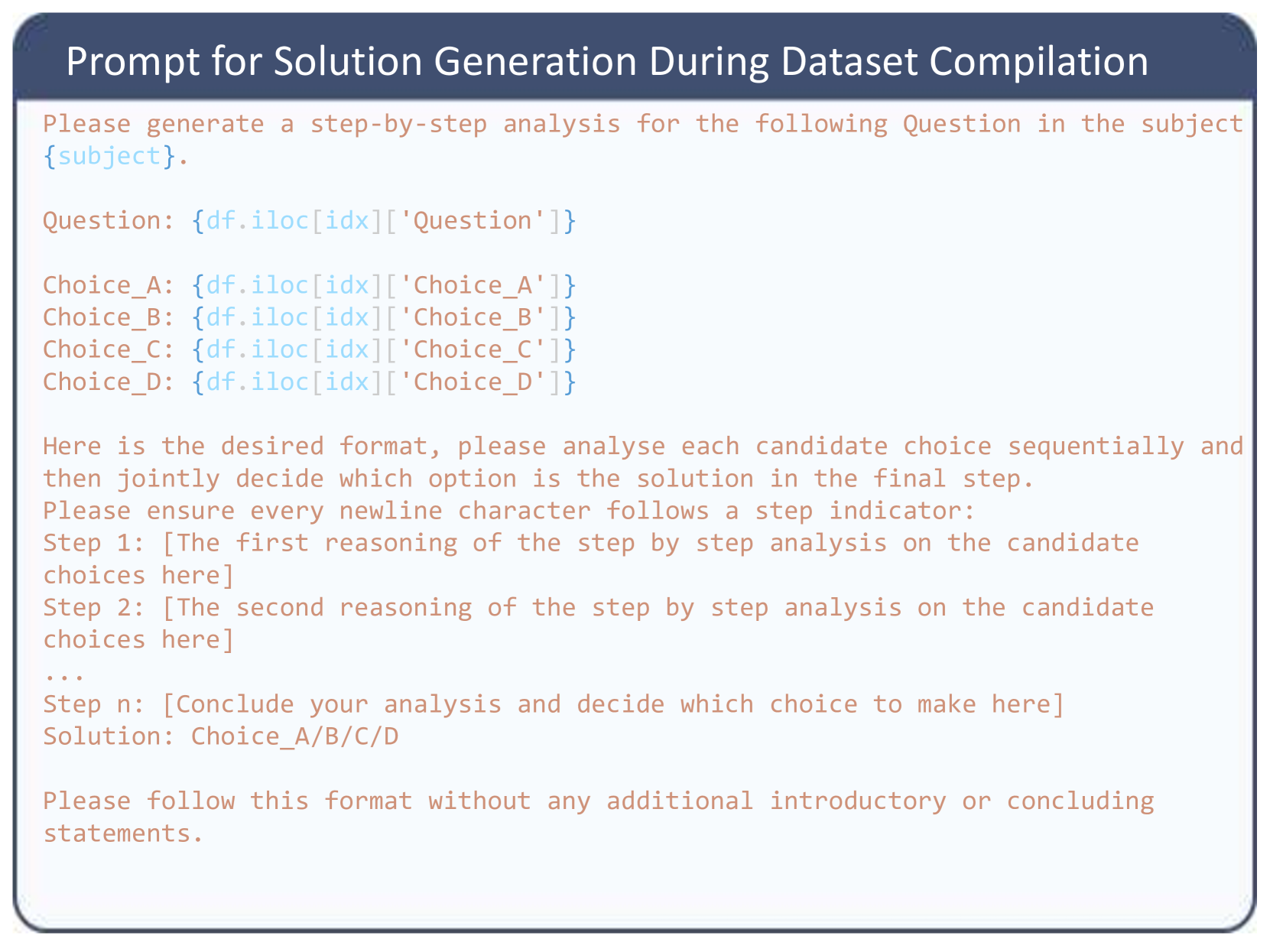
## Screenshot: Prompt Template for Solution Generation
### Overview
The image displays a text-based prompt template designed to guide the generation of a step-by-step analysis for a multiple-choice question. The template is presented within a bordered box with a dark blue header. It contains placeholder variables (e.g., `{subject}`, `{df.iloc[idx]['Question']}`) intended to be dynamically populated from a dataset, likely a pandas DataFrame. The primary language is English.
### Content Details
The complete textual content of the image is transcribed below. The text is presented in a monospaced font, with placeholders highlighted in a light blue color.
**Header (Dark Blue Bar):**
```
Prompt for Solution Generation During Dataset Compilation
```
**Main Body (Light Background):**
```
Please generate a step-by-step analysis for the following Question in the subject {subject}.
Question: {df.iloc[idx]['Question']}
Choice_A: {df.iloc[idx]['Choice_A']}
Choice_B: {df.iloc[idx]['Choice_B']}
Choice_C: {df.iloc[idx]['Choice_C']}
Choice_D: {df.iloc[idx]['Choice_D']}
Here is the desired format, please analyse each candidate choice sequentially and then jointly decide which option is the solution in the final step.
Please ensure every newline character follows a step indicator:
Step 1: [The first reasoning of the step by step analysis on the candidate choices here]
Step 2: [The second reasoning of the step by step analysis on the candidate choices here]
...
Step n: [Conclude your analysis and decide which choice to make here]
Solution: Choice_A/B/C/D
Please follow this format without any additional introductory or concluding statements.
```
### Key Observations
1. **Structure:** The template is highly structured, enforcing a specific output format with numbered steps and a final "Solution:" line.
2. **Placeholders:** It uses Python/pandas-style placeholders (`{df.iloc[idx]['Column_Name']}`), indicating it is designed for programmatic use within a data processing pipeline.
3. **Instructions:** The instructions are explicit, requiring sequential analysis of each choice (A, B, C, D) before a joint conclusion. It mandates strict adherence to the format, prohibiting extra text.
4. **Visual Design:** The text uses color differentiation (light blue for placeholders, brownish-orange for static text) to enhance readability for a human reviewing the template code.
### Interpretation
This image is not a data visualization but a **meta-template**—a set of instructions for an AI or a script to generate another piece of content (a step-by-step solution analysis).
* **Purpose:** Its core function is to standardize the output format for solution rationales during the compilation of a dataset, likely for training or evaluating AI models on reasoning tasks. The strict format ensures consistency across many generated examples.
* **Underlying Process:** The placeholders reveal the intended workflow: a script would iterate over rows (`idx`) of a DataFrame (`df`), inject the subject, question, and choices into this template, and then feed the completed prompt to a language model to produce the formatted analysis.
* **Design Intent:** The emphasis on "every newline character follows a step indicator" and the prohibition of additional statements suggests the downstream process expects machine-parsable output. The template is engineered for automation, not human conversation.
* **Context:** This is a behind-the-scenes component of a larger AI/ML dataset creation pipeline, specifically for building a dataset of reasoned solutions to multiple-choice questions.