## Prompt Template: Solution Generation During Dataset Compilation
### Overview
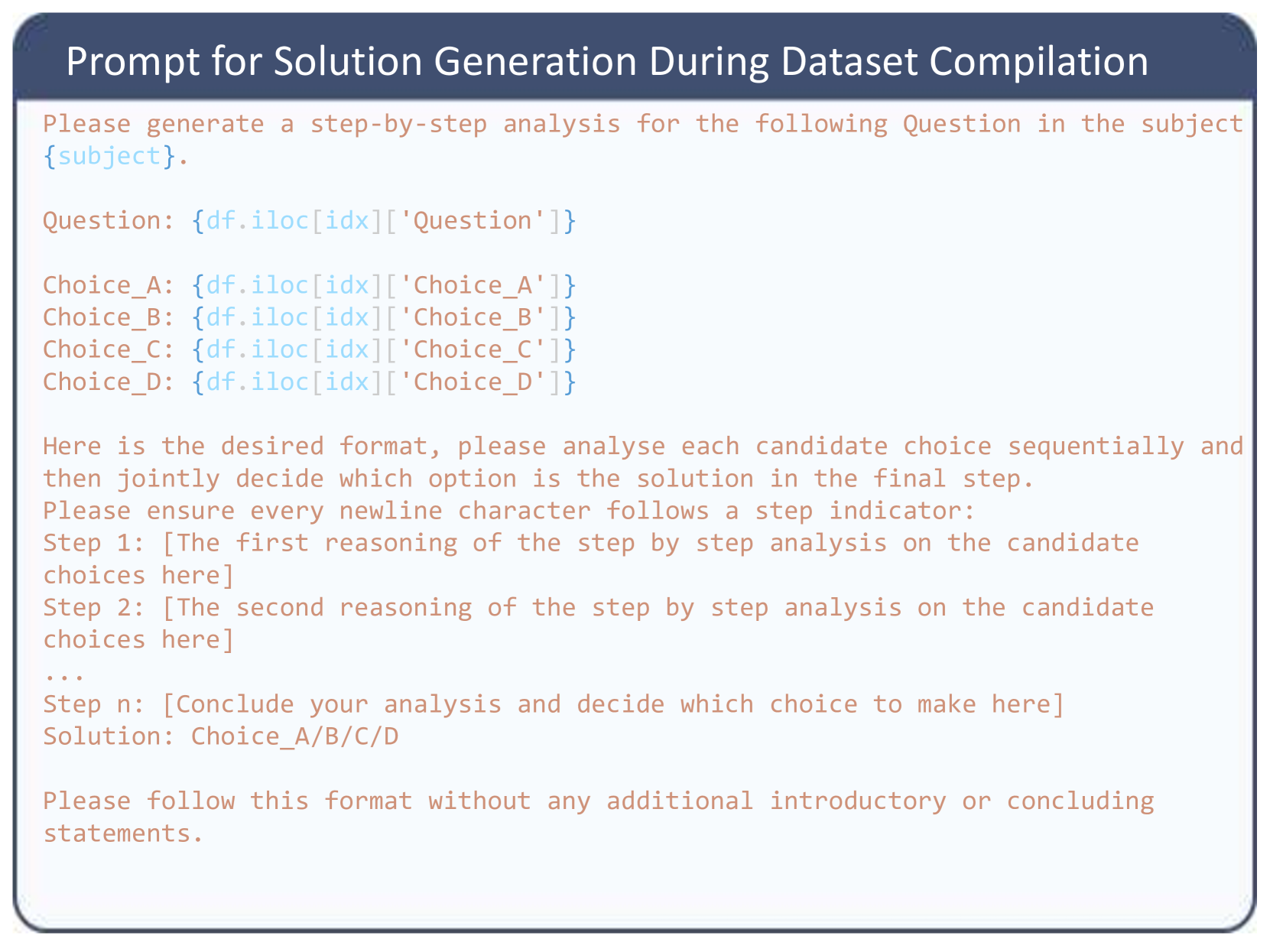
The image displays a structured prompt template designed to guide step-by-step analysis and solution generation for multiple-choice questions. It includes placeholders for dynamic content (e.g., subject, question, choices) and specifies a format for reasoning and final decision-making.
### Components/Axes
- **Title**: "Prompt for Solution Generation During Dataset Compilation"
- **Instruction Text**:
- "Please generate a step-by-step analysis for the following Question in the subject {subject}."
- Placeholders:
- `{df.iloc[idx]['Question']}` (Question)
- `{df.iloc[idx]['Choice_A']}` (Choice A)
- `{df.iloc[idx]['Choice_B']}` (Choice B)
- `{df.iloc[idx]['Choice_C']}` (Choice C)
- `{df.iloc[idx]['Choice_D']}` (Choice D)
- **Desired Format**:
- Sequential analysis of each candidate choice.
- Final decision step with solution declaration (e.g., "Solution: Choice_A/B/C/D").
- Step indicators (Step 1, Step 2, ..., Step n) with bracketed reasoning.
### Detailed Analysis
- **Placeholders**:
- All placeholders use Python-like syntax (`df.iloc[idx]`) to reference dataframes, suggesting integration with a dataset.
- Choices are labeled A–D, with no default values (e.g., `{df.iloc[idx]['Choice_A']}`).
- **Format Requirements**:
- Analysis must follow a strict step-by-step structure.
- Each step must include reasoning for a candidate choice.
- Final solution must explicitly state the correct choice (A/B/C/D).
- No additional introductory or concluding statements are allowed.
### Key Observations
1. **Dynamic Content**: The template relies on external data (e.g., `df.iloc[idx]`) to populate questions and choices, indicating automation for dataset compilation.
2. **Structured Reasoning**: The emphasis on step-by-step analysis ensures transparency and reproducibility in solution generation.
3. **Rigorous Constraints**: The prohibition of extra text enforces adherence to the specified format, critical for dataset consistency.
### Interpretation
This template is designed for automated question-answering systems or human annotators to generate consistent, explainable solutions. By enforcing step-by-step reasoning, it ensures that each choice is evaluated methodically before a final decision. The use of dataframe indexing (`iloc[idx]`) implies integration with a labeled dataset, where `idx` represents the row index of the current question. The strict format minimizes ambiguity, making it suitable for training machine learning models or standardizing human annotations.
## No numerical data, trends, or visual elements present. The image is purely textual and procedural.