## Diagram: Jacobi-based vs. Sparsity-based Drafting for LLMs
### Overview
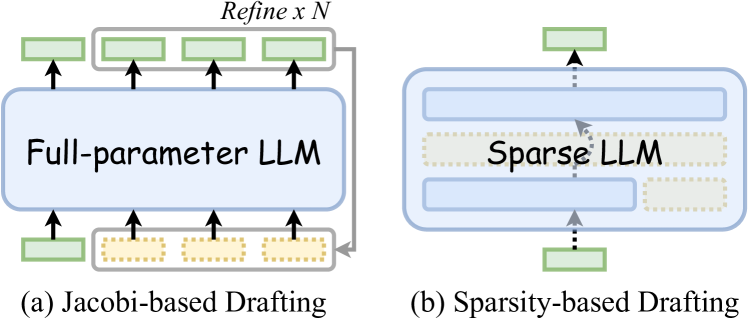
The image compares two methods for refining large language models (LLMs):
- **(a) Jacobi-based Drafting**: A full-parameter LLM with iterative refinement steps.
- **(b) Sparsity-based Drafting**: A sparse LLM with reduced connectivity, emphasizing parameter efficiency.
### Components/Axes
- **Labels**:
- **(a)** "Jacobi-based Drafting" (title), "Full-parameter LLM" (central block), "Refine x N" (arrows), and dotted arrows for iterative refinement.
- **(b)** "Sparsity-based Drafting" (title), "Sparse LLM" (central block), and dashed arrows indicating sparsity.
- **Visual Elements**:
- Rectangular blocks represent LLM components.
- Arrows denote refinement/sparsity processes.
- Dotted/dashed lines differentiate refinement (solid) from sparsity (dashed).
### Detailed Analysis
- **(a) Jacobi-based Drafting**:
- A full-parameter LLM is refined iteratively via "Refine x N" steps (solid arrows).
- Dotted arrows suggest feedback loops or additional refinement stages.
- **(b) Sparsity-based Drafting**:
- A sparse LLM is depicted with reduced connectivity (dashed arrows).
- The "Sparse" label emphasizes parameter efficiency.
### Key Observations
- Jacobi-based drafting focuses on iterative refinement of a full-parameter model.
- Sparsity-based drafting prioritizes reduced parameter usage via sparse connections.
- No numerical data or quantitative values are provided in the diagram.
### Interpretation
The diagrams illustrate two contrasting approaches to LLM optimization:
1. **Jacobi-based**: Emphasizes iterative refinement, likely improving model accuracy at the cost of computational resources.
2. **Sparsity-based**: Prioritizes efficiency by reducing parameter density, potentially lowering computational costs but possibly sacrificing some performance.
- The absence of numerical data limits direct comparison of performance metrics (e.g., accuracy, speed).
- The use of "Refine x N" and "Sparse" labels suggests a trade-off between model complexity and efficiency.