## Chart: Validation Score vs. Training Step for GRPO and MEL
### Overview
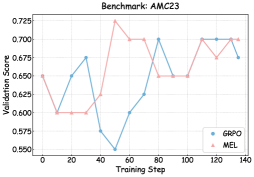
The image is a line chart comparing the validation scores of two methods, GRPO and MEL, over a series of training steps. The chart displays how the validation score changes as the training progresses for each method.
### Components/Axes
* **Title:** Benchmark: AMC23
* **X-axis:** Training Step (values ranging from 0 to 140 in increments of 20)
* **Y-axis:** Validation Score (values ranging from 0.550 to 0.725 in increments of 0.025)
* **Legend:** Located in the bottom-right corner.
* GRPO (Blue line)
* MEL (Pink line)
### Detailed Analysis
* **GRPO (Blue Line):**
* Trend: Initially decreases, then increases sharply, followed by a decrease and subsequent increase, and finally stabilizes.
* Data Points:
* 0 Training Step: ~0.65
* 20 Training Step: ~0.65
* 40 Training Step: ~0.575
* 60 Training Step: ~0.55
* 80 Training Step: ~0.625
* 100 Training Step: ~0.65
* 120 Training Step: ~0.70
* 140 Training Step: ~0.675
* **MEL (Pink Line):**
* Trend: Initially decreases, then increases sharply, followed by a decrease and subsequent increase, and finally stabilizes.
* Data Points:
* 0 Training Step: ~0.65
* 20 Training Step: ~0.60
* 40 Training Step: ~0.625
* 60 Training Step: ~0.725
* 80 Training Step: ~0.70
* 100 Training Step: ~0.65
* 120 Training Step: ~0.675
* 140 Training Step: ~0.70
### Key Observations
* Both GRPO and MEL show fluctuations in validation scores during training.
* MEL reaches a higher peak validation score (~0.725) compared to GRPO (~0.70).
* Towards the end of the training steps (120-140), both methods seem to stabilize.
### Interpretation
The chart compares the performance of two methods, GRPO and MEL, on the AMC23 benchmark. The validation scores indicate how well each method is generalizing to unseen data during training. The fluctuations suggest that both methods are experiencing some degree of instability or adaptation during the training process. MEL appears to achieve a slightly better peak performance, but both methods converge to similar validation scores at the end of the training period. The data suggests that both methods are viable for this benchmark, but MEL might be slightly more effective in reaching a higher validation score.