## Diagram: Lemma Graph
### Overview
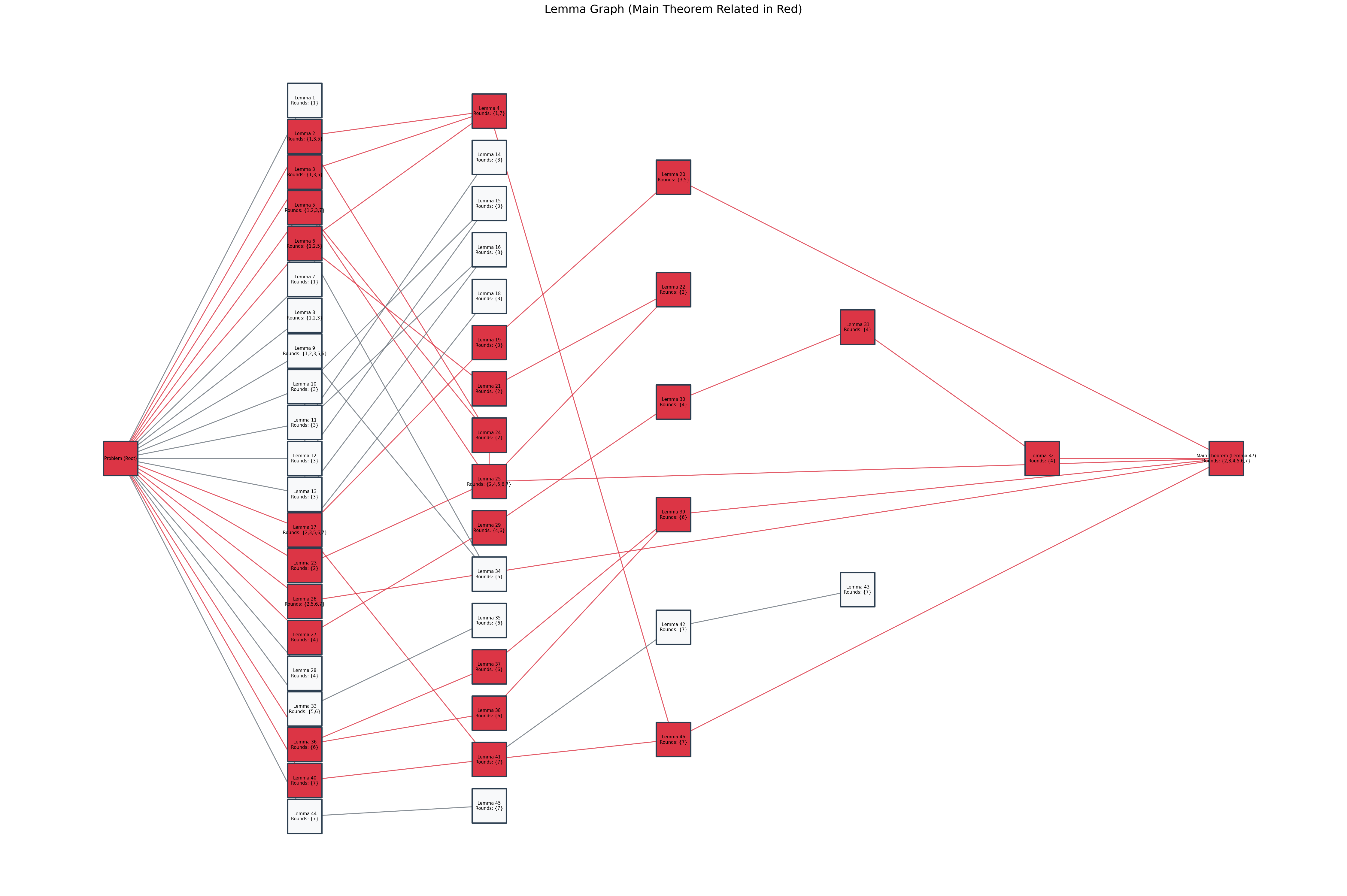
The image is a directed graph representing the relationships between different lemmas and a main theorem. The graph consists of nodes labeled as "Lemma [Number]" or "Problem (Root)" and "Main Theorem (Lemma 47)", with edges connecting these nodes. The nodes are colored either red or gray, with red nodes indicating a direct relationship to the main theorem. Each node also includes information about the "Rounds" associated with it, represented as a set of numbers.
### Components/Axes
* **Nodes:** Represented by rectangles, labeled with "Lemma [Number]" or "Problem (Root)" and "Main Theorem (Lemma 47)". Each node also contains "Rounds: {numbers}".
* **Edges:** Represented by lines connecting the nodes, indicating a dependency or relationship. Red lines indicate a direct relationship to the Main Theorem.
* **Colors:** Red nodes and edges indicate a direct relationship to the Main Theorem. Gray nodes and edges indicate an indirect relationship.
* **Title:** "Lemma Graph (Main Theorem Related in Red)" is located at the top of the image.
### Detailed Analysis
Here's a breakdown of the nodes and their connections, along with the "Rounds" information:
* **Problem (Root):** Located on the left side of the diagram. It is the starting point of the graph. It connects to all the nodes in the second column.
* **Lemma 1:** Rounds: {1}. Located in the top-left of the second column. Red node.
* **Lemma 2:** Rounds: {1,3,5}. Located in the second position of the second column. Red node.
* **Lemma 3:** Rounds: {1,3,5}. Located in the third position of the second column. Red node.
* **Lemma 5:** Rounds: {1,2,3,7}. Located in the fourth position of the second column. Red node.
* **Lemma 6:** Rounds: {1,2,5}. Located in the fifth position of the second column. Red node.
* **Lemma 7:** Rounds: {1}. Located in the sixth position of the second column. Red node.
* **Lemma 8:** Rounds: {1,2,3}. Located in the seventh position of the second column. Gray node.
* **Lemma 9:** Rounds: {1,2,3,5,6}. Located in the eighth position of the second column. Red node.
* **Lemma 10:** Rounds: {3}. Located in the ninth position of the second column. Red node.
* **Lemma 11:** Rounds: {3}. Located in the tenth position of the second column. Gray node.
* **Lemma 12:** Rounds: {3}. Located in the eleventh position of the second column. Gray node.
* **Lemma 13:** Rounds: {3}. Located in the twelfth position of the second column. Gray node.
* **Lemma 17:** Rounds: {2,3,5,6,7}. Located in the thirteenth position of the second column. Red node.
* **Lemma 23:** Rounds: {2}. Located in the fourteenth position of the second column. Red node.
* **Lemma 26:** Rounds: {2,5,6,7}. Located in the fifteenth position of the second column. Red node.
* **Lemma 27:** Rounds: {4}. Located in the sixteenth position of the second column. Red node.
* **Lemma 28:** Rounds: {4}. Located in the seventeenth position of the second column. Red node.
* **Lemma 33:** Rounds: {5,6}. Located in the eighteenth position of the second column. Red node.
* **Lemma 36:** Rounds: {6}. Located in the nineteenth position of the second column. Red node.
* **Lemma 40:** Rounds: {7}. Located in the twentieth position of the second column. Red node.
* **Lemma 44:** Rounds: {7}. Located in the twenty-first position of the second column. Red node.
* **Lemma 4:** Rounds: {1,7}. Located in the top-left of the third column. Red node.
* **Lemma 14:** Rounds: {3}. Located in the second position of the third column. Red node.
* **Lemma 15:** Rounds: {3}. Located in the third position of the third column. Gray node.
* **Lemma 16:** Rounds: {3}. Located in the fourth position of the third column. Gray node.
* **Lemma 18:** Rounds: {3}. Located in the fifth position of the third column. Gray node.
* **Lemma 19:** Rounds: {3}. Located in the sixth position of the third column. Red node.
* **Lemma 21:** Rounds: {2}. Located in the seventh position of the third column. Red node.
* **Lemma 24:** Rounds: {2}. Located in the eighth position of the third column. Red node.
* **Lemma 25:** Rounds: {2,4,5,6,7}. Located in the ninth position of the third column. Red node.
* **Lemma 29:** Rounds: {4,6}. Located in the tenth position of the third column. Red node.
* **Lemma 34:** Rounds: {5}. Located in the eleventh position of the third column. Gray node.
* **Lemma 35:** Rounds: {6}. Located in the twelfth position of the third column. Red node.
* **Lemma 37:** Rounds: {6}. Located in the thirteenth position of the third column. Red node.
* **Lemma 38:** Rounds: {6}. Located in the fourteenth position of the third column. Gray node.
* **Lemma 41:** Rounds: {7}. Located in the fifteenth position of the third column. Red node.
* **Lemma 45:** Rounds: {7}. Located in the sixteenth position of the third column. Red node.
* **Lemma 20:** Rounds: {3,5}. Located in the top-left of the fourth column. Red node.
* **Lemma 22:** Rounds: {2}. Located in the second position of the fourth column. Red node.
* **Lemma 30:** Rounds: {4}. Located in the third position of the fourth column. Red node.
* **Lemma 31:** Rounds: {4}. Located in the fourth position of the fourth column. Red node.
* **Lemma 39:** Rounds: {6}. Located in the fifth position of the fourth column. Red node.
* **Lemma 42:** Rounds: {7}. Located in the sixth position of the fourth column. Red node.
* **Lemma 43:** Rounds: {7}. Located in the seventh position of the fourth column. Gray node.
* **Lemma 46:** Rounds: {7}. Located in the eighth position of the fourth column. Red node.
* **Main Theorem (Lemma 47):** Rounds: {2,3,4,5,6,7}. Located on the right side of the diagram. Red node.
### Key Observations
* The "Problem (Root)" node connects to all nodes in the second column.
* Red nodes indicate a direct relationship to the "Main Theorem (Lemma 47)".
* Gray nodes indicate an indirect relationship to the "Main Theorem (Lemma 47)".
* The "Rounds" information varies for each lemma.
* The "Main Theorem (Lemma 47)" node is the destination of many red edges.
### Interpretation
The diagram illustrates the dependencies between different lemmas and how they contribute to proving the "Main Theorem (Lemma 47)". The red nodes and edges highlight the lemmas that are directly involved in proving the main theorem, while the gray nodes represent lemmas that are indirectly related or serve as supporting lemmas. The "Rounds" information likely refers to specific rounds or iterations in a proof or algorithm where the lemma is relevant. The graph structure provides a visual representation of the logical flow and dependencies within the proof. The "Problem (Root)" serves as the initial condition or starting point for the chain of reasoning leading to the main theorem.