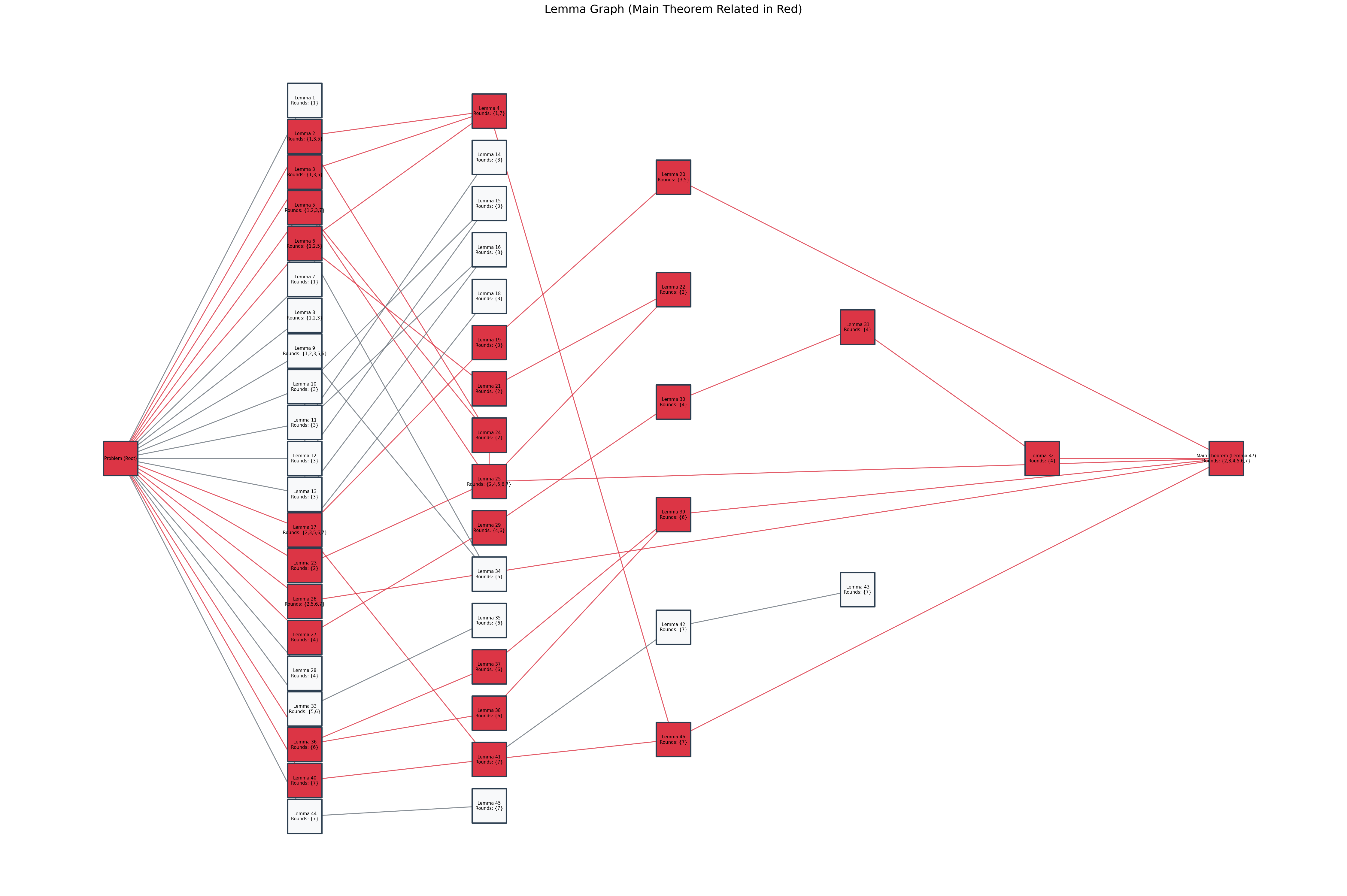
## Directed Graph: Lemma Graph (Main Theorem Related in Red)
### Overview
The image depicts a directed graph representing logical dependencies between lemmas and axioms, with the "Main Theorem" (Lemma 47) as the central node. Nodes are labeled with "Lemma X" (e.g., Lemma 4, Lemma 21) and "Axiom Y" (e.g., Axiom 1, Axiom 2). Red edges and nodes highlight the main theorem-related lemmas, while gray edges and nodes represent auxiliary or intermediate steps. The graph is structured in a hierarchical, tree-like format with the "Problem State" as the root and the "Main Theorem" as the terminal node.
### Components/Axes
- **Nodes**:
- **Problem State**: Root node (leftmost column).
- **Lemmas**: Labeled as "Lemma X" (e.g., Lemma 1, Lemma 4, Lemma 21, Lemma 47).
- **Axioms**: Labeled as "Axiom Y" (e.g., Axiom 1, Axiom 2).
- **Main Theorem**: "Main Theorem (Lemma 47)" (rightmost node).
- **Edges**:
- **Red edges**: Connect nodes related to the main theorem.
- **Gray edges**: Connect auxiliary or intermediate steps.
- **Legend**:
- Red color indicates "Main Theorem Related" (applies to nodes and edges).
- Gray color indicates non-main theorem-related elements.
### Detailed Analysis
- **Node Labels**:
- **Lemmas**:
- Lemma 1 (Axiom 1)
- Lemma 4 (Axiom 1)
- Lemma 14 (Axiom 3)
- Lemma 21 (Axiom 2)
- Lemma 29 (Axiom 2)
- Lemma 47 (Main Theorem)
- **Axioms**:
- Axiom 1 (appears in Lemma 1, Lemma 4)
- Axiom 2 (appears in Lemma 21, Lemma 29)
- Axiom 3 (appears in Lemma 14)
- **Main Theorem**: Lemma 47 (connected to Lemma 21, Lemma 29, Lemma 43, Lemma 46).
- **Edge Connections**:
- The "Problem State" connects to Lemma 1, Lemma 4, and Lemma 14.
- Lemma 4 connects to Lemma 14, Lemma 21, and Lemma 29.
- Lemma 21 connects to Lemma 29, Lemma 43, and Lemma 46.
- Lemma 29 connects to Lemma 43, Lemma 46, and Lemma 47.
- Lemma 43 connects to Lemma 46 and Lemma 47.
- Lemma 46 connects to Lemma 47.
- **Color Coding**:
- Red nodes/edges: Lemma 4, Lemma 21, Lemma 29, Lemma 47, and their connecting edges.
- Gray nodes/edges: All other nodes and edges.
### Key Observations
1. **Central Role of Lemma 47**: The Main Theorem (Lemma 47) is the terminal node, connected to multiple lemmas (21, 29, 43, 46), indicating it synthesizes prior results.
2. **Hierarchical Structure**: The graph progresses from the Problem State through intermediate lemmas (e.g., Lemma 1, Lemma 4) to the Main Theorem.
3. **Redundancy in Axioms**: Axiom 1 is used in Lemma 1 and Lemma 4, while Axiom 2 is used in Lemma 21 and Lemma 29.
4. **Critical Pathways**: Red edges form a "main theorem pathway" from Lemma 4 → Lemma 21 → Lemma 29 → Lemma 47.
### Interpretation
The graph illustrates a logical framework where the Main Theorem (Lemma 47) is derived through a sequence of lemmas and axioms. The red nodes and edges emphasize the critical steps required to reach the theorem, suggesting a dependency chain. The use of Axiom 1 and Axiom 2 in multiple lemmas indicates foundational assumptions. The hierarchical layout implies a structured proof, with the Problem State as the starting point and the Main Theorem as the culmination. The absence of gray nodes in the main pathway highlights the focus on the theorem's derivation. This structure could represent a formal proof system or a dependency graph in a mathematical or computational context.