## Diagram: LLM Python Code Generation
### Overview
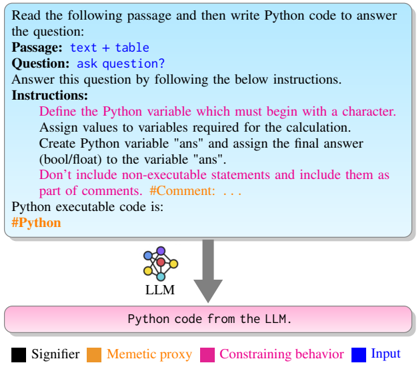
The image illustrates a process where a Large Language Model (LLM) generates Python code based on a given passage and question. The diagram outlines the input, instructions, and output of this process, along with a legend explaining the color-coded elements.
### Components/Axes
* **Top Section (Input & Instructions):**
* Text: "Read the following passage and then write Python code to answer the question:"
* "Passage: text + table"
* "Question: ask question?"
* "Answer this question by following the below instructions."
* Instructions:
* "Define the Python variable which must begin with a character."
* "Assign values to variables required for the calculation."
* "Create Python variable "ans" and assign the final answer (bool/float) to the variable "ans"."
* "Don't include non-executable statements and include them as part of comments. #Comment: ..."
* "Python executable code is:"
* "#Python"
* **Middle Section (LLM):**
* A network diagram representing the LLM. The nodes are colored blue, yellow, green, and purple.
* Text: "LLM"
* A downward-pointing gray arrow indicating the flow of information.
* **Bottom Section (Output):**
* Text: "Python code from the LLM."
* **Legend (Bottom):**
* Black square: "Signifier"
* Orange square: "Memetic proxy"
* Pink square: "Constraining behavior"
* Blue square: "Input"
### Detailed Analysis or ### Content Details
The diagram shows the flow of information from a given passage and question to the LLM, which then generates Python code. The instructions specify how the Python code should be structured, including variable naming conventions and the handling of comments. The legend provides a color-coded key to understanding the different elements involved in the process.
### Key Observations
* The input consists of a passage (text + table) and a question.
* The LLM processes this input and generates Python code.
* Specific instructions are provided to guide the code generation process.
* The legend categorizes the elements involved in the process using color-coding.
### Interpretation
The diagram illustrates a typical use case of LLMs in generating code from natural language instructions. The instructions provided to the LLM are crucial in ensuring that the generated code meets specific requirements. The color-coded legend helps to understand the different aspects of the process, such as the input, the constraints, and the resulting code. The diagram highlights the role of LLMs in automating code generation and the importance of providing clear and specific instructions to achieve the desired outcome.