\n
## Diagram: LLM Code Generation Process
### Overview
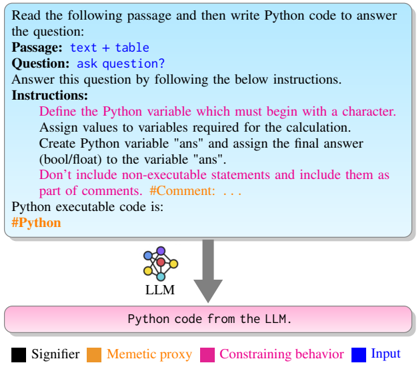
The image depicts a diagram illustrating the process of generating Python code using a Large Language Model (LLM) based on a given passage, question, and instructions. The diagram highlights the different components involved and categorizes them using color-coding.
### Components/Axes
The diagram is segmented into several sections, each with a specific role:
* **Input (Blue):** Contains the "Passage: text + table", "Question: ask question?", and "Instructions" sections.
* **Signifier (Black):** A rectangular block labeled "#Python" representing the Python executable code area.
* **Memetic Proxy (Orange):** A visual representation of the LLM, depicted as a network of interconnected nodes.
* **Constraining Behavior (Pink):** A rectangular block labeled "Python code from the LLM."
* **Legend:** Located at the bottom of the image, defining the color-coding scheme:
* Black: Signifier
* Orange: Memetic proxy
* Pink: Constraining behavior
* Blue: Input
### Detailed Analysis or Content Details
The diagram shows a flow from the top (Input) to the bottom (Output).
* **Input Section:**
* "Passage: text + table"
* "Question: ask question?"
* "Instructions:" followed by a list of instructions:
* "Define the Python variable which must begin with a character."
* "Assign values to variables required for the calculation."
* "Create Python variable “ans” and assign the final answer (bool/float) to the variable “ans”."
* "Don’t include non-executable statements and include them as part of comments. #Comment: . . ."
* **Signifier Section:**
* "#Python" is displayed within a black rectangle.
* **Memetic Proxy Section:**
* The LLM is represented by a complex network of interconnected nodes.
* **Constraining Behavior Section:**
* "Python code from the LLM." is displayed within a pink rectangle.
* **Flow:** An arrow points downwards from the LLM (orange) towards the "Python code from the LLM." (pink) block, indicating the generation of code.
### Key Observations
The diagram emphasizes the structured approach to code generation, highlighting the importance of clear instructions and the role of the LLM as a processing unit. The color-coding helps to differentiate between the input, the LLM itself, the code output, and the constraints applied during the process.
### Interpretation
The diagram illustrates a conceptual framework for how an LLM can be used to generate Python code. The "Input" section represents the problem statement, while the "Instructions" provide the rules and constraints for the LLM to follow. The LLM (Memetic Proxy) then processes this information and generates the "Python code from the LLM." (Constraining Behavior). The "Signifier" section indicates the expected output format.
The diagram suggests a process where the LLM doesn't simply produce code randomly, but rather operates within a defined set of rules and constraints. This is crucial for ensuring the generated code is correct, executable, and adheres to specific requirements. The use of comments as a way to exclude non-executable statements is also highlighted.
The diagram is a high-level representation and doesn't delve into the specifics of the LLM's internal workings or the algorithms used for code generation. It focuses on the overall flow and the key components involved in the process. It's a conceptual model rather than a detailed technical blueprint.